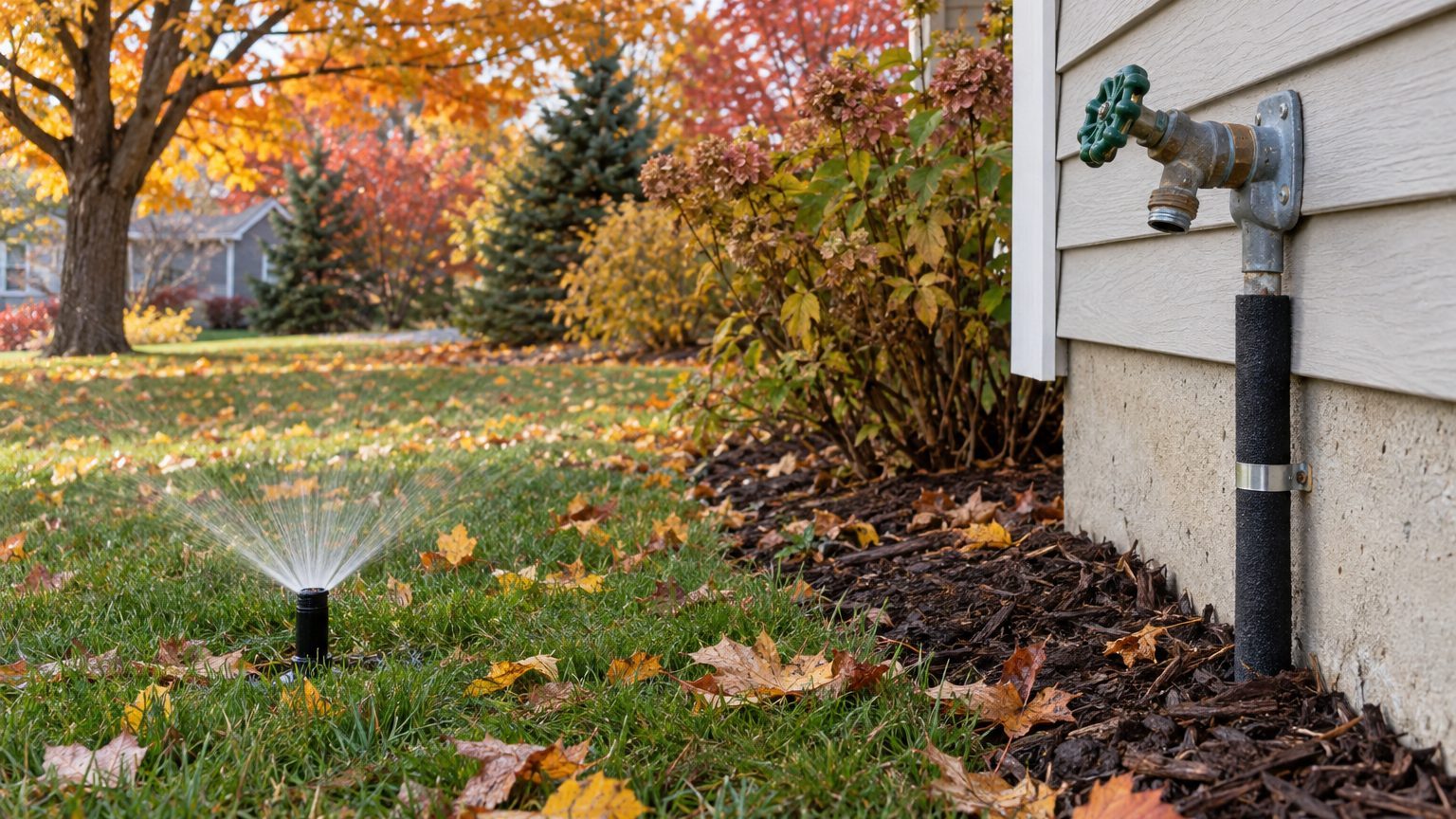

In Alberta, plan to winterize sprinklers and outdoor faucets from mid-September into early October, timed to the first fall frost. The rule is simple: act before the first hard freeze, not after the first light one. Hoses come off, taps get drained, and irrigation lines get cleared with compressed air. Watch the overnight forecast more closely than the calendar, because a cold snap ignores the date you had in mind.
When to do it in Alberta
Aim for the window from mid-September into early October, and always finish before the first hard freeze rather than after the first light one. Environment and Climate Change Canada’s Canadian Climate Normals (1981-2010) put the average first fall frost at the Calgary International Airport station on September 16, which makes that date the middle of your window, not the start of a safe period.
That distinction matters because of how an average works. September 16 is a mean date, so in one year out of two the first frost arrives later than that. In the other half, it arrives earlier. Nobody can treat the date as a deadline that has already been beaten. A light frost is a surface event: a clear night, a whitened lawn, tomato leaves gone black. A hard freeze is different, with air temperatures dropping well below zero and staying there for hours. That is the night water inside a pipe turns to ice. Sprinkler lines and outdoor taps exist precisely at the boundary between heated and unheated space, and they are the first place it happens.
Alberta is not a place where you can skip the job. The same normals show the coldest month at Calgary with a mean daily minimum of -13.2 °C, which is 8.2 °F for readers comparing with the northern United States. That is the average night in the coldest month, not the record low, so plenty of nights run colder. Water left in an exposed line has months of this ahead of it. Natural Resources Canada rates Calgary at Canadian plant hardiness zone 4a (1991-2020 normals). That number belongs to a different system than the USDA zones, built on seven climate variables instead of one, and it does not convert to a USDA zone. Its main use here is as a reminder that this is a serious winter, one where a partial job is a gamble.
One geographic caution. All of these figures come from a single station at Calgary. Alberta is not one climate, and colder ground, meaning districts farther north and at higher elevation, sees frost earlier in the fall. If your yard sits in one of those places, move the whole job earlier than the Calgary window, not later. The reverse mistake, waiting for a spring-like September to end before starting, is the one that costs people a repair bill.
A practical way to use all this: start checking the ten-day forecast in early September. When overnight lows begin flirting with zero, do the hoses and faucets that same weekend. Book or schedule the sprinkler blowout so it lands before any forecast of a sustained hard freeze. Doing it a little early costs you a few weeks of hand watering at worst. Doing it late can cost you a split valve. The rest of the fall yard routine, such as Winterizing Outdoor Faucets Before the First Freeze and the tasks for Winterizing a Lawn, fits naturally into the same stretch of weeks.
Sprinkler lines: drain or blow out
Water expands when it freezes, and a sealed pipe has nowhere to let it go. Think of a full bottle left in the freezer: the bottle loses. Buried polyethylene or PVC lines, the fittings that join them, the valves that control each zone, and the backflow preventer near the house all hold water after the last watering. Ice forms first at low spots and in rigid parts like valve bodies and risers, which crack instead of stretching. The damage is invisible all winter. You only find it in spring, when the system pressurizes and a crack starts to leak.
Three ways to clear the water
Sprinkler systems are emptied in one of three ways, and they are not equally forgiving.
| Method | How it works | Fit for Alberta |
|---|---|---|
| Manual drain | You shut off the supply and open drain valves at the low points so gravity empties the lines. | Works only if the system was built with sloped lines and manual drains. Sprinkler heads and risers can keep water. |
| Automatic drain | Small valves open when line pressure drops and let water seep out at low spots. | A convenience, not a guarantee. It can leave pockets of water and is a weak defense against months of deep cold. |
| Compressed-air blowout | Air pushed through the lines, zone by zone, forces the water out of pipes, valves, and heads. | The method to plan on. It clears water that gravity leaves behind. |
Manual and automatic drains have a place, but both depend on gravity and on every low point being where the installer expected it to be. Yards settle, lines shift, and a low spot forms where none existed. Air does not care about any of that. With the water supply shut off, air is forced through each zone in turn until only a fine mist comes out of the heads. Then the next zone gets the same treatment. Running all zones at once or running air too long in one zone can stress components, which is why the zone-by-zone approach is standard.
Given the cold in the Calgary normals, compressed-air blowout is the method to plan on in Alberta, with manual or automatic drains as backup, never as the only line of defense. Do it inside the mid-September to early October window, and before the first hard freeze.
Blowouts are also the step where a professional is the sensible choice. The job needs a compressor with enough airflow, and the wrong setup can push more force through the system than heads and fittings tolerate. The air can throw debris from a head at speed, so eye protection is a must, and nobody should lean over a pressurized line. A pro is a good call if the system has no blowout connection, if you are unsure where the shutoff and backflow device are, if there are many zones, or if you had a freeze failure in a past spring. Call before the window opens so you are not chasing an appointment while the forecast turns.
Outdoor faucets and hoses
The faucet job takes ten minutes, and it uses nothing but your hands. Start by disconnecting every hose, splitter, timer, and sprayer from the outside tap. Then find the interior shutoff valve for that tap, often in a basement or utility room near where the pipe goes through the wall, and turn it off. Go outside, open the tap fully, and leave it open so any remaining water drains out and has room to expand. If the interior valve has a small bleeder cap, open it over a bucket to release what is left. That is where the work stops. Cutting into a line, adding a shutoff, or changing a tap is a plumber’s job.
Do this in the same mid-September to early October window as the sprinklers, and treat the hard freeze as your outer limit. Hoses have no reason to wait. Coil each one, drain it, and store it indoors, since a hose left outside collects water in its low loops and becomes brittle in extreme cold.
Frost-free faucets deserve a separate word, because owners of these often assume the job is done for them. The design is clever: the valve seat sits at the end of a long stem, deep inside the heated wall, so the part that holds water is protected by the house. The faucet body is also set to tilt slightly downward, so the water in the barrel runs out each time the tap is shut. Attach a hose and that whole system fails. The water in the hose, especially if the nozzle is closed, stays in the faucet’s barrel and can’t drain. When it freezes, it splits the pipe section outside the warm zone, and you find out in spring when the tap is turned on and water sprays inside the wall.
So the rule is short: disconnect every hose before the first hard freeze, even from a frost-free tap. Details on how these faucets are built are in Frost-Free Outdoor Taps. If your tap tilts upward instead of down, or drips after you shut it, it will hold water. Fixing that needs a plumber, and it is worth arranging before winter, not in March.
What goes wrong here
The most common failure in this climate is the early cold snap. Someone plans to do the sprinklers “next weekend,” and a hard freeze lands in between. The lines are full, and the damage is done overnight. In spring it looks like a geyser at a head, a wet patch that appears with no rain, or a zone with weak pressure. If you can see the forecast turning ahead of a scheduled blowout, do the emergency version right away: shut off the irrigation supply, open manual drain valves, and take hoses off every tap. The full blowout can follow once the cold passes.
Then there is the forgotten hose. It is easy to miss the one in the back corner, the one attached to a rain barrel, or the short one on a side tap. It looks harmless, but it traps water against the faucet, and the pipe behind the wall takes the hit. In spring the signs are a spray inside the wall, a stain on a ceiling below, or a drip in the basement the first time someone opens the tap. Prevention is boring: walk the whole property with a checklist. Every tap, every hose, every attachment.
The third one is the valve box that floods. Valve boxes sit in the ground and hold the zone valves. If a lid has cracked or the box sits at a low point, water collects and freezes around the valves, splitting them even after the lines were cleared. In spring the symptoms are a zone that will not shut off, a valve that hums, or a soggy patch near the box. In fall, lift the lid, clear debris, check for standing water, and make sure the blowout included the valves. A frozen-pipe repair inside the house is a related and more expensive failure, covered in Frozen Pipes.
Watch the overnight forecast from mid-September, and treat any forecast of a hard freeze as your deadline. In spring, turn the water on slowly and walk the yard before you trust it. More seasonal timing for the province sits in the Alberta guides.
Common questions
Is mid-September too early to blow out sprinklers?
Not too early for the system. September 16 is only an average first frost at Calgary, so half of years bring frost later, and half earlier. Shutting down early costs you a few weeks of hand watering if fall stays dry, but the lines cannot be hurt by being empty. Shutting down late is the risk.
Can I blow out my own lines with a compressor?
Some homeowners do, but it needs the right airflow and a careful, zone-by-zone approach, because too much force damages heads and fittings. Wear eye protection and never stand over a line under pressure. If your system lacks a blowout connection or you are unsure of the layout, hire a professional and book before the window opens.
Do I still need to shut off the inside valve for a frost-free tap?
Disconnecting the hose is the step that protects a frost-free tap. Closing the interior shutoff and opening the outside tap is a good extra where the valve exists. If your house has no interior shutoff, do not try to add one. That is plumbing work, and a licensed plumber should handle it.
My property is farther north or higher up than Calgary. Should I wait longer?
No, go earlier. Colder districts get their first fall frost sooner, so the whole shutdown moves earlier than the Calgary window. Keep in mind that the Canadian normals here cover 1981-2010, while US figures elsewhere cover 1991-2020, so treat any two averages as roughly comparable, not identical.