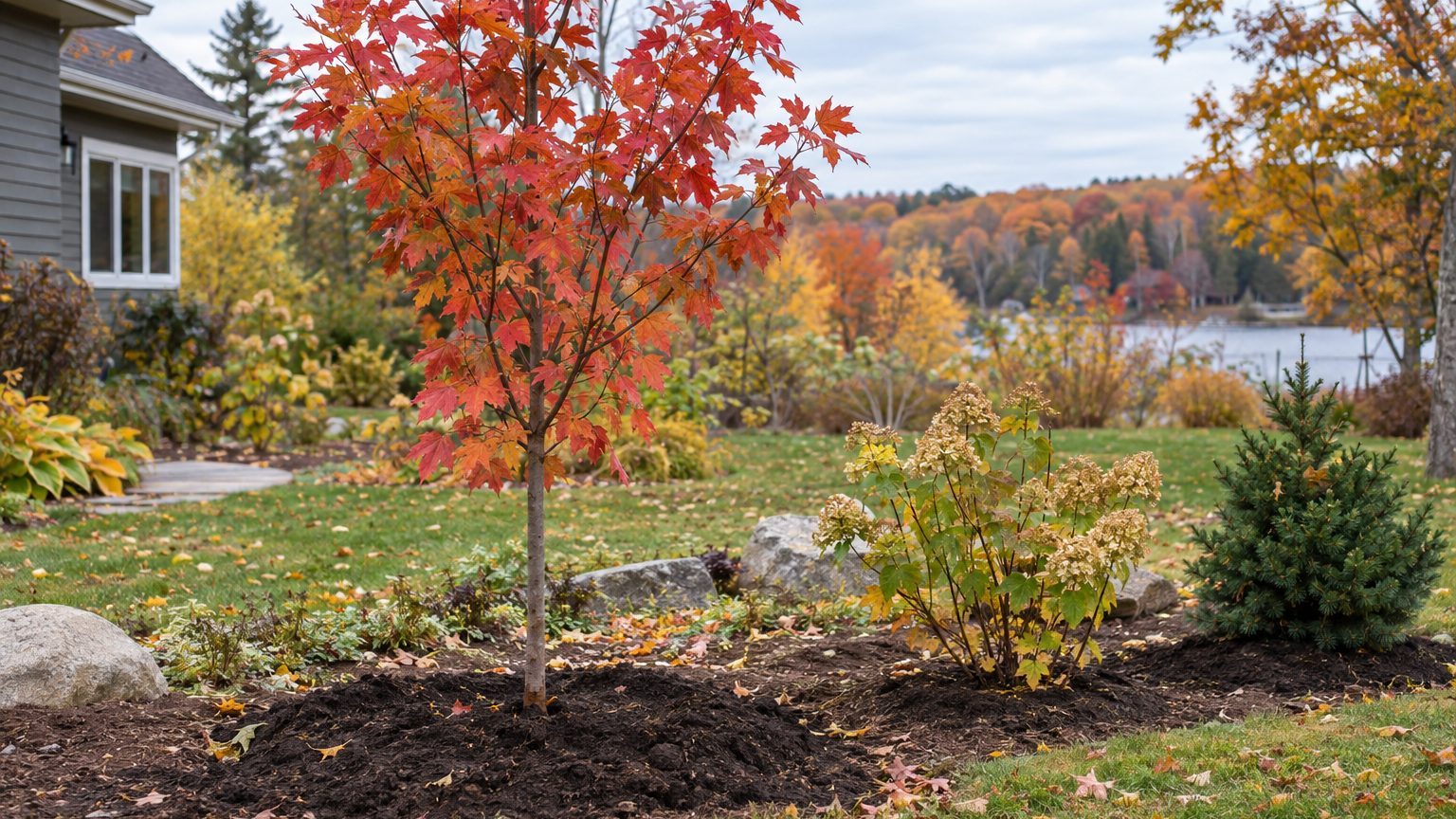

In Maryland, the safe target for planting trees and shrubs in fall is September 14 to September 24, six weeks before the first fall frost. NOAA’s 1991-2020 Climate Normals put that frost between October 26 and November 5. Consider it the conservative line, not a cliff. Roots keep growing while the soil is workable and above freezing, and the ground freezes well after the air first dips to 32°F. A tree that goes in during October isn’t doomed. It has less margin for error.
The deadline in Maryland
Leaves drop and the top of a tree goes quiet long before the roots do. Below ground, roots keep extending as long as the soil isn’t frozen, which in Maryland can mean well into late fall. That is the whole reason fall planting works: the plant spends autumn building a root system, then meets spring with a head start instead of a shock.
Cornell Cooperative Extension states the timing rule this way: “Fall is an excellent time for transplanting, provided you get them to their new home at least 6 weeks before the ground freezes, allowing them time to establish roots before winter dormancy.” Notice what it counts from. Not the first frost, but the day the ground itself freezes. Soil holds heat far longer than air does, so that day arrives later than the first frost, sometimes by a good margin.
Nobody publishes a tidy statewide “ground freeze date,” so the practical move is to work from the first fall frost, which is well documented. NOAA’s NCEI normals for Baltimore show the first 32°F freeze landing between October 26 and November 5 (that’s the 30-70% probability band). Count six weeks back from that range and you get a conservative target of September 14 to September 24. Get the plant in by then and you have honored the Cornell rule with room to spare.
Why the real limit falls later
Because the ground freezes after the first frost, the true cutoff sits later than that September window. Baltimore’s coldest month has a mean daily minimum of 25.4°F (NOAA NCEI Climate Normals, 1991-2020), well under freezing, so the ground does lock up in central Maryland and the deadline genuinely applies there. It just isn’t a hard wall in mid-September. Think of the September range as the date when planting is easy and forgiving, and the weeks after as the stretch where success depends on plant choice and follow-up watering.
Adjusting for where you live
The state is not one climate. Western Maryland, meaning Garrett and Allegany counties, is mountainous and colder, so its first fall frost comes earlier and the planting window closes earlier than the Baltimore numbers suggest. The Eastern Shore runs milder, so its frost comes later and the window stretches out. The USDA Plant Hardiness Zone Map (2023) puts the state at 5b-8a, which tells you how much the conditions vary. Look up your own first-frost range, count back from it, and check the details in First and Last Frost Dates in Maryland.
What to plant late, and what to wait on
Timing matters less for some plants than for others. Fully hardy container-grown and balled-and-burlapped trees and shrubs are the safest candidates for the tail end of the season. Container plants come with an intact root system that barely notices the move, and balled plants carry a chunk of their own soil. If the plant is rated for your zone with room to spare, it can settle in during October and still be fine.
Deciduous trees and shrubs fit that description best. Maples, oaks, and most flowering shrubs are dormant or heading there, so they’re not asking their roots to feed a full canopy while they recover. Broadleaf evergreens such as hollies, boxwood, and rhododendrons are the opposite case. They keep their leaves and keep losing water all winter, and a young root system in cold soil can’t replace it fast enough. That mismatch is where winter burn comes from.
| Plant type | Late fall outlook in Maryland | Reason |
|---|---|---|
| Container-grown, hardy deciduous | Good, even after the safe window | Intact roots, no leaves to feed |
| Balled-and-burlapped, hardy deciduous | Good if planted promptly | Carries its own soil, but needs steady moisture |
| Broadleaf evergreens | Best inside the September window | Leaves lose water all winter |
| Needled evergreens | Best inside the September window | Foliage stays exposed to wind and sun |
| Plants at the edge of their zone | Wait for spring | Thin roots and little cold tolerance |
Borderline plants deserve special caution. With Baltimore’s coldest-month minimum at 25.4°F, a plant sold at the warm edge of its range, like crape myrtle in a colder pocket of the state, gets no help from a rushed fall planting. It needs a full growing season of roots behind it before it meets a hard cold snap. Wait until spring for anything rated at the edge of your zone.
For the mechanics of digging the hole and setting the plant, the basics in Planting and Caring for Trees, Shrubs and Perennials apply just as they do in spring. The difference in fall is that you can’t fix a poor planting job next month. The plant has fewer weeks to correct mistakes, so set it at the right depth the first time and loosen circling roots on container plants.
Watering and mulch until the ground freezes
A new planting doesn’t stop needing water when the weather cools. Cool air lowers demand, but roots are still trying to spread into unfamiliar soil, and dry soil stops them. Fall in Maryland can turn dry for weeks at a stretch, so rain isn’t something to count on. Soak the root zone deeply, let the top layer of soil dry a bit, then soak again. Short, frequent sprinkles wet only the surface and keep roots shallow. Water deeply until the ground freezes, and if a dry spell hits in November or December, water again on a day when the soil isn’t frozen.
Mulch does two jobs here: it holds moisture and it evens out soil temperature. NC State Extension puts it plainly in its Extension Gardener Handbook: “A 2-inch to 3-inch layer of mulch suppresses most annual weed seeds and makes it easy to hand-pull any that do germinate.” And, on trees: “Provide a 3-inch layer of mulch to reduce water loss and maintain uniform soil moisture and temperature around roots.” Two sentences, two purposes, nearly the same depth. Stay in that range. More does not help, and it suffocates roots and invites rot.
Shape matters as much as depth. Spread mulch in a wide, flat ring around the plant and keep it from touching the trunk or stems, where constant dampness breeds decay and gives rodents cover. A mound piled against the bark, the so-called mulch volcano, is a common mistake. You can find more on the details in Mulching Without Killing the Plant.
The first winter is about roots, not growth. A newly planted tree may look identical in April to how it looked in October, and that’s normal. Whatever energy the plant has goes underground, anchoring and reaching for water. Top growth comes afterward, once roots can support it. That is why fussing over a fall planting’s appearance is pointless. What counts is moist soil, stable temperatures, and an undisturbed root zone until spring.
What goes wrong
The most common failure is simply planting too late for the local climate. Put a tree in the ground just before a hard freeze and its roots have no time to grow. It may survive on stored energy, but it goes into winter weak. Colder parts of the state, especially Garrett and Allegany, hit this limit earlier than the Baltimore area, so a date that works near the Chesapeake can be too late in the mountains. Mark the first frost in your own town, and count back six weeks.
Winter burn shows up on evergreens as brown, scorched-looking needles or leaf edges in late winter. Wind and sun pull moisture out of the foliage while frozen or cold soil keeps the roots from replacing it. Young, newly planted evergreens are the most exposed. Deep watering before freeze-up, a proper mulch ring, and planting inside the September window are the best defenses.
Shallow root balls can also heave. In Maryland the ground does freeze and thaw repeatedly through winter, and that cycle can push a poorly anchored plant upward, exposing roots to air. Mulch moderates the swings, and checking plants after a thaw lets you press any lifted root ball back down. And a dry fall quietly undoes many plantings: no rain, no watering, roots that never spread. Gardeners in other states run the same clock against their own frost dates, as in How Late Can You Plant Trees and Shrubs in Fall in Missouri?, and the mechanics of failure are the same everywhere.
Common questions
Can I still plant trees in Maryland in November?
Sometimes, though it falls outside the conservative window. The ground in central Maryland usually stays workable for a while after the first fall frost, which NOAA places between October 26 and November 5. A hardy container-grown deciduous tree can still do fine if you plant it promptly, water it deeply, and mulch it. Evergreens and borderline plants are better held until spring.
Is fall better than spring for planting in Maryland?
For hardy plants, fall is an excellent choice because roots get months to establish in cool, moist soil before the next growing season. Spring planting has the opposite risk, since the plant has to build roots while summer heat and drought arrive. Evergreens planted late and plants at the edge of their zone are the exceptions, and they do better in spring.
Does the September 14 to September 24 target apply everywhere in Maryland?
No. That range comes from six weeks before Baltimore’s first fall frost, October 26 to November 5. Western Maryland is colder and mountainous, so its frost comes earlier and the target moves earlier. The Eastern Shore is milder, and its target slides later. Find your local first-frost range and count back from it. The Maryland guides collect more region-by-region timing.
Should I fertilize a tree I plant in fall?
Hold off. The first winter is about roots, and a heavy dose of fertilizer pushes soft top growth that cold can damage. Put your effort into water and a properly shaped mulch ring instead, and revisit feeding in spring once the plant is actively growing. If you’re unsure what the soil needs, a soil test through your county extension office will tell you more than guessing.