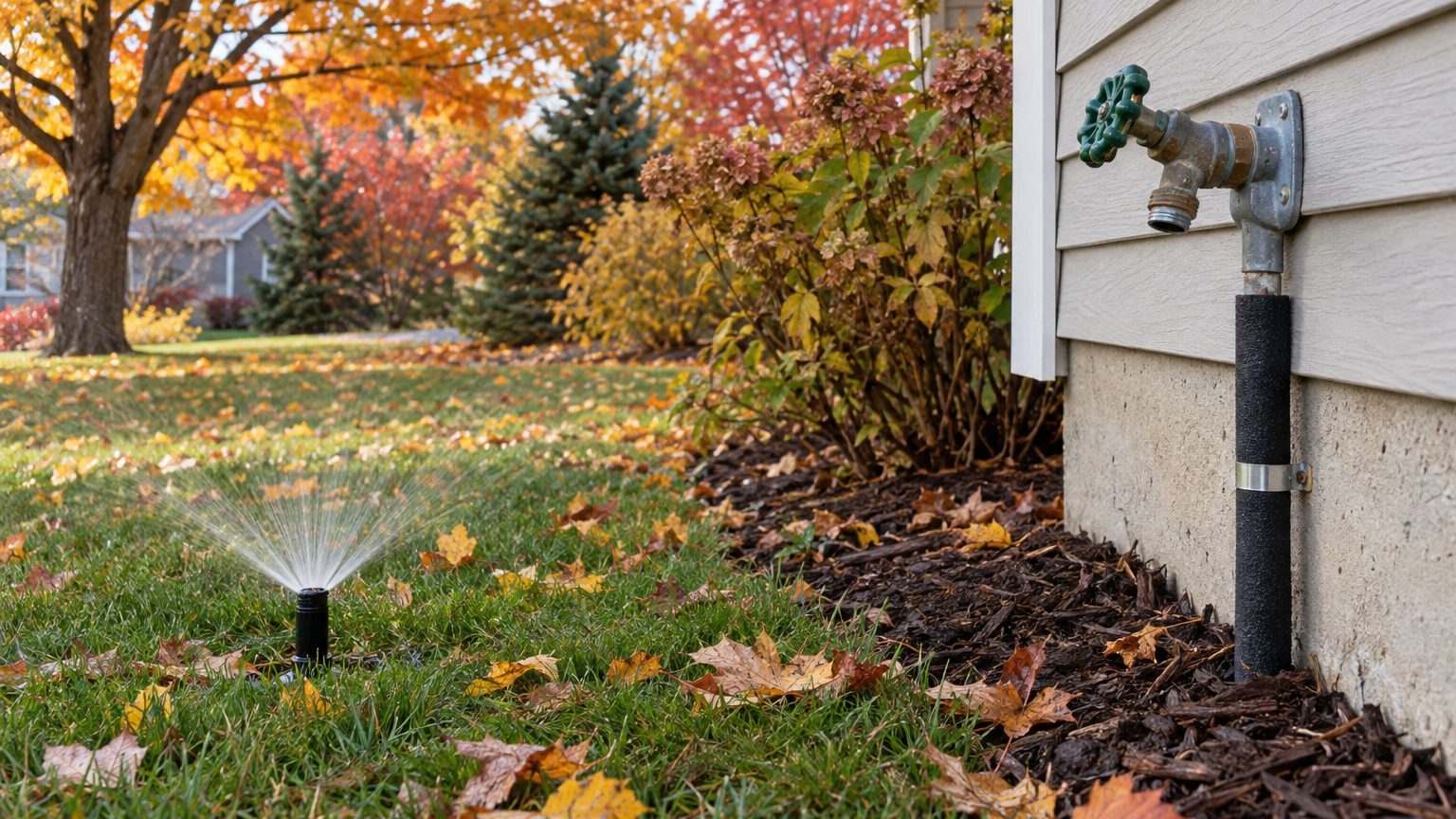

Nebraska gives you a deadline, not a calendar date. The deadline is the first hard freeze, and in the Omaha area that tends to show up in the second half of October. Sprinkler lines and outdoor taps need attention while the days are still mild and the lawn is still green. Waiting for a frosty morning to trigger the chore is the usual mistake. The job takes an afternoon, while a split line in April can take a lot longer to fix.
When to do it in Nebraska
For Omaha, the first fall frost lands between October 15 and October 26, based on the 30-70% probability band for a 32°F freeze in NOAA’s 1991-2020 U.S. Climate Normals. The rule is to drain before the first hard freeze, not after the first light one. A light frost is a warning shot. By the time a hard freeze arrives, water sitting in an above-ground pipe has already had its chance to turn to ice.
Write this one down: finish the sprinkler blowout and the faucet shutdown before the October 15 to October 26 range opens. Think of that range as a cutoff, not a target. Hitting the last possible afternoon leaves no margin for a rainy weekend, a sick compressor, or a forecast that flips a week early.
This is not a climate where you can skip the job. Omaha’s coldest month has a mean daily minimum of 15.2°F (NOAA NCEI Climate Normals 1991-2020), well below freezing night after night. The USDA Plant Hardiness Zone Map 2023 puts Nebraska in zones 4a to 5b, which is a cold-winter range. Any water left in a line or valve will freeze at some point between now and spring. The question is only whether it freezes inside something that can burst.
What the frost range really tells you
Those dates describe a probability band, not a prediction. Somewhere inside that stretch, a 32°F night goes from possible to likely, and some years it comes sooner. A light frost matters less for buried lines, since soil holds heat longer than air does. The parts that go first are the ones sitting in open air: the backflow preventer, exposed fittings, and the outdoor spigot. That is why the order of the day is the exposed hardware first, then everything underground.
Adjusting for your own address
The figures come from an airport weather station, and the reference city is Omaha. Suburban and rural properties typically see the first fall frost earlier than the airport does, often by one to two weeks, and more at elevation. Colder country, meaning farther north in the state and up toward the higher ground in the Panhandle, gets its first frost earlier still. So fall tasks move earlier as you go north and west, never later. Check your own county’s frost dates before settling on a finish line, and leave yourself some room on the early side.
The lawn has its own end-of-season decisions, and the last watering of the year is one of them (see Winterizing a Lawn). Other seasonal timing across the state is collected in the Nebraska guides.
Sprinkler lines: drain or blow out
Why frozen water splits lines and valves
Water expands as it turns to ice, and pipes do not. A sealed stretch of pipe full of water has nowhere to put that extra volume, so the pressure climbs until the weakest spot gives way. That weak spot is rarely a neat, obvious one. Plastic irrigation pipe can crack along its length, threaded fittings split at the joint, and sprinkler heads crack at the body. Valves are the worst offenders because they hold water in small chambers with thin walls and diaphragms.
The damage stays hidden until spring. Ice plugs the crack while it is frozen, so the system looks fine all winter. Then the first zone comes on in April and water sprays out of the ground, or the pressure gauge drops and the lawn stays stubbornly dry in one patch. In a place where the coldest month averages a nightly low of 15.2°F, every inch of water left in the system is a gamble you will lose eventually.
Three ways to clear the water
There are three methods, and they are not equally reliable.
| Method | How it works | Fit for Nebraska |
|---|---|---|
| Manual drain | You open drain valves at the low points of the system and let gravity pull water out | Works only if the system was built with drain valves and the lines slope toward them |
| Automatic drain | Valves open on their own when line pressure drops after shutoff | Helpful backup, but water can stay trapped in dips or around settled lines |
| Compressed-air blowout | Air pushed through each zone forces water out of the heads | The standard for a hard-freeze climate like this one |
Gravity-based methods depend on the lines being pitched correctly and staying that way. Soil settles over years, and a line that once drained perfectly can develop a low spot that holds a cup or two. A blowout does not care about slope, because the air pushes water uphill and out. That is why, with a winter this cold, it is the method most Nebraska systems call for. If your installer built in manual drains and you have confirmed they clear the lines, draining can work, but a blowout is the safer choice when you are unsure.
The basic sequence is the same either way. Shut off the water supply to the system and open the test or drain points. Put the controller into its off or rain mode rather than unplugging it, so the schedule stays saved. Then clear the zones one at a time, stopping each when only a light mist comes from the heads. Running a zone dry for long wears the heads and can overheat them, so take it zone by zone instead of letting air run.
When a professional is the sensible choice
A compressor pushing too much pressure into plastic lines and small heads can do the damage you are trying to prevent. If you do not own a suitable compressor, have not done a blowout before, or cannot tell which valve is the main shutoff, hiring it out is money well spent. The same goes for any system with a backflow preventer you are unsure how to isolate. Book the blowout before the October 15 to October 26 frost range opens so you are not competing with a forecast to get it done.
Outdoor faucets and hoses
The short version: turn valves, nothing else
Outdoor taps are the simplest part of the job, and they call for nothing more than turning valves by hand. Anything beyond that, such as cutting, soldering, replacing a cartridge, or adjusting pipe pitch, belongs to a plumber. Start by disconnecting every hose, including the short ones on splitters and timers. Drain each hose and coil it indoors. Then find the interior shutoff valve for that line, usually in a basement, crawl space, or utility area near where the pipe goes through the wall. Close it, go back outside, and open the tap so the trapped water can run out. Leave the outdoor tap open for the winter so any remaining moisture has room to expand.
Do this before the October 15 to October 26 range arrives in the Omaha area, and earlier if you live farther north or west. A fuller walkthrough of the steps is in Winterizing Outdoor Faucets Before the First Freeze.
Why a frost-free faucet still fails with a hose attached
A frost-free faucet is built with a long stem so the actual shutoff sits inside the warm part of the wall, not at the outside spout. When you turn it off, the water in the pipe beyond that point is supposed to drain out through the spout. That only works if air can get in and water can get out. A hose left on the spigot, even one that looks empty, traps water in the barrel because the hose holds back the flow and often keeps a small amount of pressure in the tip. The water freezes inside the pipe, and the crack shows up behind the wall, not at the faucet.
That is the reason the hose comes off every time, no matter what type of faucet you have. Details on how the design works and what to look for are in Frost-Free Outdoor Taps. Take hoses off every tap before the first hard freeze, and close the interior valve where one exists. If there is no interior valve, or a tap keeps dripping after you close it, leave that to a plumber instead of trying to fix it yourself.
What goes wrong here
The early cold snap
Nebraska can throw a hard freeze at the front edge of the frost range or ahead of it. Colder northern and western parts of the state hit freezing earlier than Omaha does. If the system is not drained by then, the first morning shows up as a cracked backflow preventer or a burst fitting above ground. In spring, you see it as a geyser at the first startup or a zone that will not hold pressure. The prevention is timing: pick a finish line before the reference range begins and treat any forecast showing a night near freezing as a prompt to move the job up.
The forgotten hose
One hose left on a frost-free tap is enough. It rarely shows itself in fall and never in winter. The sign comes in spring, when you turn the tap on and water drips inside the wall or appears on an interior ceiling below the spigot. The fix is cheap habits: a short walk around the house, checking every side, including the side you rarely use, and every tap near the garage, patio, or garden. A written checklist on the garage wall works better than memory.
The flooded valve box
Valve boxes sit in the ground and collect water. If a manifold or valve is sitting in a pool when the temperature falls, ice forms around it and cracks the body. In spring, the signature is a valve that will not shut off fully, or a zone that runs when it should not. Check each box before the blowout and look for standing water. If it is wet, it needs a plumber or irrigation pro to address drainage. Burst pipes in the house follow a different pattern, covered under Frozen Pipes.
Common questions
Is it too early to blow out sprinklers in September?
Not for the pipes. The only reason to wait is if you still need to water a lawn or new sod. A blowout done well ahead of the first frost range costs nothing in protection. If the weather turns dry after you have shut the system down, a hose and portable sprinkler can cover a thirsty patch of lawn for a couple of weeks.
Can I just shut off the water to the system and skip the blowout?
No. Closing the supply valve stops new water from coming in, but it does nothing for the water already in the lines, heads, and valves. That leftover water is what freezes and breaks things. The supply shutoff is step one, not the whole job.
What if the forecast looks warm in October?
A warm stretch does not cancel winter. With a coldest-month mean daily minimum of 15.2°F at the Omaha reference station, a hard freeze will arrive sooner or later, and often quickly after a warm spell. Waiting for a mild forecast to keep holding is how people get caught by a sharp drop. The safer habit is to finish inside the window and be done.
How do I know if my property freezes earlier than Omaha?
Look up frost dates for your county and compare them to the Omaha range of October 15 to October 26. Rural properties, open low spots, higher ground, and the northern and western parts of the state tend to freeze earlier, often by one to two weeks. One more caution: the USDA hardiness zone, which runs 4a to 5b across Nebraska on the 2023 map, rates the coldest extreme of the winter, not the timing of the first fall frost. It tells you how cold the winter gets, but it will not tell you when to drain.