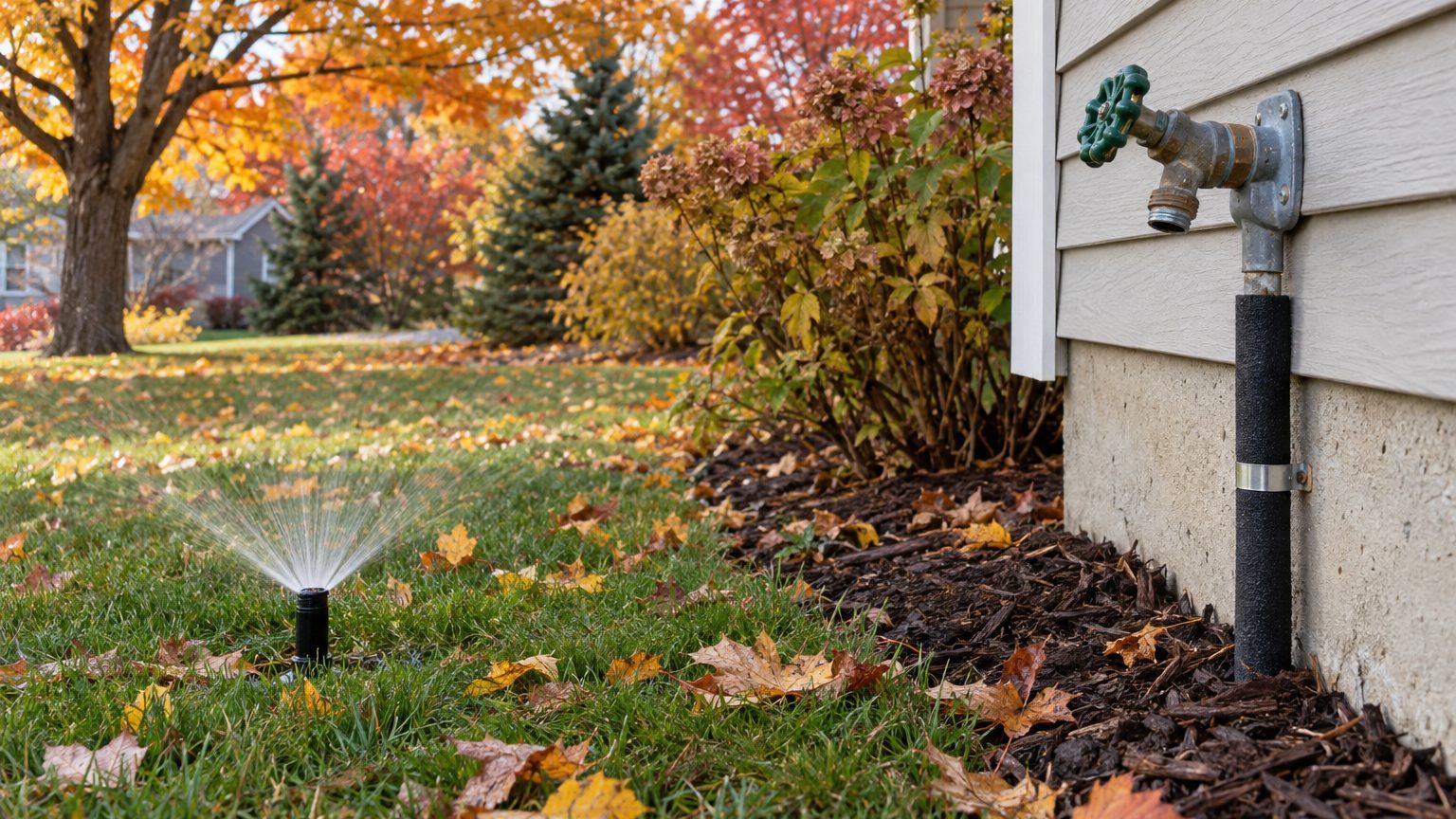

Sprinkler lines and outdoor taps in South Dakota need to be drained in the weeks around the first fall frost, which for much of the state means late September into early October. Miss that stretch and a single hard freeze can split a buried pipe or a faucet you won’t discover until April. The job takes an afternoon: hoses off, taps drained, lines cleared with compressed air. What follows covers the dates, the methods, and the spring damage that tells you something got missed.
When to do it in South Dakota
Finish the shutdown before the first hard freeze, not after the first light one. In Sioux Falls, that puts the work inside or just ahead of a September 24 to October 4 window, the range NOAA’s NCEI 1991-2020 Climate Normals give for the 30 to 70 percent probability band of a first 32°F freeze at the airport weather station (USW00014944).
Write this on the calendar: finish before September 24 to October 4 opens if you live outside town or north of Sioux Falls, and no later than inside that window if you live in the city.
Why does the light frost versus hard freeze distinction matter? A light frost is usually a brief dip on a clear night. Buried soil is still holding summer heat, so the main sprinkler lines are fine. What suffers is anything sitting in open air: the above-ground backflow assembly, hose spigots, exposed risers. A hard freeze is different. It’s a run of nights well below 32°F, with afternoons that never recover, and the cold works down into the soil and into the shallow pipe. Treat the first light frost as the alarm bell. People who read it as an all-clear tend to get caught, because Septembers in the Dakotas love to follow a frosty night with a week of 70s.
Why South Dakota doesn’t get to skip the blowout
Some states can get away with a quick faucet check and call it winterized. This is not one of them. NOAA’s 1991-2020 normals put the mean daily minimum of the coldest month in Sioux Falls at 8.5°F. That is the average nightly low in the deepest part of winter, not a record cold snap, which means a typical January night sits far below the point where trapped water turns to ice. A full shutdown, including clearing the sprinkler lines, is the standard job here, not an optional extra.
Your yard is probably not the airport
The September 24 to October 4 range belongs to the Sioux Falls reference station. It’s a starting point, not a guarantee for the whole state. NOAA’s own caution is that suburban and rural sites often see the first fall frost one to two weeks earlier than the airport, and more than that at elevation. The colder the spot (farther north, higher up, or out in open country), the earlier the first frost lands, so the shutdown moves earlier too. Never later.
For context, the USDA Plant Hardiness Zone Map (2023 edition, built on 1991-2020 normals) lists South Dakota at 3b-5b, a wide range that tells you conditions differ a lot from one county to the next. Check your own county’s frost dates and the National Weather Service forecast for your area, or ask your local SDSU Extension office. More regional how-tos live in the South Dakota guides, and the rest of your fall lawn routine, covered in Winterizing a Lawn, runs on much the same calendar.
Sprinkler lines: drain or blow out
Why trapped water breaks things
Water expands as it freezes. Inside an open pipe that’s harmless, since the ice just pushes along. Inside a pipe closed at both ends, it’s a different story. An ice plug forms, pressure builds between the plug and the nearest closed valve or cap, and the pipe gives out, often a few feet away from where the ice actually sits. That’s why damage tends to show up at fittings, valve bodies and the backflow assembly rather than along a straight run of pipe.
A sprinkler system has plenty of places for water to hide: low spots in the pipe, the inside of each zone valve, the bodies of the heads, risers and swing joints, and the backflow preventer sitting above ground at the house. Plastic pipe tolerates some freezing. Threaded fittings and brass or plastic valve parts usually don’t, and a hairline crack stays invisible until the system is pressurized in spring.
Three ways to clear the lines
Manual drain means opening valves at the low points of the system and letting gravity do the work. It only works if the installer put a drain valve at every low spot and the pipes slope toward them. It does nothing for water held in valve bodies or heads.
Automatic drain valves open on their own when line pressure falls and let water seep out. They’re convenient, but a bit of grit can keep one from closing or opening fully, and a saturated bed of soil around the valve can slow the drainage to a crawl. Most owners can’t tell from the surface whether each one actually emptied its section.
Compressed-air blowout pushes the water out through the heads, one zone at a time. You shut off the water supply to the system, connect a compressor at the blowout port, and run each zone until only a fine mist comes out, then repeat the cycle through all zones. It’s the most thorough method because it reaches the valves, risers and heads that gravity leaves wet.
Given that 8.5°F coldest-month average, use compressed-air blowout as the default and treat drain valves as backup, not as the whole plan. Run it too aggressively and the compressed air itself does damage. Stay under the pressure rating of the pipe, heads and backflow parts, never run a single zone dry for a long stretch (friction heat softens plastic), keep your face away from the heads, and wear eye protection. A small shop compressor often can’t move enough air volume to clear a zone properly, which is a common reason DIY blowouts leave water behind.
When a professional makes sense
Call one if you don’t know where the blowout port or main shutoff is, if the system has many zones or a long run from the house, if you lack a compressor with enough air volume, or if the system has burst before. The same goes for anything involving the backflow assembly beyond turning its valves: that’s plumbing work, and in some South Dakota towns it carries local rules. Arrange the visit before the frost window opens in your area, not after the forecast turns.
Outdoor faucets and hoses
The faucet routine takes about ten minutes per spigot and involves nothing but turning valves and pulling hoses. Start by disconnecting every hose, along with splitters, timers and sprayers. Then find the interior shutoff valve for that outdoor line (usually in a basement, crawl space or utility room near the wall where the spigot sits) and close it. Go back outside and open the spigot all the way so the water downstream can drain. Leave it open for the winter.
Hoses off, interior valve closed, outside tap left open, all before the first hard freeze. That’s the whole decision. If you’re in the colder north or in higher country, do it in the days leading up to your local first-frost range, which as noted earlier runs a week or two ahead of Sioux Falls’s September 24 to October 4 window.
Why a frost-free faucet still fails with a hose attached
A frost-free faucet has a long stem that puts the actual shutoff deep inside the warm side of the wall, so the exposed part of the pipe should drain empty after each use. The design depends on gravity: water has to run out of the barrel through the spout. Leave a hose connected, even a short one, and the hose holds water against the spout. The barrel stays full, and in freezing weather that water turns to ice in the section of pipe closest to the cold. The split happens in the pipe, often inside the wall, and shows itself only when you turn the water on in spring and it leaks where you can’t see it. More on how these fixtures work is in Frost-Free Outdoor Taps.
The same logic explains why a pitched installation matters. A frost-free tap that was mounted level or sloping back toward the house won’t drain fully even without a hose. If you suspect that’s the case, it’s a plumber’s fix, not a DIY job. Beyond turning valves and pulling hoses, leave the work to a licensed plumber.
For a step-by-step version of the same routine, see Winterizing Outdoor Faucets Before the First Freeze. And if a line does freeze despite your best efforts, Frozen Pipes covers what to do next.
What goes wrong here
The early cold snap
The classic South Dakota failure isn’t ignorance. It’s timing. A hard freeze arrives while the hoses are still out and the sprinkler system is still full, because the weekend for the chore kept getting pushed back. The NOAA window of September 24 to October 4 is a probability band, not a promise, so some years the freeze comes earlier than anyone planned, especially in rural and northern yards. What it looks like in spring: a zone that won’t build pressure, a valve that leaks or won’t close, a dripping backflow assembly. Treat the first forecast of a hard freeze as the deadline: pull hoses and drain taps that day, and run or book the blowout next.
The forgotten hose
One hose left on one spigot, usually the one behind the shrubs or at the far end of the garage. In spring the symptom is a spigot that sprays from the handle or a damp patch on the interior wall or basement ceiling when the water goes back on. The prevention is a walk-around checklist: every spigot, every hose, including the one attached to a rain barrel or a pet-water bucket. A quick glance at each tap before the first frost range beats finding out the expensive way.
The flooded valve box
The green lid in the lawn hides the zone valves, and it can fill with water from rain or snowmelt. If the valves inside weren’t blown out, or the box holds standing water, a freeze can crack a valve body or a fitting. Spring signs include a zone that runs all the time or never shuts off, wet ground around the box, and heads that barely pop up. To prevent it, make sure the blowout clears the valve manifold, keep the lid on, and look for pooling around the box before winter. If the box doesn’t drain on its own, that’s a job for an irrigation pro.
When you restart in spring, open the main valve slowly rather than all at once. A sudden rush of water into empty lines is hard on cracked fittings, and a slow fill lets you spot a leak before it floods a bed.
Common questions
Does the winterizing date change away from Sioux Falls?
Yes. The September 24 to October 4 range is NOAA’s figure for the Sioux Falls airport station. Colder parts of the state, including the north and higher ground, typically see the first fall frost earlier, so fall chores like draining and blowouts move earlier there too. NOAA’s own note says suburban and rural sites often run one to two weeks earlier than the airport, and more at elevation. Check your county’s frost dates.
What if a freeze is forecast and I haven’t winterized yet?
Do the quick fixes right away: pull every hose, close the interior valve to each outdoor line, and open the spigots. Turn off the water supply to the sprinkler system. Then arrange the blowout as soon as the weather allows. A brief dip below freezing isn’t always fatal to buried lines, but it’s the exposed parts, the backflow assembly and spigots, that fail first.
Can I winterize the sprinkler system myself?
Faucets and hoses, yes. The sprinkler blowout can be a DIY job if you have a compressor with enough air volume, know where the blowout port and shutoff are, and stay under the pressure ratings of your components. If any of that is uncertain, hire an irrigation professional. A system that looks drained but isn’t can crack in the first hard freeze.
Do frost-free faucets need winterizing?
They need less, but they still need it. Remove the hose, and close the interior shutoff valve to that line if there is one. A frost-free faucet drains by gravity, and a connected hose keeps water trapped in the barrel where it can freeze and split the pipe inside the wall.