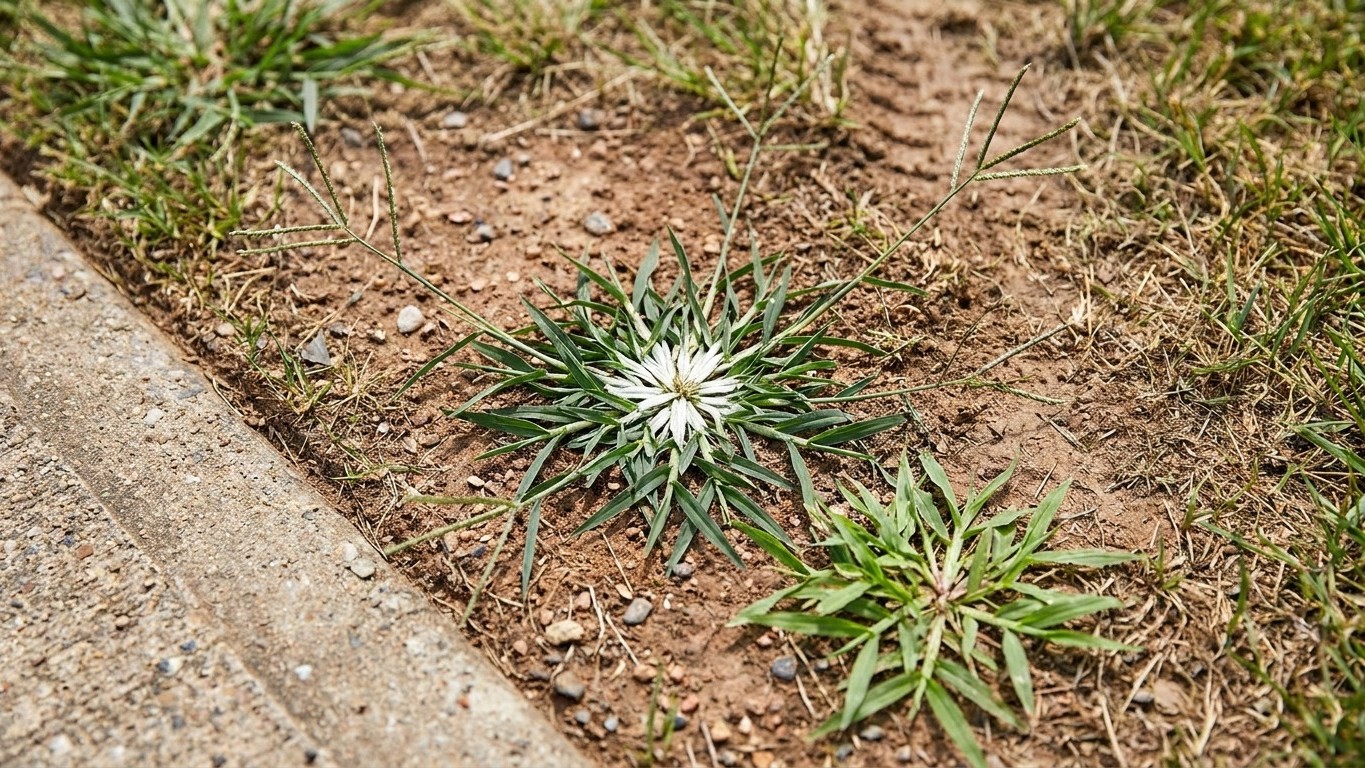

Set the mower to 2 to 3 inches for Kentucky bluegrass and fine fescues, 3 to 3.5 inches for tall fescue, and 1.5 to 2.5 inches for perennial ryegrass and rough bluegrass. These are the cool-season grasses that suit Alberta’s climate. The gap between them is wide enough that cutting one at another’s height can thin a lawn. Check which species you have, then raise the deck as summer heats up.
The mowing height for Alberta lawns
Mowing height is the one setting that decides how much leaf a grass plant keeps to feed itself. Leaf blades capture the sunlight that pays for roots, and taller grass also shades the soil, which keeps it cooler and makes life harder for weed seedlings. Each species has a range where that balance works, and the ranges do not overlap neatly.
| Grass | Mowing height |
|---|---|
| Tall Fescue | 3 to 3.5 inches |
| Fine Fescues | 2 to 3 inches |
| Kentucky Bluegrass | 2 to 3 inches |
| Perennial Ryegrass | 1.5 to 2.5 inches |
| Rough Bluegrass | 1.5 to 2.5 inches |
These ranges are consistent with what land-grant extension programs publish for each species. A lawn of tall fescue cut at 1.5 inches is scalped, with most of its leaf gone. A ryegrass lawn left at 3.5 inches tends to flop over and mat. The numbers are not interchangeable.
The list is short because Alberta’s growing season is short. Warm-season grasses do their growing in sustained heat and go dormant, turning brown, when it cools. On average, Calgary’s last spring frost falls on May 21 and its first fall frost on September 16. That leaves about four months between the two average dates, with frost risk on both sides. A grass that needs long, hot stretches to thrive will spend much of that window not growing, and it will not recover well. Skip them, and stick with the five above.
Most lawns are mixes, not single species. If yours is a blend, mow for the grass that dominates it, and when in doubt pick the middle of the 2 to 3 inch range, which sits inside the ranges for Kentucky bluegrass and fine fescues and overlaps the top of the ryegrass range. For seed advice and local conditions, Alberta Agriculture and Irrigation is the provincial starting point. The general principles for any lawn are covered in Mowing a Lawn.
Raising the deck when the heat comes
July is when most lawns get mowed too short. The grass grows fast in June, the lawn looks shaggy, and the instinct is to scalp it back. Do the opposite once hot spells arrive. Move to the top of your species range: 3 inches for Kentucky bluegrass and fine fescues, 2.5 inches for ryegrass and rough bluegrass, 3.5 inches for tall fescue. The extra leaf shades the crown and the soil, so the lawn loses less water to evaporation.
Rainfall in Calgary tells part of the story. Environment and Climate Change Canada’s 1981-2010 normals for the Calgary Int’l A station show about 216 mm (8.5 inches) across June, July and August, out of 419 mm (16.5 inches) for the whole year. June is the wettest of the three at about 94 mm (3.7 inches). July drops to about 66 mm (2.58 inches), and August is the driest at 57 mm (2.24 inches). A tall lawn going into August has less rain behind it than the one that went through June.
Why the rainfall figure never reads alone
Eight and a half inches of summer rain does not mean the same thing on every lot. Sandy soil lets it through within the day, so a sandy lawn can need watering every second day even in a wet summer. Clay holds it for about a week. Heat adds another layer: hot days pull moisture out of the soil quickly, and rain that comes as one summer thunderstorm mostly runs off rather than soaking in. A slope, a south-facing wall or a city setting shifts the picture further.
These are normals for one station, not a forecast, and not your yard. A cheap rain gauge on your own plot settles it better than any regional average. Note also that these are 1981-2010 figures, while US sites such as this one generally use 1991-2020 normals, so the two are not directly comparable.
The one-third rule, and why it is not arbitrary
Never remove more than one-third of the blade in a single cut. This is the oldest rule in turf care, and it rests on biology: a grass plant that loses a large share of its leaf at once stops feeding its roots until new leaf grows back. Roots stall, and the plant draws on stored reserves it cannot replenish quickly.
The rule turns your mowing height into a schedule. Cut Kentucky bluegrass at 3 inches and it is due when it reaches 4.5 inches. Tall fescue held at 3.5 inches should be mowed before it passes 5.25 inches. Ryegrass kept at 2.5 inches wants cutting at roughly 3.75 inches. Lower heights mean tighter intervals, which is a hidden cost of the short-cut lawn: it needs the mower more often.
The common failure is the missed week. A wet June pushes growth, you skip a weekend, and the lawn is now twice the height it should be. Dropping the deck to the target in one pass breaks the rule. Cut it back in two stages instead, mowing high first and then again a few days later at your target. It costs an extra pass but spares the lawn a shock it handles badly in dry weather.
Clippings from a one-third cut are short enough to fall between the blades and break down. Leave them where they fall. Long, heavy clippings from an overgrown lawn clump on the surface and are the ones worth raking.
The first and last cut of the year
The first cut is set by growth, not by the calendar. Wait until the grass has grown enough that one pass removes no more than a third of the blade, and the ground is firm enough to carry the mower without ruts. In Calgary, the average last spring frost is May 21. That is a midpoint, not a safe date: in one year out of two the last frost falls later. Treat it as the middle of a window, and do not count on the lawn being past frost risk on that day.
The same caution applies in autumn. September 16 is the average first fall frost at the Calgary Int’l A station, and in half of years it comes later. Frost does not end mowing, because grass keeps growing until cold slows it. Keep cutting on the one-third rule until growth stops, and finish the season within your species range. Do not drop below its bottom number to tidy up for winter.
Both dates come from a single airport station, and a province is not one climate. Northern and upland districts can run weeks behind Calgary in spring and arrive at frost sooner in fall. Use these dates as an anchor for the Calgary area and watch your own lawn and local conditions elsewhere. Neighbouring regions face the same questions with different numbers, as How High to Mow a Lawn in Saskatchewan and How High to Mow a Lawn in New Hampshire show.
Common questions
What is the best mowing height for a typical Alberta lawn?
For Kentucky bluegrass or a fine fescue lawn, 2 to 3 inches, and the upper end in summer. Tall fescue wants 3 to 3.5 inches. Perennial ryegrass and rough bluegrass sit lower, at 1.5 to 2.5 inches.
Can I grow a warm-season grass in Alberta?
It will not hold. Warm-season grasses grow in sustained heat and go dormant when it cools. With an average last frost of May 21 and first fall frost of September 16 in Calgary, they get too little time at full growth.
Should I bag the clippings?
Usually not. Following the one-third rule leaves short clippings that break down on the lawn. Rake or bag only when the grass got too long and the clippings are clumping.
How much rain does an Alberta lawn get in summer?
At the Calgary Int’l A station, normals for 1981-2010 show about 216 mm (8.5 inches) across June, July and August. August is the driest month at 57 mm (2.24 inches). Your soil, slope and local storms change what reaches the roots, so a rain gauge in your own yard is the best check.