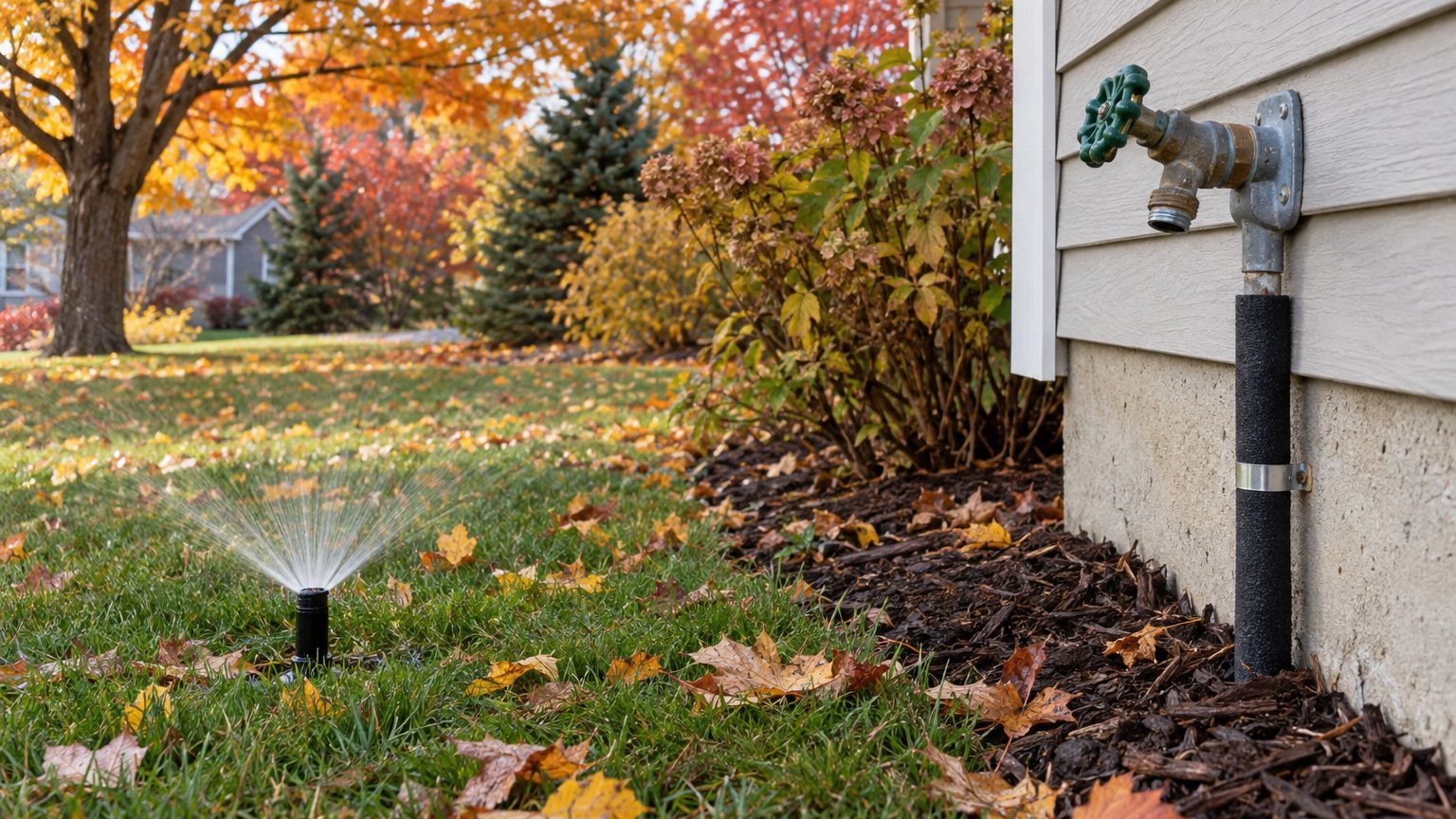

Ohio gives you a short fall window for shutting down irrigation and outdoor taps, and it closes around the first frost, not around Thanksgiving. Sprinkler lines, valves and hose bibs all hold water that can freeze and split, and the damage stays hidden until spring. Winter lows here sit well under the freezing line, so skipping the job is a gamble. Below: the timing, the three ways to clear sprinkler lines, the faucet routine, and the failures that show up after the thaw.
When to do it in Ohio
Get the work done before the first hard freeze, not after the first light one. For zone 6a, the Ohio State University Extension’s Ohio Gardening Calendar puts the first fall frost at October 5 to October 15, so sprinklers should be drained and hoses off by the time that range opens.
If you’re reading this at the start of October, the window is open right now. The date to write down: finish before the October 5 to October 15 first-frost range, and treat anything later as borrowed time.
Ohio is not a place where a full shutdown is optional. The NOAA NCEI Climate Normals for 1991 to 2020, using Columbus as the reference station, put the mean daily minimum of the coldest month at 22.0°F. That is ten degrees under the freezing point on an average night, and an average hides the colder ones. Nothing about that number supports a light-touch approach. Lines and spigots that hold water will eventually see temperatures that split them.
Why the first frost sets the deadline
A first frost is a modest event: a skim of ice on the windshield, a blackened basil plant. Buried lines usually come through that night fine, because the soil holds onto summer heat. The problem is what follows. Nobody can say whether the hard freeze arrives in a few mild weeks or in the first real cold snap, and the parts above ground feel it first. The backflow preventer, exposed pipe and outdoor spigots all sit in the open air.
Waiting for the first frost to start the job also means working in worse conditions. Cold fingers, short days, and a compressor or a plumber’s schedule you can’t control all work against you. Doing it a little early costs nothing, since a drained system sits harmlessly until spring.
How location in Ohio moves the window
The October 5 to October 15 range belongs to zone 6a. The USDA Plant Hardiness Zone Map 2023, built on 1991 to 2020 normals and on a single variable, the average annual extreme minimum temperature, places Ohio in zones 5b to 6b. The state is not uniform. Farther north and on higher ground, the first fall frost comes earlier, so the draining comes earlier too. Southern Ohio and lower, sheltered spots tend to get a little more runway, though a cold snap does not read the map.
If you live in the colder part of the state, treat the start of the range as your finish line rather than the end of it. The Ohio guides go deeper on regional differences. Lawn work runs on a gentler clock, and Winterizing a Lawn covers it separately.
Sprinkler lines: drain or blow out
What freezing does to the system
Water expands as it turns to ice, and a closed pipe has nowhere to let that growth go. The pressure pushes outward until the weakest point gives. In a sprinkler system the weakest points are the fittings, the valve bodies, the sprinkler heads and the above-ground backflow preventer. Poly pipe can stretch a bit, PVC fittings crack, and brass valves split along a seam.
The cruel part is timing. The ice plug holds the water in place all winter. Nothing leaks until the thaw, when the water runs out through the split the moment you pressurize the system in spring. That is why a repair that looked like a free weekend task in October turns into a trench in April.
Three ways to clear the lines
Sprinkler systems are drained one of three ways, and they are not equal. The table lays out how each works and where it fits.
| Method | How it works | Fit for Ohio winters |
|---|---|---|
| Manual drain | You shut off the water supply, then open drain valves at the low points so gravity pulls water out | Works only if the system was installed with low-point drains and sloped lines; pockets of water can stay in flat or uneven runs |
| Automatic drain | Valves open on their own when line pressure drops after shutoff, letting water run out | Convenient, but it relies on the same gravity and slope, and heads and valves can still hold water |
| Compressed-air blowout | Air pushed through each zone forces water out of pipes, valves and heads | The most thorough option, and the usual choice where winter lows run well under freezing |
With a coldest-month minimum of 22.0°F at the Columbus reference station (NOAA NCEI Climate Normals 1991-2020), Ohio does not forgive leftover pockets of water. For most Ohio systems, a compressed-air blowout is the safe default, with the manual or automatic drains as a first step rather than the whole job.
Doing a blowout yourself takes more care than it looks. The air has to go zone by zone, never at a pressure above what the pipe and heads are rated for, and nobody should stand over a backflow preventer or a sprinkler head while it runs. Eye protection is not optional. A compressor too small for the job leaves water behind; one set too high damages heads and fittings.
When a professional is the sensible choice
Call a pro if you don’t own a compressor that suits your system, if you don’t know how many zones you have or where the shutoff sits, or if you’ve had freeze damage before and want to know why. The same goes for any system with an above-ground backflow preventer you aren’t sure how to isolate, and for anything with a main line you haven’t traced. A blowout is a quick visit for someone who does it every fall. Repairing a split manifold is not.
Outdoor faucets and hoses
The shutdown, in order
An outdoor faucet is the simplest thing to protect and the one most often forgotten. The routine is turning valves and pulling off attachments, nothing more:
- Disconnect every hose, splitter, timer and sprayer from every outdoor spigot.
- Find the interior shutoff valve for that spigot, usually in a basement or crawl space, and turn it off.
- Open the outdoor spigot fully so the water between the two valves can run out.
- Leave the outdoor spigot open for the winter, with the hose gone, so nothing refills or traps.
If a spigot has no interior shutoff, or you can’t find it, stop there. Adding a valve, replacing a spigot or opening a wall is plumbing work, and that belongs to a licensed plumber. The same rule applies if the spigot drips after you shut it off, which means something inside is worn or the valve isn’t sealing.
For the full walkthrough, see Winterizing Outdoor Faucets Before the First Freeze. Pull every hose off before the October 5 to October 15 first-frost range, the first fall frost the Ohio State University Extension lists for zone 6a. A hose left on through that range is a hose left on through the first hard night.
Why a frost-free faucet still fails with a hose attached
A frost-free faucet puts the actual valve seat deep inside the wall, on the warm side, with a long tube running out to the spout. After you shut it off, the water in that tube is meant to drain out through the spout, since the tube is built with a slight slope. The design works only when the spout is open to the air.
Leave a hose attached and the water can’t leave. The hose holds a column of water that backs into the tube, and any residual water sits in the barrel. When the cold arrives, it freezes in the one place the faucet was designed to keep dry. The split happens inside the barrel, often within the wall, and you won’t see a thing until spring, when turning the water on sends it into the wall cavity instead of out of the spout. That is a hidden leak, not a visible one.
A frost-free faucet protects you only if you also disconnect the hose, which is why the label “frost-free” leads many people to skip the step. More on how these fixtures are built and maintained is in Frost-Free Outdoor Taps.
What goes wrong here
Ohio’s trouble is rarely deep winter. It is the week the shutdown gets postponed.
The early cold snap before anyone has drained
October can feel warm right up to the night it doesn’t. With a first frost range of October 5 to October 15 for zone 6a (Ohio State University Extension), a hard freeze can follow a mild stretch quickly, especially in the colder north. Systems that were meant to be done “next weekend” end up full of water on the wrong night.
In spring, the sign is a geyser, a zone that won’t run, or a soaked patch of lawn where pressure should have built. Prevention is plain: pick the weekend before the range opens and treat it as fixed.
The forgotten hose
The hose on the side of the garage, the one behind the shed. A hose left connected to a frost-free faucet shows up in spring as damp drywall, a stain on a basement ceiling below the faucet, or water spraying inside the wall as the tap opens. The cure costs nothing: walk the whole house, front and back, with a checklist. Indoor plumbing in cold corners faces similar risks, and Frozen Pipes explains how to spot them.
The valve box that floods
The green box in the lawn holds valves and often sits below the surface. Water collects in it from rain and snowmelt, and what the blowout leaves behind can freeze around the valves. In spring the sign is a weeping valve, a zone that sticks on or off, or a box full of water. Prevention is a thorough blowout that includes the valves, a lid that fits, and ground that slopes away from the box. Turn the water back on slowly in spring and walk the yard before trusting any zone, because a split found in minutes is a cheap repair and one found after a week of running is not.
Common questions
Can I wait until the first frost to start?
It’s risky. The first fall frost for zone 6a falls between October 5 and October 15, according to Ohio State University Extension, and the hard freeze can follow with little warning. Finish before that range opens, and sooner in northern Ohio or on higher ground, where the first frost comes earlier.
Is draining the valves by hand enough?
Sometimes, but not reliably. A manual drain depends on gravity, and any dip or flat stretch in the lines holds water. With the coldest-month mean minimum at 22.0°F in Columbus (NOAA NCEI Climate Normals 1991-2020), a compressed-air blowout is the safer default. A professional can tell you if your layout drains cleanly on its own.
Can a frost-free faucet stay hooked up to a hose?
No. The hose traps water in the tube, so it can’t drain, and it freezes inside the wall. Disconnect the hose, shut the interior valve if you have one, and leave the outdoor spigot open.
Does Ohio’s hardiness zone change my drain date?
The USDA Plant Hardiness Zone Map 2023 places Ohio in zones 5b to 6b, but that zone rests on the average annual extreme minimum temperature, not on the first fall frost. The frost date is the better guide for timing. If your home is in the colder part of the state, start earlier than the October 5 to October 15 range suggests for zone 6a.