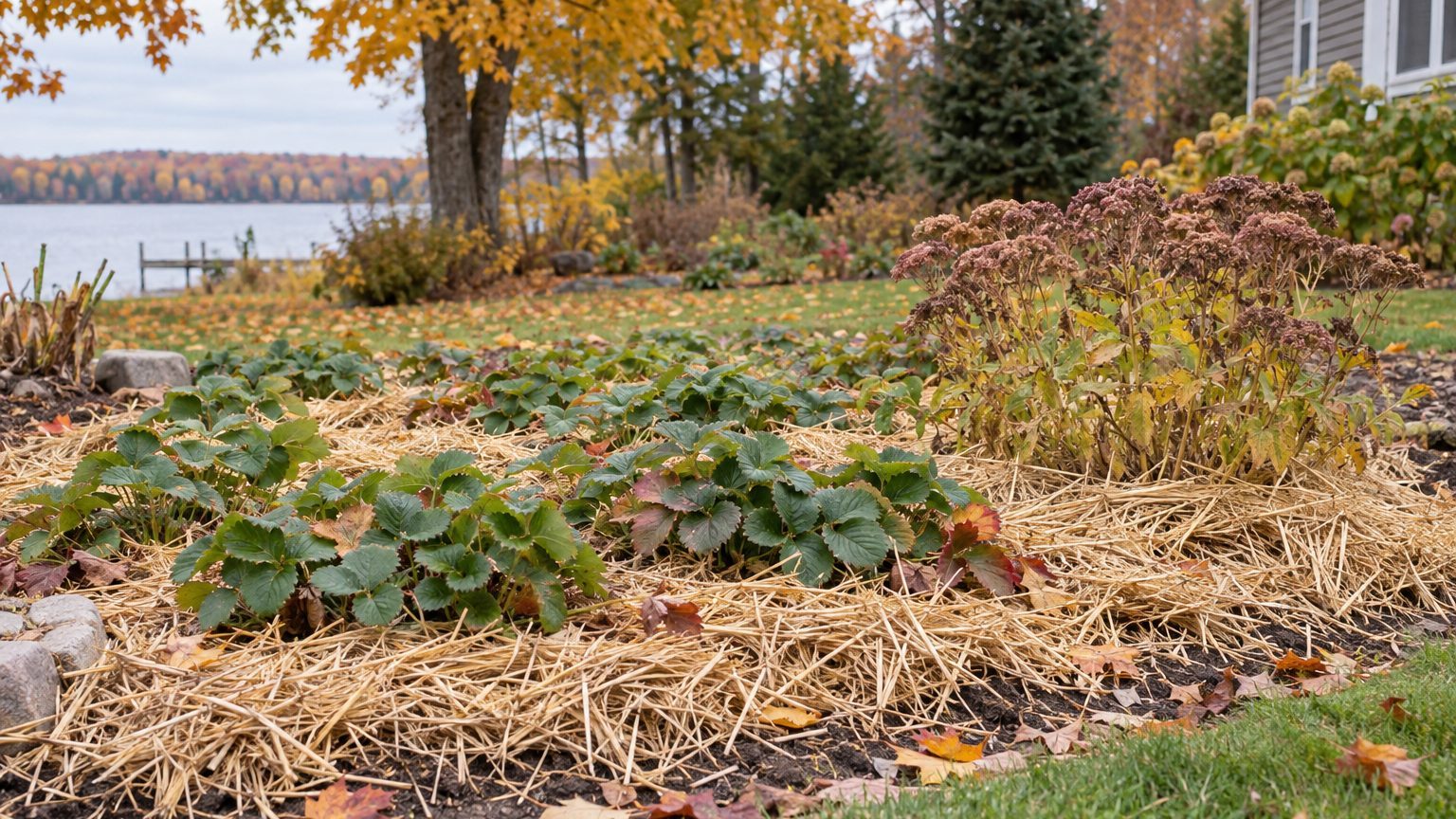

Winter mulch in West Virginia goes down after the ground starts to freeze, not before. NOAA’s 1991-2020 Climate Normals put the first 32°F freeze at Charleston between October 18 and November 1, so the window opens once that stretch has passed and hard freezes keep coming back. Strawberries and borderline perennials follow the same rule. Higher ground freezes earlier, so the schedule shifts earlier there. The reasons, and the mistakes that cost plants, are below.
When to put winter mulch down in West Virginia
Start with what the mulch is for. It does not keep plants warm. Its job is to keep the soil frozen once it freezes, so the ground stays put through January thaws instead of swinging between rock-hard and mud. The reference station at Charleston shows why this matters here: NOAA NCEI’s 1991-2020 Climate Normals put the mean daily minimum of the coldest month at 26.1°F. That is well below freezing, so the ground does freeze in the Mountain State, but a minimum that sits only a few degrees under 32°F means it also thaws repeatedly. Those repeated cycles do the damage.
Why the calendar is a trap
A first frost is not the same as frozen ground. The NOAA normals for Charleston (station USW00013866) give October 18 to November 1 as the band where a 32°F freeze becomes likely, roughly a 30 to 70 percent chance. A frost blackens basil and zucchini leaves, but the soil underneath still holds summer heat. Spread mulch over that warm soil and you build a cozy blanket for exactly the wrong tenants: rodents looking for a winter nest, and fungi that thrive in damp, mild conditions under a mat of straw or leaves. Plants also stay soft and active instead of settling into dormancy.
So the rule runs on conditions, not a date. Mulch after the first fall frost window of October 18 to November 1 has passed, and once the soil surface has begun to freeze. In a typical Charleston fall that points to the weeks after that window closes, once hard freezes are repeating rather than occasional. Charleston sits in a river valley, though. Ridges, higher counties and the northern part of the state see their first freeze noticeably earlier, so mulching shifts earlier there. Spring cleanup shifts later.
Reading your own yard
You do not need a thermometer. A few signs tell you the soil has turned:
- The surface is crusted or stiff on several mornings in a row, and it stays firm until midday.
- A trowel meets resistance in the top of the bed rather than sliding in.
- Puddles and mud ruts from earlier in fall have stiffened into ridges.
Before spreading anything, pull the weeds, finish any last watering of new plantings, and leave the material ready in bags or a pile at the edge of the bed. Then wait. Gardeners who spread in mid-October because the first frost came early are the ones writing about moldy crowns in March. Local frost numbers vary by county, and the guide to First and Last Frost Dates in West Virginia helps you place your own yard relative to Charleston.
Strawberries
Strawberries are the plant most worth covering. A strawberry crown, the compact woody stem at the soil line where all the leaves and flower buds originate, sits right at the surface. Bare cold can injure it directly. The bigger threat is frost heave: when soil freezes, thaws and freezes again, the expanding and contracting ground pushes shallow roots upward, and the crown ends up perched above the soil with its roots exposed to drying air. A plant that heaves in January often looks fine until spring, then fails to leaf out. If you are still deciding where and how to plant, the broader guide to Growing Strawberries covers the beds themselves.
What to use and how much
Clean straw is the standard cover. It is light, it traps air without packing down, and it lets water pass through. Look for straw rather than hay; hay is full of seed heads that will sprout in your berry patch in April. Pine needles work as a second choice where they are available.
On depth, the only figure I can give you comes from NC State Extension’s Gardener Handbook, which says: “A 2-inch to 3-inch layer of mulch suppresses most annual weed seeds and makes it easy to hand-pull any that do germinate.” That is general mulch guidance, not a strawberry-specific rule, but it is a sound ceiling. Straw fluffs up when you first spread it and settles, so shake it loosely over the rows to that range and stop. Piling more on is not extra protection. A thick, soggy blanket over crowns is how you grow rot.
Pulling it back in spring
Uncovering is as important as covering. Strawberries under straw start growing before the weather has really turned, and new leaves under the cover come up pale yellow. That color is the signal. Rake the straw off the crowns as soon as you see new pale growth, and keep it in the aisles so you can pull it back over the plants on a frost night. Open blossoms are the most frost-sensitive part of the plant, which is why the straw stays within arm’s reach for a while. Because the last frost date moves later as you go north and up in elevation, the uncovering window does too, so check your own area before you rake.
Perennials and borderline plants
Most established, well-adapted perennials in West Virginia do not need winter mulch to survive. The USDA Plant Hardiness Zone Map 2023, built on the average annual extreme minimum temperature, places the state in zones 5a to 7a, and Charleston sits at the milder end of what the state experiences. The northern panhandle and the high ridges are colder. A peony or daylily that is rated well below your zone can sit through winter on its own. Mulch earns its place with a narrower list.
| Plant type | Winter risk | What the mulch does |
|---|---|---|
| Perennials planted this fall | Roots not yet anchored, easily heaved | Keeps soil from thawing and refreezing around young roots |
| Shallow-rooted plants such as heuchera and garden mums | Heaving out of the ground | Holds the crown in place |
| Plants near the edge of their hardiness zone | Cold at the root zone | Moderates soil temperature swings |
| Lavender, rosemary and other Mediterranean herbs | Cold and wet crowns | Light cover only, with drainage first |
Newly planted perennials get the most benefit. They have had only a few months to root, so a freeze-thaw cycle tugs them out with little resistance. The same goes for any plant that sits close to its zone limit. The herbs are a special case, since too much cover rots them faster than cold kills them. The piece on Getting Perennial Herbs Through the Winter covers that balance.
Depth follows the same NC State Extension guidance quoted above: “A 2-inch to 3-inch layer of mulch suppresses most annual weed seeds and makes it easy to hand-pull any that do germinate.” For woody plants the same handbook says: “Provide a 3-inch layer of mulch to reduce water loss and maintain uniform soil moisture and temperature around roots.” Both fall in the same order of depth, so more than that buys you nothing. Shredded leaves, shredded bark or pine straw all work.
The method matters more than the material. Make a ring, not a pile. Leave a few inches of bare soil right at the crown or stem and spread the mulch around it in a doughnut, so moisture does not sit against the plant and the stem stays dry enough to resist rot. Shaped like a volcano, mulch rots bark and hides rodent activity. The full reasoning is in Mulching Without Killing the Plant.
What goes wrong
Four mistakes account for most winter mulch failures, and each leaves a recognizable mark.
Too early, too thick, or too wet
Mulching too early shows up as crowns that turn soft and brown at the base, or as plants that push out tender new growth in a warm December spell and get burned by the next freeze. The fix is patience: wait until the first-frost window of October 18 to November 1 has passed at Charleston, and until the soil surface is freezing. Earlier in higher counties.
Matting is the next one. Whole leaves, especially maple and sycamore, flatten into a wet, airless sheet that holds water against the crown. You will find it in spring as a slimy gray layer with plants dead underneath. Shred leaves first, or use straw, and keep to the 2-inch to 3-inch range from NC State Extension rather than burying the plant.
Voles and the spring cleanup
Voles nest under thick mulch because it gives them cover, warmth and a food supply of bark and roots. You see it as small tunnels in the mulch, gnawed crowns and girdled stems at the base of shrubs. Late mulching helps, since the animals have usually settled elsewhere by the time you spread it. So does keeping mulch pulled back from stems and trunks, and checking rows in midwinter for runways.
Last, the forgotten cover. Straw left on strawberries into warm weather smothers new growth, keeps the crowns wet, and invites fungal rot on the first berries. Pull the cover back as growth begins, well before bloom, and spot-check any bed that has been under mulch since fall. A bed left covered is a bed you cannot see, and what you do not inspect tends to fail without warning.
Common questions
Should I mulch strawberries right after the first frost?
No. A first frost in the October 18 to November 1 range at Charleston still leaves warm soil underneath. Wait until hard freezes are repeating and the soil surface is firm in the mornings, then spread straw.
Is the timing different in the mountains?
Yes. NOAA’s Charleston figures describe a river valley, and higher elevations across the state freeze noticeably earlier in fall. Mulch earlier there, and uncover later in spring.
How deep should winter mulch be?
NC State Extension says: “A 2-inch to 3-inch layer of mulch suppresses most annual weed seeds and makes it easy to hand-pull any that do germinate.” For trees and shrubs it says: “Provide a 3-inch layer of mulch to reduce water loss and maintain uniform soil moisture and temperature around roots.” Stay inside that range and keep it off the crown.
Do all my perennials need winter mulch?
No. The USDA Plant Hardiness Zone Map 2023 places West Virginia in zones 5a to 7a, and established, hardy perennials usually manage unaided. Mulch helps new plantings, shallow-rooted plants and anything near the edge of its hardiness. More local guidance sits in the West Virginia guides.