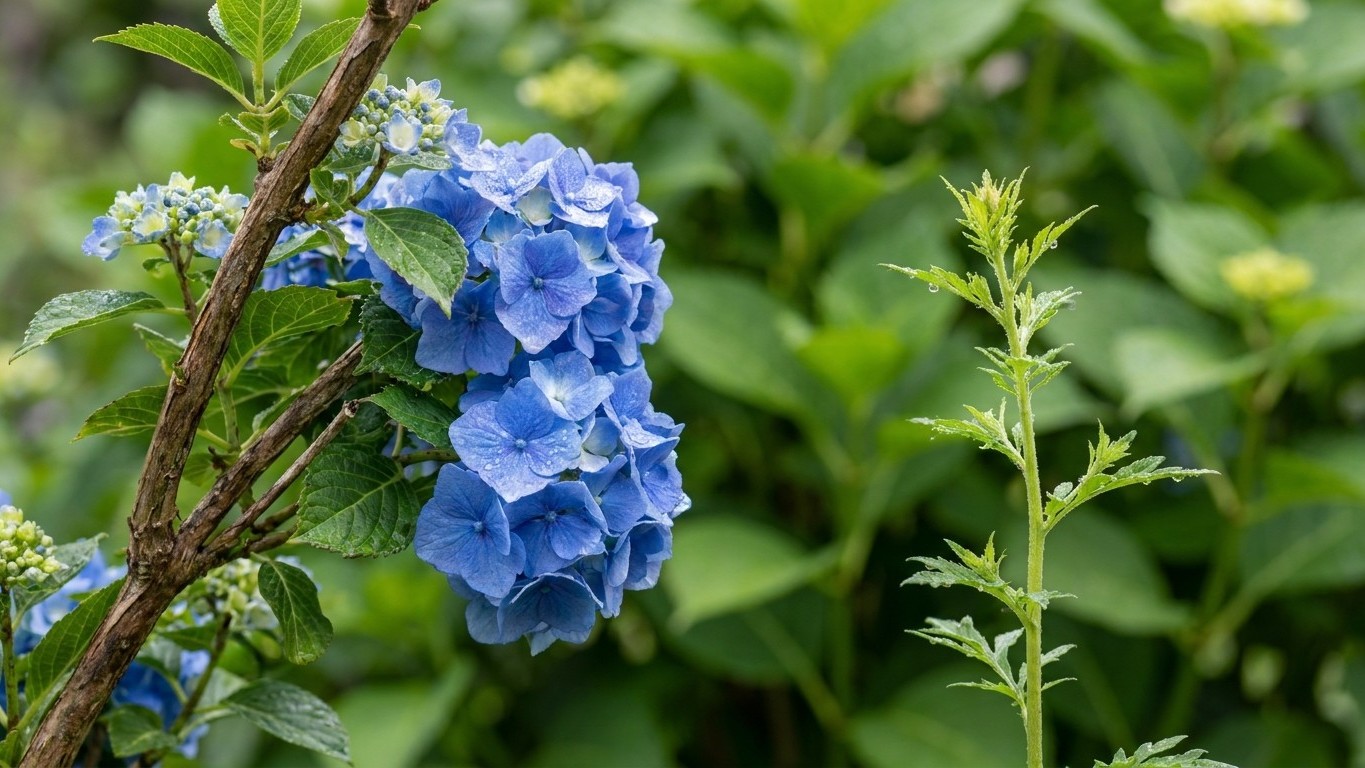

Hydrangeas can thrive in Newfoundland and Labrador, but the type you buy decides the outcome. Panicle and smooth hydrangeas flower on new wood and shrug off most winters. Bigleaf types gamble with their buds. At St. John’s, the average last spring frost is May 30, so container plants go in the ground in early June, later in northern and upland districts. Wind and winter damage matter more here than summer heat.
When to plant Hydrangeas in Newfoundland and Labrador

The reference point is the weather station at St. John’s airport. Environment and Climate Change Canada’s 1981-2010 climate normals put the average last spring frost there on May 30, the first fall frost on October 17, and the frost-free stretch at 139 days. Read those as averages, not guarantees. A mean date means that in one year out of two, frost arrives later than May 30. The St. John’s figure also describes one coastal location. Gardens in the interior, at elevation, along the northern Avalon, and anywhere in Labrador run weeks behind it. A province is not one climate, and these normals come from Environment and Climate Change Canada’s published data, which cover 1981-2010 (US figures usually cover 1991-2020, so don’t compare dates directly with a US guide).
Why you start with plants, not seed
Seed starting is the usual first step with vegetables, but it is the wrong tool for hydrangeas. Named varieties do not come true from seed, and seedlings can take years to flower. Gardeners get new plants from nursery containers or from softwood cuttings taken in early summer. The “indoor start” in this case is the greenhouse the nursery already ran for you, which means the plant you bring home has soft, sheltered growth that has never felt wind.
Counting back from the planting date
Set a target planting date one week after the average last frost: June 6 at St. John’s. That cushion is a rule of thumb, not a published frost threshold. It exists because a 50 percent chance of a later frost is poor odds for tender new leaves. Now count back. Hardening off takes 7 to 10 days, so the first day outdoors is May 27 at the latest. Start with two hours of morning shade, add a little sun and wind each day, and leave the pot out overnight only for the final two or three days. Buy the plant before that, ideally by mid-May, when garden centers still have the best selection.
For your own district, replace May 30 with your local last-frost estimate, add a week, then subtract ten days. Gardeners in higher or more northerly areas should check local knowledge before trusting any single date. Planting is workable through July if you water steadily. By early September, the plant has too little time to root before the ground freezes, and fall-planted shrubs are the ones that heave out of the soil over winter.
Soil and site preparation
Start with the site, because the shrub cannot be moved cheaply after it settles. Wind is the main enemy in much of the province. Pick a spot sheltered by a house wall, fence, or evergreen hedge, ideally facing south or east so the plant gets morning sun. Panicle hydrangeas tolerate full sun in cool summers, which is a real advantage over warmer states. Bigleaf types prefer afternoon relief even here. Near the coast, salt spray burns foliage, so place the shrub behind a screen rather than in the open.
Hydrangeas want soil that holds moisture but drains. Heavy clay stays waterlogged in spring and rots roots, and sandy or gravelly ground dries out by midsummer. Peaty ground, which is common in many parts of the region, is often acidic and rich in organic matter, though no one should assume their own yard matches. Dig a hole 12 inches deep and fill it with water. If it is still standing there after several hours, build a raised bed 8 to 12 inches high rather than burying the plant deeper. Ask the provincial agriculture office about soil testing before you add anything for pH. Guessing with aluminum sulfate or lime wastes money and can harm roots.
Timing matters. Work compost, leaf mold, or well-rotted manure into a 3-foot circle four to six weeks before planting, so the amendments settle. On planting day, dig the hole twice as wide as the root ball and no deeper, keeping the crown level with the soil. Spacing depends on the type: roughly 3 to 4 feet for smooth and compact panicles, 5 to 6 feet for bigleaf, and 6 to 8 feet for full-size panicles. Check the plant tag for mature width. Water slowly after planting and put down 2 to 3 inches of mulch, keeping it a hand’s width away from the stems.
Varieties that suit Newfoundland and Labrador
Forget “days to maturity” as vegetable gardeners use it. For a hydrangea, the traits that matter are when the plant forms and opens its flowers, whether the flower buds come on last year’s wood or this year’s growth, and how much cold the stems can take. That third trait is the equivalent of determinate versus indeterminate: a new-wood bloomer produces flowers from fresh stems every spring, while an old-wood bloomer must carry its buds through the winter.
New-wood types are therefore the safer choice in a province with long winters, unpredictable thaws, and late frosts. Even if cold kills stems back to the snow line, they leaf out and bloom the same year. Old-wood types may leave you with a green shrub and no flowers.
| Type | Blooms on | Widely sold examples | Good for |
|---|---|---|---|
| Panicle (Hydrangea paniculata) | New wood | ‘Limelight’, ‘Quick Fire’, ‘Little Lime’, ‘Bobo’ | Reliable bloom, sun tolerance, wind tolerance. ‘Quick Fire’ is known for opening early, which helps in a short season. |
| Smooth (Hydrangea arborescens) | New wood | ‘Annabelle’, ‘Incrediball’ | Dependable after harsh winters, and good in partial shade. ‘Incrediball’ has sturdier stems than ‘Annabelle’. |
| Bigleaf (Hydrangea macrophylla) | Old wood (some rebloom on new) | ‘Endless Summer’ and other rebloomers | Blue or pink color for a sheltered spot. Rebloomers offer a backup if frost kills old-wood buds. |
| Climbing (Hydrangea petiolaris) | Old wood | Sold under the species name | Shady walls and fences, slow but hardy. |
Disease resistance is a secondary trait. Panicles generally handle leaf spot and mildew better than bigleaf types, and good spacing reduces both. Availability varies by garden center, so ask what your local nursery stocks and, if you are in the northern part of the province or Labrador, ask what has survived there for neighbors. For comparison, gardeners in warmer, more humid regions face different choices, as the guide to Growing Hydrangeas in Alabama: Types, Colour and Winter shows, where heat tolerance rather than cold hardiness steers the decision. The cool maritime conditions in Growing Hydrangeas in Washington: Types, Colour and Winter are closer to some Newfoundland coastal gardens, though winters here are harsher.
On colour: white and green panicle and smooth varieties stay that way, but bigleaf blues and pinks depend on soil chemistry. Acidic soil with available aluminum tends toward blue, while near-neutral to alkaline soil tends toward pink. Test first, then adjust slowly over a full season, not in one dose.
What to plant alongside
The neighbors that help most are the ones that do jobs hydrangeas cannot do for themselves. Hostas and ferns shade the root zone, keep soil cooler, and suppress weeds. They like the same moist, partly shaded conditions, so the watering routine for one works for both. Astilbe and heuchera fill the same niche with finer foliage. Spring bulbs such as daffodils cover the early weeks, when hydrangeas are still leafless, then die back as the shrub fills out. Rhododendrons share the preference for acidic soil and are a natural partner in cool, humid gardens.
Panicle and smooth hydrangeas offer open, fertile flowers that bees and other insects visit, which is a real pollinator benefit. Mophead types are mostly sterile showy florets and offer far less. Planting something with accessible flowers nearby, such as bee balm or coneflower, gives pollinators a reason to stay.
What to keep away is more specific. Large trees with shallow roots, such as maples, willows, and birches, take water and nutrients from a nearby shrub, and hydrangeas dry out visibly beside them. Avoid crowding the plant with mildew-prone neighbors like phlox, since poor airflow helps fungal problems on every plant in the bed. Lilies get lily leaf beetle (a pest on the Maine list), but the beetle does not use hydrangeas, so there is no cross-infection risk to worry about, only a reason to inspect the lilies separately.
Be skeptical of folk pairings. Claims that marigolds, garlic, or lavender will repel pests from hydrangeas rest on little solid evidence. A pungent plant nearby may mask scent for a moment, but it will not protect a shrub. If you like those plants, grow them for their own sake.
Watering, feeding and support
Water and mulch
Hydrangea means “water vessel,” and the plant’s wilting behavior shows why. Give an established shrub about 1 inch of water a week, delivered in one or two deep soakings rather than daily sprinkles, because deep watering pushes roots down where the soil stays cooler. Newly planted shrubs need water every two or three days for the first several weeks. Check the soil with a finger: if the top 2 inches are dry, water. Afternoon wilting on a hot day is normal if the plant perks up by evening. A plant that is still limp the next morning needs water.
A 2 to 3 inch layer of shredded bark, leaf mold, or composted wood chips slows evaporation and moderates root temperature. Keep it off the stems to avoid rot, and refresh it each spring.
Feeding, support, and pruning
Feed lightly. Apply a balanced slow-release fertilizer once when growth starts in spring and, if the plant looks pale, again in early summer. Stop by midsummer. Late nitrogen pushes soft growth that frost will kill and delays the hardening of stems that the shrub needs before winter. More fertilizer does not mean more blooms; it often means more leaves.
Support is mainly a concern for large-headed types. ‘Annabelle’ is the famous flopper, drooping after rain, and a peony ring set early in spring holds it up. Sturdier cultivars like ‘Incrediball’ and most panicles rarely need it. Pruning follows the bloom habit. Cut new-wood bloomers in late winter or early spring, removing dead wood and shortening stems by about a third for larger heads. Leave old-wood bloomers alone except for dead stems, which you can only identify after buds break in spring, so wait until leaves emerge before cutting anything. Hydrangeas send up occasional suckers from the base. Dig and pot them as free plants, or remove them if you want a tidy shape.
Common problems

Reading the symptoms
Blossom end rot, fruit cracking, and curling fruit leaves belong to tomatoes, not hydrangeas. The troubles that actually show up here look different. No flowers on a bigleaf hydrangea usually points to buds killed by winter cold, a late frost after leaf-out, or hard pruning at the wrong time. The shrub is healthy but barren. Switch to a new-wood type or a rebloomer, and protect the plant better next year. Brown, crispy leaf edges mean wind burn, salt spray, or drought, depending on where the plant sits. Wilt that does not recover overnight is nearly always a watering problem, either too little or soggy soil that has rotted roots. Dig a bit to check before adding more water. Gray-white film on leaves is powdery mildew, which appears in humid, crowded conditions. Thin stems, improve airflow, and avoid overhead watering. Brown or purple spots with a defined edge suggest leaf spot, best handled by raking up fallen leaves in autumn and keeping foliage dry.
Pests
No Canadian province publishes a home-garden pest list of the kind US extension services do, so the best available reference is the University of Maine Cooperative Extension, which documents ten pests in a neighboring region: browntail moth, cabbage maggot, Colorado potato beetle, emerald ash borer, lily leaf beetle, seedcorn maggot, spotted wing drosophila, squash vine borer, striped cucumber beetle, and winter moth. The biology crosses the border, but the calendar does not always, and this list does not tell you which pests are dominant in Newfoundland and Labrador. Most of those target vegetables, lilies, or ash trees. Winter moth and browntail moth caterpillars feed on the leaves of many deciduous trees and shrubs, so they could plausibly chew on a hydrangea. Browntail caterpillar hairs can cause a skin rash, so avoid handling them barehanded. If you see chewed leaves, take a photo and a sample to the provincial agriculture office for identification before spraying anything. Aphids and spider mites are the common general-purpose hydrangea pests anywhere, and a hard spray of water dislodges both.
Ripening before the frost comes back
Hydrangeas do not produce fruit to ripen, so the question changes: do the flowers open and do the stems harden before frost? The arithmetic is the same count-back used for vegetables. Start with the 139 frost-free days at St. John’s, then subtract a week of cushion after the average last frost. That leaves about 132 days between planting and the average first frost of October 17. Both of those are mean dates, so in half of all years the season is shorter on one end or the other.
Now subtract what the plant needs. A new-wood hydrangea that leafs out in late May typically needs roughly ten to twelve weeks of growth before panicles or smooth heads open, so figure about 70 to 84 days. That leaves around 48 to 62 days for blooms to show, color up, and for stems to harden before frost. Panicles and smooth types finish comfortably. A late-blooming rebloomer on bigleaf may open its second flush right as frost arrives, and that flush is lost in cold years. Old-wood bloomers face a different test: their buds formed last summer and need to survive the winter, so the frost date matters more in autumn, when the stems must harden.
Redo the sum for your own district. Take your local frost-free days, subtract 7 for the cushion, then subtract 70 to 84 for bloom time. If your gardening season is 110 days (a hypothetical number, not a measured one), you have only 19 to 33 days left, and an early-flowering panicle like ‘Quick Fire’ is a better bet than a late one. What buys extra weeks: a larger, already-established nursery plant, a south-facing wall that absorbs heat, a windbreak, and row cover over tender new growth during a late-spring cold snap. Black plastic, so useful for warming vegetable beds, is a poor idea around hydrangea roots, which need cool, moist soil.
Harvest and end of season
The harvest is the flower. Cut stems for fresh arrangements in the early morning, when they are fullest, with a sharp blade just above a leaf pair. Plunge them in water immediately and re-cut the ends under water. For drying, wait until the heads feel papery and the colors have shifted to a muted antique tone, usually late summer. Panicle blooms dry well on the shrub. Cut them, strip the leaves, and either hang them upside down in a dry, dark room or stand them in an inch of water in a vase and let it evaporate. That second method is the closest thing to “ripening off the vine,” and it keeps color and shape better than rushing the process. Stored away from damp and direct sun, dried heads last a year or more.
As October 17 (the average first fall frost at St. John’s) approaches, shift to winter prep. Water deeply if the autumn is dry. Mulch heavily after the ground has cooled, not while it is still warm. Where wind is a problem, build a burlap screen on stakes rather than wrapping the plant tightly, since trapped moisture encourages rot. Leave spent flower heads on bigleaf types through winter, because they offer a little insulation for the buds below. Hold off on pruning old-wood bloomers until spring.
Local help
Climate varies sharply across the province, and no single page can give you a date for every district. The Newfoundland and Labrador Department of Fisheries, Forestry and Agriculture is the place to ask about regional planting dates, soil testing, and pest identification. For more regional articles, browse our Newfoundland and Labrador guides, and for the general fundamentals see How to Grow Hydrangeas: The Complete Guide.
Common questions
Will hydrangeas survive a Newfoundland and Labrador winter?
Panicle and smooth types usually do, because they bloom on new wood and recover from stem dieback. Bigleaf and climbing types are riskier, since their buds form the previous summer. Shelter from wind, mulch after the ground cools, and a snow cover all improve survival. In the far north and in Labrador, expect to test a plant before committing a whole bed.
When is the earliest I can plant?
At St. John’s the average last frost is May 30, and a week after that, around June 6, is a sensible target for tender container plants. Hardy, dormant shrubs can go in earlier if the ground is workable, but you risk cold damage to new growth. Northern and higher-elevation gardens should wait longer.
Why did my bigleaf hydrangea leaf out but never bloom?
The flower buds were most likely killed by winter cold or a late frost, or removed by pruning in fall or early spring. Bigleaf types set buds on old wood. Wait to prune until after leaves emerge, protect the shrub from wind, and consider a rebloomer or switch to a panicle.
Can I change the color of my hydrangea?
Only bigleaf and some mountain types respond. Acidic soil with available aluminum yields blue, and more neutral soil yields pink. White hydrangeas stay white. Get a soil test first, then change pH gradually over a season or two, since quick fixes can burn roots.
Should I grow hydrangeas from seed?
It is rarely worth it. Seed-grown plants do not match the parent cultivar and can take years to bloom. Buy a container plant, or root softwood cuttings in early summer. A cutting taken in July typically needs the whole following season in a pot before it is ready for the garden.