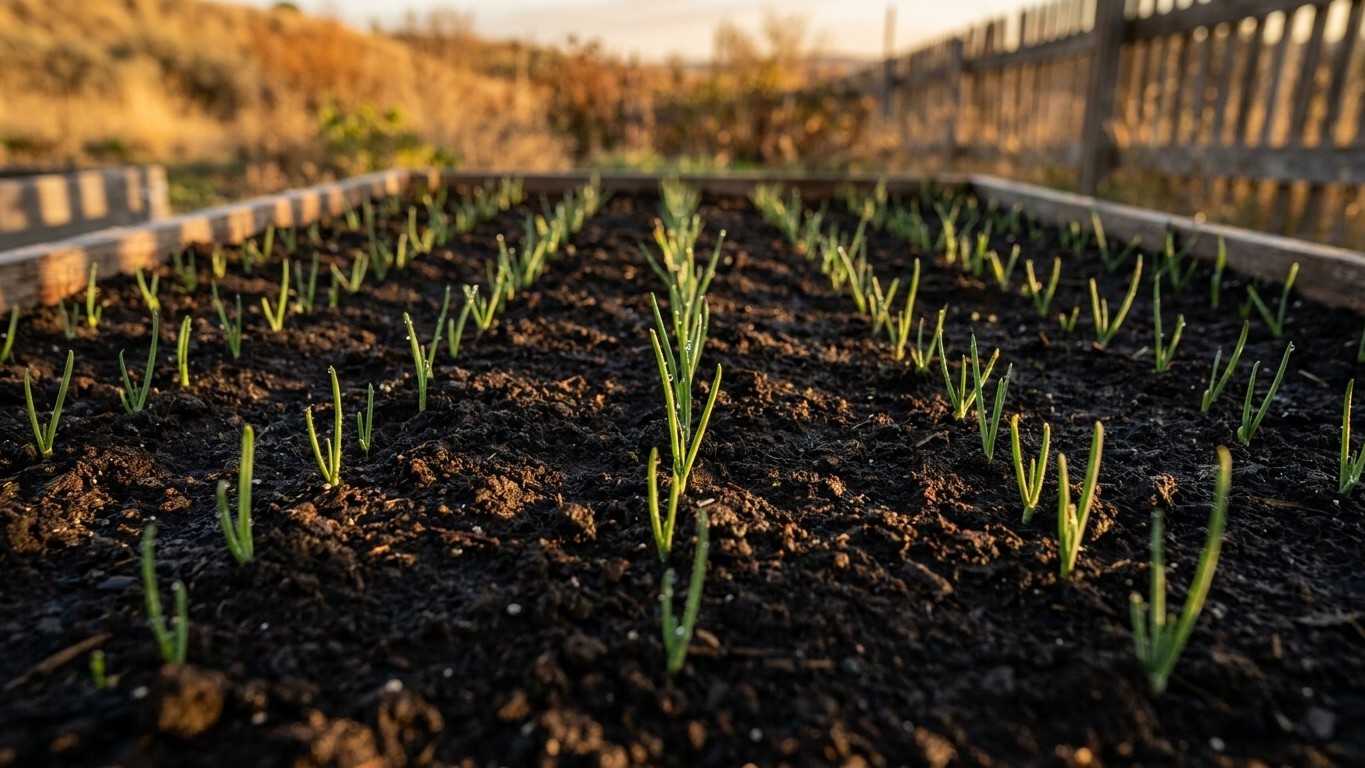

Garlic in Kansas gets eaten on a schedule. Wireworms and voles go after the cloves from planting through winter, rabbits nip the early greens, thrips rasp the leaves as spring warms, and bulb mites show up after harvest in storage. Nematodes can arrive in the seed itself. The calendar starts in autumn, and the date that anchors it is your first hard freeze.
The short answer for Kansas
The anchor is first fall frost, which falls between October 23 and November 2 in the NOAA NCEI 1991-2020 Climate Normals (the 30-70% band of 32F freeze probabilities). That band is a midpoint, not a safe date: in one year out of two, the frost arrives later. Garlic goes in the ground around that window in autumn and comes out the following summer, so nearly every pest problem is a question of what is in the soil and the mulch during the months in between.
The numbers come from one airport weather station, and an airport runs warmer than most gardens. Suburban and rural plots usually see the first fall frost earlier than the airport does, often by one to two weeks, and more at elevation. Treat the band as a reference-city figure, not a statewide guarantee.
Why does a frost date predict pests? Because it sets when the soil cools and when you plant. Plant too early and the cloves sprout into soft fall growth with soil insects still active around them. Plant on time and the cloves root quietly while the soil insects slow down. Then winter hands the job to mammals. Voles, mice and rabbits do their damage between December and March, when other food is scarce and a mulched garlic bed looks like shelter with a snack inside.
Spring brings the insects back. Thrips build up on the leaves as the weather warms, and maggots can turn up in a wet, cool spring. By harvest the damage is done or avoided, and the last threat is mites in the stored bulbs. Each of these has its own window, and each window can be counted from the frost date. For the planting side of that count, see When to Plant Garlic in Kansas: Counting Back From the First Frost.
Working it out for your own garden
A state is not one climate, and Kansas stretches a long way from east to west. Start with the reference band, October 23 to November 2, and adjust it for where you live. A rural or suburban garden commonly runs one to two weeks earlier than the airport. Subtract that from both ends and your first frost lands somewhere between October 9 and October 26. Garden-edge cold pockets, such as low ground where cold air pools, sit at the early end. A bed against a south-facing wall sits at the late end.
That adjusted date is your anchor, and the pest calendar hangs off it in a few simple steps. This is a way of thinking, not a published schedule, so no fixed offsets are quoted here.
- Before frost: prepare the bed. If it was sod or pasture last year, wireworms and grubs are already living there. Soil insects are still active, so this is when planting too early costs you.
- Around frost: plant, then mulch. Keep the mulch loose and thin enough that a vole can’t build a nest in it.
- Midwinter: the vole and rabbit window. Check for tunnels and nibbled shoots after thaws.
- Spring: thrips, and maggots in wet years. Scout the leaves, especially the folds near the base.
- Harvest and after: lift the bulbs the following summer and cure them. Mites and rot show up in warm, humid storage.
Because the frost date is a midpoint, build in slack. In half of all years the freeze comes after your date, so a planting window pinned to the exact median misses in roughly half the seasons. Late is usually the safer side for pests, since cloves planted after the soil has cooled have less exposure to active soil insects. The trade-off runs the other way for rooting, which needs weeks before the ground locks up. The Growing Garlic in Kansas overview covers that balance in more depth.
Last, write down your own dates. A gardener who notes the first killing frost each year for five years has a better local number than any airport station. Add the date you first saw thrips and the date voles showed up, and you have a pest calendar built on your own soil.
What changes across Kansas
The west and the east of the state do not share a frost date. The High Plains along the Colorado line sit much higher than the eastern counties, and elevation pulls the first freeze earlier, which shifts the whole pest calendar with it. Planting windows open sooner there, winter reaches the soil sooner, and spring thrips pressure can arrive in a hot, windy, dry year before the garlic has finished sizing up.
| Part of Kansas | Frost compared with the reference band | Pest pressure to expect |
|---|---|---|
| Western High Plains | Earlier, because of elevation | Thrips in dry, warm springs; rabbits and rodents in open winter ground |
| Flint Hills and central Kansas | Close to the band, earlier on exposed ridges | Wireworms in beds cut from grass; voles near prairie edges |
| Northeast, including the Kansas City area | Often nearer the later end in built-up areas, earlier in rural low ground | Rabbits and voles in suburban beds; maggots in wet springs |
| Southeast | Typically later than the west | Wet-spring maggots; longer soil-insect season in a mild fall |
Treat the table as direction, not data. It describes which way each region leans relative to the airport band, not a measured date for any county. Cities run warm, so a Kansas City suburb can stay frost-free longer than farmland ten miles out. Creek bottoms and river valleys hold cold air on still nights and frost earlier than the ridge above them.
Winter severity differs across the state too, which matters for the cloves. Kansas winters can swing from mild stretches to hard cold snaps, and varieties suited to that swing differ from those that thrive further east, so Garlic Varieties That Suit Kansas Winters is worth a read before you order seed. Gardeners just across the Missouri line in Kentucky face a milder pattern, and their calendar is laid out in When to Plant Garlic in Kentucky: Counting Back From the First Frost and Garlic Varieties That Suit Kentucky Winters. Don’t borrow their dates, though. The pest timing moves with the climate.
The mistakes this climate punishes
Kansas has hard winter swings, wide open spaces and a lot of prairie sod, and that shapes which errors cost a crop here.
Planting into fresh sod
Wireworms are the larvae of click beetles. They live in grass roots for years and bore into cloves in fall and spring. A bed cut straight from pasture or lawn invites them, and a garden near a Flint Hills pasture edge invites them more. Work the bed a season ahead if you can, or grow something else there first and keep the garlic for ground that has been cultivated.
Mulch that doubles as a vole hotel
A deep layer of straw laid right at planting is standard advice in cold places, and it works as insulation. In Kansas it also gives voles and mice a sheltered runway for the whole winter. Keep the layer modest, pull it back from the stems in spring, and keep tall grass trimmed around the bed so rodents have less cover.
Planting seed you cannot vouch for
Bulb and stem nematodes travel in infected seed garlic. Affected plants have swollen, twisted leaves and soft bulbs, and the pest can persist in the soil afterward. There is no rescue, so the fix is prevention. Buy certified or reputable seed stock and rotate the bed away from garlic and onions the next year. Saving your own cloves from a bed that looked odd is how a small problem becomes a permanent one.
Planting too early or too late
Early planting, before the soil cools, leaves cloves sprouting through warm fall weather with soil insects still active. Late planting leaves too little time to root before the ground freezes, and a poorly rooted clove can heave out of the ground in a freeze-thaw cycle, which also exposes it to anything that forages. Remember that the frost date is a midpoint, not a promise. About half of years run later and half run earlier, so aim inside the window instead of at its edge.
Checking this against your county
County-level frost dates and local pest reports come from K-State Research and Extension, which runs offices across Kansas. Staff there can tell you what is moving in your area this season, from wireworm hotspots to thrips timing in your part of the state. Contact the office nearest your garden and ask for your county’s first-frost figures before you set a planting date.
Common questions
What is the most common garlic pest in Kansas?
No Kansas-specific ranking is published in the sources used here, so no single pest can be named as the most common. Thrips in spring, rodents in winter and wireworms in grass-converted beds are the ones gardeners most often report. Your county extension office can tell you which has been worst locally.
When should I check for pests?
Check three times: at planting, in midwinter after thaws, and in spring when the leaves are growing. Your adjusted first-frost date, somewhere between October 9 and October 26 for many rural gardens, tells you when the first check is due. The reference band itself is October 23 to November 2 from the NOAA NCEI 1991-2020 Climate Normals.
Can I stop voles without chemicals?
You can reduce them. Keep mulch thin, trim grass around the bed and remove brush piles nearby. Hardware cloth around a raised bed also helps, buried a few inches into the soil. None of this is a guarantee, but it removes the shelter that makes the bed attractive.
Is stored garlic safe once it is lifted?
Mostly, if it is cured well. Bulbs lifted the following summer should dry in a shaded, airy spot before storage, because warm, damp conditions favor mites and rot. Check them every few weeks and discard soft or shriveled bulbs so they don’t spread problems to the rest.