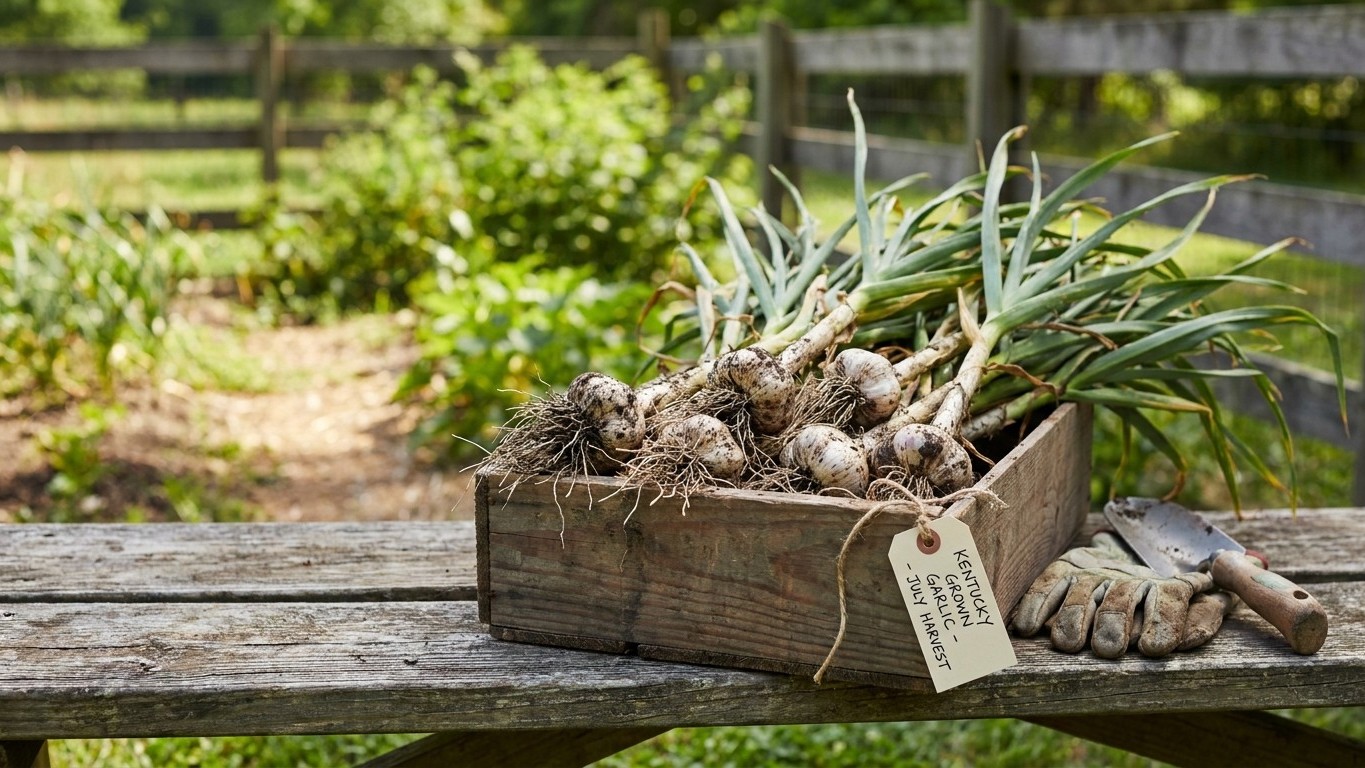

Both softneck and hardneck garlic do fine here, and the difference between them comes down to flavor and how long the bulbs keep, not whether your winter’s cold enough. Kentucky’s cold stretch runs so far past what a clove needs to divide into cloves that the weather was never really the question. What matters is timing: get your cloves into the ground mid-October to late October, pointy end up, before that first frost window closes on you.
The short answer for Kentucky

Every cultivar in wide circulation for this region goes in the ground on the same schedule: mid-October to late October. That window is set against NOAA’s 1991-2020 Climate Normals, which place the first fall frost near Louisville between November 2 and November 12. Treat that date as a midpoint, not a deadline. A midpoint means frost arrives later than the stated range in roughly half of all years, so a garden that misses the window by a week or two in a mild year still has time, while a garden that waits for a hard freeze as a signal is gambling on the wrong half of the odds.
The cold itself is not the limiting factor here. University of Georgia Extension bulletin C854 sets the vernalization requirement, the cold exposure a clove needs to divide into a full bulb, at six to eight weeks below 40°F. Kentucky’s winters deliver 21.8 weeks below that mark, more than double what any cultivar on the list actually needs. That’s why the choice between softneck and hardneck in this state comes down to flavor, storage life, and how you cook, not whether the winter is cold enough to finish the job.
Varieties for Kentucky planting
The table below lists the cultivars carried for this region, their neck type, and the shared planting window worked out from the frost data above.
| Variety | Type | Planting window |
|---|---|---|
| Early Red Italian | Softneck | Mid to late October |
| Inchelium Red | Softneck | Mid to late October |
| Italian Late | Softneck | Mid to late October |
| Lorz Italian | Softneck | Mid to late October |
| Bavarian Purple | Hardneck | Mid to late October |
| Blue Music | Hardneck | Mid to late October |
| Chesnok Red | Hardneck | Mid to late October |
| Duganski | Hardneck | Mid to late October |
| Fall Festival | Hardneck | Mid to late October |
| Georgian Crystal | Hardneck | Mid to late October |
| Georgian Fire | Hardneck | Mid to late October |
| German Red | Hardneck | Mid to late October |
| German White | Hardneck | Mid to late October |
| Ivan | Hardneck | Mid to late October |
All of these are planted in autumn and lifted the following summer. If you haven’t settled on a bed, soil prep, or spacing yet, back up to Growing Garlic in Kentucky before working through the dates below.
Working it out for your own garden
The mid-October to late-October window isn’t arbitrary. It comes from cross-referencing the catalogue planting recommendation against NOAA’s frost data for the Louisville-area station. Late October, the tail end of the window, lands somewhere between two and twelve days ahead of the earliest date in the frost range, November 2. Mid-October, the front end, lands closer to eighteen to twenty-eight days ahead of the latest date in the range, November 12. Put plainly, cloves go into Kentucky soil two to four weeks before the first fall frost, however early or late that frost turns out to fall in a given year.
Counting back from your own frost date
That same relationship is what you redo for your own county. Pull a first-fall-frost estimate for your area from NOAA or from the county extension office, then count back two to four weeks from it. That’s the same span this article’s window is built on, just applied to a different starting date. For more on the counting-back method itself, and how it interacts with spring planting decisions too, see When to Plant Garlic in Kentucky: Counting Back From the First Frost.
What moves the number
A state the size of Kentucky is not one climate, and the NOAA figure used above comes from a single station near Louisville. Elevation is the biggest lever: ground that sits higher tends to cool first in autumn, so a garden on higher terrain should expect its own frost date to land earlier than the Louisville range, not on it. A large body of water works the other direction. Water holds heat longer than open ground, so gardens close to a big reservoir’s shoreline often see frost arrive a little later than inland sites at the same latitude. Neither of those effects has a fixed number attached to it, so the next section names the places where the shift matters most and points you to where to check it for your own ground.
What changes across Kentucky
The frost figures come from a station near Louisville, and NWS Louisville itself flags that the site runs warmer than its surroundings, both later in spring and earlier in fall than rural Jefferson County around it. That’s an urban heat island effect, and it means a garden a few miles outside the city should expect its true frost window to sit earlier than the November 2 to November 12 range, not later.
Eastern Kentucky’s higher ground
The Appalachian Plateau counties in the eastern part of the state sit at meaningfully higher elevation than the Bluegrass region around Louisville and Lexington. Higher ground cools faster once autumn nights lengthen, so gardens in that part of the state should plan for their own first frost to land ahead of the Louisville-area range, and should lean toward the front of the mid-October to late-October planting window rather than the back of it.
Western Kentucky and the river valleys
The Jackson Purchase and the far-western counties sit lower and closer to the Mississippi and Ohio river valleys, and gardens near a large reservoir such as Kentucky Lake or Lake Barkley get some added buffering from the water itself. Growers in that part of the state often have a bit more room at the back end of the planting window than the Louisville figure implies, though how much depends on how close the garden actually sits to the water and how sheltered the site is otherwise.
The mistakes this climate punishes
Timing mistakes
Kentucky’s problem is rarely too little cold. It’s misjudging the calendar in either direction. Plant too early, while soil is still warm from summer, and cloves push visible top growth before real winter arrives, leaving tender leaves exposed to the first hard freeze instead of dormant underground. Plant too late, or bury cloves too shallow for the length of cold the state actually delivers, and roots don’t get established before the ground locks up, which shows up the next summer as small, uneven bulbs. A layer of mulch, straw or shredded leaves a few inches deep, matters more here than in a state with a shorter cold season simply because 21.8 weeks below 40°F is a long stretch for bare soil to swing through freeze-thaw cycles unprotected.
Disease risk from the calendar
The same fall planting window that suits garlic’s cold requirement also sits inside the temperature range where certain soil pathogens are active, according to the UC IPM Pest Management Guidelines for Onion and Garlic (UC ANR Publication 3453). Fusarium basal rot has a published range of 59 to 90°F, and September and October, the very months Kentucky planting falls in, land inside that range, along with May, June and July at the other end of the garlic year. White rot‘s range runs 50 to 75°F, and September, October, April and May all fall inside it too. Those are air-temperature figures being compared against a published soil-temperature range, so treat them as showing a season of elevated possibility, not a soil reading. A monthly average also hides a lot: a month that averages in the middle of a pathogen’s range still has cooler and warmer days inside it. None of this means the disease is guaranteed, and it doesn’t mean a month outside the range is safe either, since infected seed cloves carry these fungi into a garden regardless of the weather. The practical response is the same every year: buy clean seed stock from a source you trust, and don’t replant cloves from a bulb that showed soft, discolored basal plates or papery outer scales at harvest.
| Disease | Pathogen | Published temperature range | Months in range, Louisville-area growing season |
|---|---|---|---|
| Fusarium basal rot | Fusarium oxysporum f. sp. cepae | 59-90°F | 5 (Sept, Oct, May, June, July) |
| White rot | Sclerotium cepivorum | 50-75°F | 4 (Sept, Oct, Apr, May) |
| Pink root | Setophoma terrestris | 75-85°F (optimum) | 2 (June, July) |
| Southern blight | Sclerotium rolfsii | 86-95°F (optimum) | 0 at optimum this season |
Checking this against your county
Everything above is anchored to one weather station near Louisville, and Kentucky’s counties don’t all match it. For a figure specific to your own ground, the University of Kentucky Cooperative Extension Service maintains a county-by-county office network through extension.ca.uky.edu. A call to your county’s office is the fastest way to confirm a local frost expectation before you commit a bed of cloves to the ground, especially if you garden somewhere with notably higher elevation or a very different river or lake influence than the Louisville baseline.
Common questions
Can I still plant garlic in November in Kentucky?
You can, and in a year where frost runs late it may still root fine, but you’re working against the odds rather than with them. NOAA’s frost range for the Louisville area is November 2 to November 12, and that’s a midpoint, so pushing planting into November means betting on the later half of that range holding up.
Does it matter if I plant hardneck or softneck first?
No, both go in on the same mid-October to late-October window. The choice between them in Kentucky is about flavor, clove size, and storage life rather than cold tolerance, since the state’s winter cold clears the requirement for either type with room to spare.
What if my garlic already sprouted before winter?
Sprouted green growth on fall-planted garlic usually survives a normal Kentucky winter fine, since the growing point sits below ground and mulch buffers the worst of the cold. What it doesn’t survive well is a hard freeze arriving right after a warm stretch, which is why planting too early in still-warm soil is the riskier mistake, not planting a little late.
Should I plant garlic bought from the grocery store?
It’s not a good idea. Grocery garlic is often treated to slow sprouting, isn’t identified by cultivar, and carries an unknown disease history, which matters given how much of Kentucky’s fall planting window overlaps with the temperature range where Fusarium basal rot and white rot are active. Certified seed garlic from a known source is worth the extra cost.