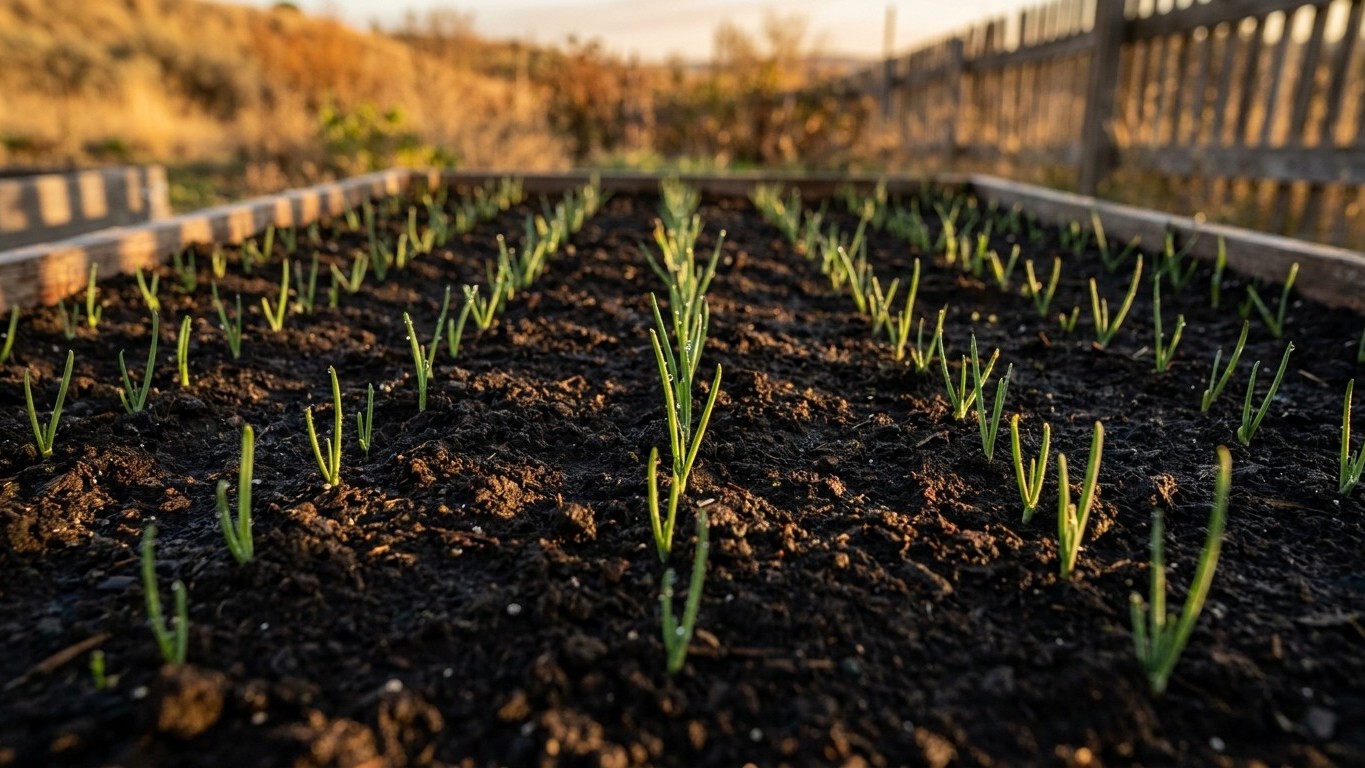

Garlic in Minnesota gets eaten on two schedules. From planting through winter, voles, mice and squirrels dig at the bed, and wireworms chew into cloves in the soil. From spring through midsummer, maggots work at the base of the plant and thrips rasp the leaves. Most of the damage is preventable, and most of the prevention happens in the fall.
The short answer for Minnesota
The calendar starts with the first fall frost, which in the Twin Cities falls between October 11 and October 23, based on the 30-70% freeze-probability band in the NOAA NCEI 1991-2020 Climate Normals. Garlic planted around that window sits in the ground through winter, is lifted the following summer, and meets its pests in a predictable order.
That date is a midpoint, not a safe date. In one year out of two, the frost arrives later than the middle of the band, so a bed planted “after the frost” can still be planted into a warm, bug-friendly October. The Twin Cities are also the mild south of the state. Northern Minnesota runs two to three weeks tighter at both ends, which pulls the whole pest calendar earlier.
Here is the sequence that follows from the frost date:
- Fall, at planting: squirrels dig up freshly turned soil, and wireworms and nematodes already in the bed go to work on cloves.
- Winter under mulch: voles and mice tunnel where the cover keeps the ground softer and warmer than the surrounding lawn.
- Spring, as soil warms: maggot flies lay eggs near the base of young plants.
- Early summer, before lifting: thrips build up on leaves, especially in hot, dry stretches.
Planting time moves with the frost, and so does what finds your garlic. Plant early, and warm soil keeps soil pests active longer. Plant late, and cloves have less time to root before the ground locks up. If you want the planting side worked out in detail, the When to Plant Garlic in Minnesota: Counting Back From the First Frost page covers it.
Working it out for your own garden
A state is not one climate, so the arithmetic is worth doing yourself. Start with the Twin Cities window of October 11 to October 23. For a garden in the far north, subtract the two to three weeks the facts attribute to that region. October 11 minus three weeks lands around September 20, and October 23 minus two weeks lands around October 9. So a northern garden should expect its first frost somewhere between roughly September 20 and October 9, with the same midpoint caveat: half of all years run later.
Turn the frost date into a pest calendar
Once you have your own frost window, work forward from it. Planting follows the frost, and mulching follows the ground freezing, which comes later. The gap between planting and mulching is when rodents are least interested in your bed, because there is nothing warm to nest in yet. Putting mulch down while the soil is still workable gives voles a cozy shelter weeks before they would have found one on their own.
Then work back from lifting. Garlic planted in autumn is lifted the following summer, so the plants stand in the garden through every spring pest. A bed that loses a few plants to maggots in May is a bed you could have protected in April, with row cover over young shoots or by choosing a spot where onions, leeks or garlic have not grown recently. That means a four-season record is more useful than a pest spray. A simple notebook entry for each bed (what grew there, where cloves were damaged, when) tells you more about your soil than any general guide can.
What local conditions shift
Three things move your dates by as much as a couple of weeks either way. Elevation matters, since higher ground cools faster on clear nights. A large body of water matters, because Lake Superior holds heat into fall and delays frost on the shore while keeping spring cool. And the built-up heat of a city keeps downtown and inner-suburban yards a little warmer than open farmland a few miles out. If your own records show a frost date outside the Twin Cities band, trust your records. They describe your yard, and the normals describe a weather station.
What changes across Minnesota
The Twin Cities sit at the mild end of the state, and the NOAA station behind these figures is in that metro area. Gardeners in the southern counties and in the river valleys in the southeast generally live on a similar calendar, with a longer stretch of workable fall soil. That also gives wireworms, nematodes and seed-eating squirrels more time to find a new planting before the ground freezes.
Northern Minnesota, including the Iron Range, the Arrowhead and the border counties, runs two to three weeks tighter at both ends. Frost arrives sooner and spring is slower to start. For pests, that means a shorter window of soil activity in fall, but a longer cold season in which rodents lean on mulch and snow cover. Snow is an insulator. A deep, early snowpack over a mulched bed gives voles a protected corridor all winter, and you will not see the damage until the shoots fail to appear in spring.
The North Shore of Lake Superior is its own case. The lake keeps temperatures steadier there than inland, so the shoreline can feel milder than the same latitude a few miles uphill. Drive inland and up, and the calendar tightens again. That is one reason a single “northern Minnesota” date is unreliable.
Varieties matter here too, though they are not a pest fix. Hardy types that tolerate a long cold winter are the ones that make sense in the north, and the Garlic Varieties That Suit Minnesota Winters page goes through them. For the broader picture of the crop in this state, start with Growing Garlic in Minnesota. If you are comparing with the Deep South, where the whole logic runs the other way, the Mississippi pages on When to Plant Garlic in Mississippi: Counting Back From the First Frost and Garlic Varieties That Suit Mississippi Winters show how different the calendar looks there.
The mistakes this climate punishes
Planting too early is the first one. In a warm October, cloves that sprout before winter send up green shoots that cold, wind and rodents can strip back. Cloves need roots, not top growth, going into the freeze. Because the frost date is a midpoint, a calendar date like “mid-October” is no guarantee. Watch soil and weather, not the day on the wall.
Planting too late is the opposite error. Cloves that go in just before the ground locks up have little time to anchor. Frost heave then pushes shallow, poorly rooted cloves up toward the surface over a Minnesota winter, where squirrels and birds find them easily and cold finishes the job. Planting at a proper depth, with firm soil over the clove, protects against both heaving and digging.
Mulching too soon is a mistake you pay for in spring. Straw or leaves put on while the soil is still warm shelters mice and voles before they have anywhere else to go. Wait until the surface begins to freeze. If you have had vole damage before, use a thicker layer of loose, airy mulch only after the ground is hard, and think about guarding the bed with hardware cloth in a trench around it.
Planting where sod just came out is a common way to hand wireworms a feast. These soil-dwelling larvae thrive in turf and grassy ground and chew into the cloves. A bed that has been cultivated for a season or two before garlic goes in is a safer bet.
The last one is replanting garlic you are unsure about. Bulb and stem nematodes can travel in infected seed stock, and once they are in a bed they are very hard to remove. Distorted, swollen, soft-looking plants are the warning sign. Buy clean seed garlic from a reputable grower, and do not plant cloves from bulbs that showed those symptoms. Grocery-store garlic is not a good substitute for seed stock. It may not be adapted to Minnesota winters, and you do not know where it came from.
Checking this against your county
The frost figures above describe one station in the Twin Cities, so your county may differ. For local frost dates, soil advice and pest identification, the University of Minnesota Extension is the place to start. Bring a damaged plant or a photo of the symptoms, because a nematode problem and a maggot problem call for very different responses.
Common questions
When are garlic pests most active in Minnesota?
There are two peaks. One runs from planting through winter, when rodents and soil insects go after cloves and young shoots. The other comes in spring and early summer, when maggots and thrips attack the growing plants. Both are tied to the first fall frost, which in the Twin Cities falls between October 11 and October 23.
Do deer eat garlic?
Garlic is not usually a favorite, and its strong smell tends to put browsing animals off. The animals that dig, such as squirrels, voles and mice, cause far more trouble in Minnesota beds than the ones that browse.
Is a frost date safe to plant on?
No. It is a midpoint, so in one year out of two the first frost comes later than the date you are counting on. Use it as a guide for when to start watching the soil, not as a guarantee that conditions have changed.
How can I avoid nematodes in my garlic?
Start with clean seed garlic from a reliable source, and keep records of which beds have shown distorted or swollen plants. Do not replant cloves from infected bulbs. For a diagnosis, take a sample to your county office of the University of Minnesota Extension.