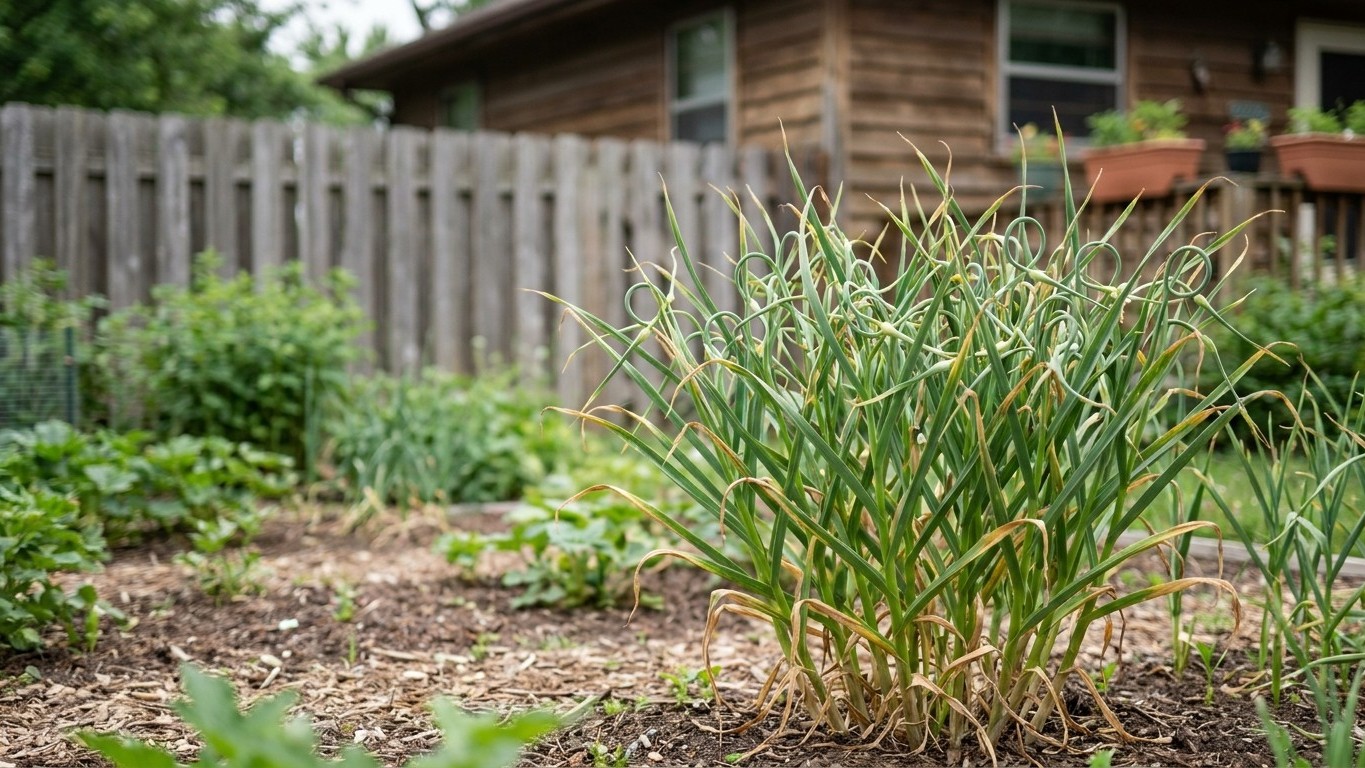

Garlic does fine in your Minnesota yard, and the cold isn’t the part you need to worry about — hardneck garlic actually wants a real winter, it’s what splits the bulb into cloves you’ll harvest later. What decides whether next year’s crop is good has already happened by the time snow flies: it’s when you got the cloves into the ground this fall. So go plant hardneck varieties like German Red or Duganski sometime between mid-September and early October, aiming to beat your area’s first hard freeze by a few weeks. Get that timing right and the winter takes care of itself.
The short answer for Minnesota

NOAA’s 1991-2020 climate normals for the Minneapolis-St. Paul station put the first fall freeze at October 11 to October 23. That is a midpoint window, not a guarantee: in roughly half the years on record, the freeze arrives later than the range, so treat these dates as a planning anchor rather than a hard deadline. Every variety here goes into the ground mid-September to early October, ahead of that freeze window, so cloves have time to root before the soil locks up for winter.
The bigger decision for Minnesota is not the calendar, it’s neck type. Hardneck garlic tolerates cold winters better than softneck, and ten of the fourteen varieties worth growing here are hardneck types: Bavarian Purple, Blue Music, Chesnok Red, Duganski, Fall Festival, Georgian Crystal, Georgian Fire, German Red, German White and Ivan. The four softneck options, Early Red Italian, Inchelium Red, Italian Late and Lorz Italian, still grow here, but they suit a milder microclimate or a grower who wants longer storage more than extra cold tolerance.
That Minneapolis figure is measured at one station in the mild south of the state. A grower elsewhere should treat it as a starting point, not a local truth, which is exactly what the next section works through.
| Variety | Type | Set-out window |
|---|---|---|
| Early Red Italian | Softneck | Mid September to early October |
| Inchelium Red | Softneck | Mid September to early October |
| Italian Late | Softneck | Mid September to early October |
| Lorz Italian | Softneck | Mid September to early October |
| Bavarian Purple | Hardneck | Mid September to early October |
| Blue Music | Hardneck | Mid September to early October |
| Chesnok Red | Hardneck | Mid September to early October |
| Duganski | Hardneck | Mid September to early October |
| Fall Festival | Hardneck | Mid September to early October |
| Georgian Crystal | Hardneck | Mid September to early October |
| Georgian Fire | Hardneck | Mid September to early October |
| German Red | Hardneck | Mid September to early October |
| German White | Hardneck | Mid September to early October |
| Ivan | Hardneck | Mid September to early October |
Working it out for your own garden
Counting back from your local frost date
Start with NOAA’s 1991-2020 climate normals for the weather station nearest your own garden, not the Minneapolis figure, since the Twin Cities sit in the mildest part of the state. The arithmetic behind the mid-September to early October planting window is simple subtraction: counting back from a first-frost range of October 11 to October 23 lands you roughly two to four weeks earlier on the calendar, which is exactly where that window falls. If your own weather station reports a first-frost range that runs a week or two earlier than Minneapolis’s, shift your planting window the same amount earlier. Don’t wait for a date that was calculated for a different city.
What shifts the window on your own site
Lake Superior’s North Shore runs measurably milder into fall than the interior of the Arrowhead region, because open water releases stored summer heat as the air cools. A garden a few miles inland from Duluth can see its first freeze land a week or two behind a garden on the Iron Range at a similar latitude. Elevation works the other way: a low-lying garden in a river valley collects cold air on clear nights and frosts before a hillside garden nearby, sometimes by more than a week. None of this shows up in a single climate-normal figure, which is why the Minneapolis number in this article is a starting point, never a verdict on your own yard.
The practical fix is a personal frost log. Note the date of your garden’s first hard frost for three or four years running, and use that instead of a regional average once you have it. Until then, lean toward the earlier end of the mid-September to early October window if your site sits in a frost pocket, and toward the later end if you garden inside a city’s heat island or close to open water.
For the fuller week-by-week countdown from frost date to planting day, When to Plant Garlic in Minnesota: Counting Back From the First Frost works through the same arithmetic in more detail.
What changes across Minnesota
Minnesota’s growing season runs longest in the southeast, around the Twin Cities and Rochester, and shortest across the Arrowhead and the northern border counties near International Falls and the Iron Range. NOAA’s 1991-2020 climate normals come from the Minneapolis-St. Paul station, which sits in the mildest part of the state; northern Minnesota runs two to three weeks tighter at both ends of the season, meaning fall frost arrives earlier and the ground stays workable for a shorter stretch in spring.
Regions that run ahead of the Twin Cities figure
That gap matters more for garlic than for a quick summer crop, because garlic sits in the ground through the entire winter. A grower near Duluth or on the Iron Range should plan to get cloves in the ground on the early side of the mid-September to early October range, since the region’s own first frost lands ahead of the Minneapolis figure. A grower in the Red River Valley in the northwest faces a similar squeeze from open, wind-exposed farmland with little tree cover to buffer cold snaps, even though the latitude alone wouldn’t predict as tight a window as the Arrowhead.
Regions with more room to work
Southern Minnesota, from the Twin Cities down through Rochester and the Mississippi bluff country, has the most room to work with. A late finish to a warm September there rarely threatens fall garlic planting the way it can farther north, and a grower in that part of the state can lean toward the later end of the planting window without much added risk.
Soil varies enough across the state to shift practical timing by a few days either way. The heavier clay loams common in the southeast hold moisture and warmth longer into fall, while the sandier ground of central Minnesota’s outwash plains cools and drains faster. Neither difference is large enough to push a grower out of the mid-September to early October window, but it can decide whether you plant at the early or late edge of it.
The mistakes this climate punishes
The costliest mistake in Minnesota is planting a softneck variety and expecting hardneck-level cold tolerance, or the reverse: choosing a hardneck for a warm microclimate where a softneck like Inchelium Red or Lorz Italian would store longer with no drawback. Since ten of the fourteen catalogue varieties suited to this state are hardneck, most growers here default to hardneck without thinking it through, and lose out on the extra shelf life a softneck offers where the site runs mild enough to support one.
Timing errors that cost a bulb crop
Planting too early lets shoots emerge above ground before winter, which then get damaged by the first hard freeze and weaken the bulb the following summer. Planting too late, especially once the ground has begun to freeze, doesn’t give cloves enough time to root before dormancy sets in, and a poorly rooted clove is far more likely to heave out of the soil during a freeze-thaw cycle. Planting too shallow compounds both problems: a clove set only an inch or two deep is more exposed to frost heave regardless of when it went in.
- Setting cloves in the ground while soil is still warm from summer, ahead of the mid-September to early October window
- Waiting until after the ground has started to freeze to get a late shipment of seed garlic into the soil
- Planting too shallow, which leaves cloves exposed to frost heave through winter thaw cycles
- Skipping a winter mulch layer in an open, wind-exposed garden with little snow cover to insulate the soil
Seed stock quality matters as much as timing. Buying uninspected or unknown-origin garlic for planting can introduce soilborne disease regardless of how well the climate suits the crop. UC IPM’s guidelines for onion and garlic (UC ANR Publication 3453) note that white rot, caused by the pathogen Sclerotium cepivorum, is active where soil temperatures run 50 to 75°F, and fusarium basal rot, caused by Fusarium oxysporum f. sp. cepae, is active from 59 to 90°F. Minnesota’s mean air temperatures fall inside both ranges during four months of the growing season, September plus May, June and July, though air temperature is not soil temperature, and a monthly average hides plenty of warmer and cooler days within it. Neither figure means the disease is guaranteed here, and neither means it’s absent outside those months. The surest protection is planting certified disease-free seed garlic rather than saving cloves of unknown health from a previous crop. Southern blight and pink root, by contrast, favor much warmer soil, 86 to 95°F and 75 to 85°F respectively, ranges that Minnesota’s growing-season air temperatures don’t reach on average, which makes both a lower risk here without ruling them out.
Checking this against your county
Every figure in this article comes from a single station, Minneapolis, and a state is never one climate. Before you commit a full bed to a fall planting date, check your own county’s numbers against University of Minnesota Extension, which maintains county-level guidance and can point you toward a weather station closer to your own garden than the Twin Cities figure used here. Growing Garlic in Minnesota lays out the full planting-to-harvest sequence.
A five-minute call to your county’s extension office is cheaper than replanting a bed in November because the local frost window ran earlier than the statewide figure suggested.
Common questions
Can I plant garlic in Minnesota in spring instead of fall?
Not with good results. Garlic needs a cold period before active growth starts, and the fall planting window used throughout this state is built around giving cloves that exposure before the ground freezes. A clove tucked into spring soil skips most of that cold exposure and typically forms a small round bulb with no separate cloves, rather than a full head. If you missed the fall window, hold your seed garlic in a cool, dry spot and plant it the following fall instead.
Is it too late to plant if I missed early October?
Not necessarily. The mid-September to early October window is calculated from Minneapolis’s average first frost of October 11 to October 23, according to NOAA’s 1991-2020 climate normals, but that date is a midpoint, and roughly half of all years run later than it. Cloves planted into mid-October in a year with a late frost can still root before the ground locks up. What actually rules out planting is the ground freezing solid, not a date on the calendar.
Do I need to mulch garlic over a Minnesota winter?
Most growers here do, especially in an open site with little natural snow cover. A layer of straw or shredded leaves buffers the soil against the freeze-thaw swings that heave shallow cloves out of the ground, and it matters more in years with a thin or late snowpack than in years with steady cover from December on.
Can I plant garlic from the grocery store?
It’s not a good idea. Grocery garlic is rarely labeled by variety, so you have no way to know if it’s a hardneck suited to Minnesota’s cold or a softneck bred for a warmer growing region, and it’s sometimes treated to slow sprouting, which also slows the rooting a fall-planted clove needs to do before winter. Buying named seed garlic from a supplier that states the variety and its neck type removes that guesswork.