
Honolulu’s coldest month still averages a daily low of 66.8°F, according to NOAA’s 1991-2020 Climate Normals. Water in a sprinkler line needs 32°F to freeze, and in the parts of Hawaii where people live and garden, it never gets there. The mainland ritual of a fall blowout mostly does not apply. A smaller, year-round maintenance routine does, along with one situation where the old rule comes back.
When to do it in Hawaii
Lowland Hawaii has no first fall frost to count from, so there is no winterizing window to circle on a calendar. The mainland rule, before the first hard freeze and not after the first light one, only matters where a freeze can happen, and NOAA’s 1991-2020 Climate Normals for the Honolulu station record zero days per year at or below 32°F.
The same dataset is blunter than that. For every freeze percentile at 32°F and at 36°F, NOAA’s calculation returns a not-computable flag, because there is no freeze date to build a percentile from. No freeze occurs in inhabited areas. Frost shows up only on the high volcanic summits (Mauna Kea, Mauna Loa and Haleakala), never where anyone is running a hose or a zone valve.
The USDA Plant Hardiness Zone Map 2023 lists Hawaii at 9a-13a. That figure is a territory-wide range built on one variable, the average annual extreme minimum temperature, and it says nothing about when to drain a pipe. Honolulu is the reference city here, and other parts of the state differ. The direction of the difference is predictable, though. Higher ground runs colder, so anyone with equipment near the summits, such as a remote water tank or a caretaker’s spigot, would act earlier in the fall than anyone at sea level, and would follow the first-hard-freeze rule exactly as a mainland owner does.
For everyone else, skipping the blowout is not the same as doing nothing. The decision to write down: replace the fall blowout with a fall check of the controller schedule, the heads and the valve boxes. That check pays off in any month, and a reasonable time to do it is when the weather shifts from the drier stretch to the wetter one, since that is when water use on the property changes most.
A short version of that check:
- Run each zone by hand and watch for geysers, tilted heads, and spray that hits the house or the street.
- Reset the controller to match the rain your side of the island actually gets. Windward and leeward sides can differ a lot, and a summer schedule left running through a wet spell wastes water and feeds fungus.
- Test the rain sensor, if you have one, by pressing it or soaking it as the maker directs.
- Open each valve box lid and look for standing water, cracked fittings and insects.
- Pull hoses off the spigots and coil them out of the sun.
Rainfall, elevation, and windward versus leeward exposure govern outdoor water use here, not frost. If you want to see how the mainland approach works for comparison, the guide to Winterizing Outdoor Faucets Before the First Freeze lays it out. For more on the islands, see the Hawaii guides.
Sprinkler lines: drain or blow out
Water expands when it turns to ice, and a sealed pipe has nowhere to put the extra volume. In a sprinkler system the weak points give way first: the plastic fittings, the valve bodies, the backflow assembly and the heads themselves. The split often happens on the first night of the freeze, but nobody sees it until the system is turned back on and water sprays out of a crack in the pipe. That is why mainland owners clear the lines before the first hard freeze. The water has to be out before the cold arrives, not after.
Three ways to clear a line
Manual drain systems have a small valve at the low points of the pipe run. You open them, gravity pulls the water out, and you close them again in spring. Automatic drain valves do the same job by themselves: when line pressure drops, a spring-loaded valve opens at each low point and lets the water out. A compressed-air blowout pushes the water out through the heads, one zone at a time, using an air compressor connected to the system.
| Method | How it works | Where it fits |
|---|---|---|
| Manual drain | Low-point valves opened by hand, gravity does the work | Cold-winter systems built with sloped lines |
| Automatic drain | Valves open on their own when pressure falls | Cold-winter systems, usually left to run without attention |
| Compressed-air blowout | Air pushes water out of each zone through the heads | Cold-winter systems where lines are level or hold water |
None of the three is required for a system sitting where the Honolulu normals apply. With a coldest-month minimum averaging 66.8°F and no days at or below 32°F, the water in your lines stays liquid all year. Draining a working system also has a cost: it dries out parts that are meant to stay wet, and restarting it can introduce air that makes valves chatter. For lowland Hawaii, the decision is to leave the lines full and not schedule a blowout at all.
The air method also carries a risk that gets little attention. A compressor pushing air through plastic pipe and heads at too high a pressure can crack fittings, blow apart a head, or damage a valve diaphragm. Contractors who do this work use regulated pressure and clear one zone at a time. It is another reason not to run a blowout on a system that does not need one.
A professional is the sensible choice in a few situations. If a property sits high enough on the volcanic slopes that frost is a real possibility, a licensed irrigation contractor can assess the layout, mark the low points and decide between a drain and a blowout. The same goes for a vacation home that will sit empty, a system with a pump or a backflow assembly you are unsure how to isolate, or a system that has lost pressure for no clear reason. A hidden leak under a lawn looks the same on the water bill whether it comes from cold or from age.
The off-season job that matters more in Hawaii is leak hunting. UV light, mower strikes and root pressure break more heads and fittings here than any freeze. A zone that runs for a few minutes and leaves a permanently soggy patch is telling you something. So is a controller showing that every zone ran on a day it rained.
Outdoor faucets and hoses
On the mainland, the faucet routine takes about ten minutes. Disconnect every hose from every spigot, close the interior shutoff valve that feeds that line, then open the outside tap to let the remaining water drain out. Leave the outside tap open until spring so that any water left in the pipe has room to expand. That is all it takes, and it is also all a homeowner should do. Cutting pipe, replacing a spigot or tracing a line inside a wall is a plumber’s job.
A frost-free faucet is built with a long stem so that the valve seat sits well inside the warm wall, and the barrel is sloped to drain outward. But a hose left attached keeps the water in the barrel, because the water cannot run out through the spout. The trapped water can freeze and split the pipe behind the wall, where the damage stays hidden until the tap is turned on in spring. The design only works when the faucet is free to drain. The guide to Frost-Free Outdoor Taps covers how these faucets are built, and the one on Frozen Pipes covers what to do when the worst happens.
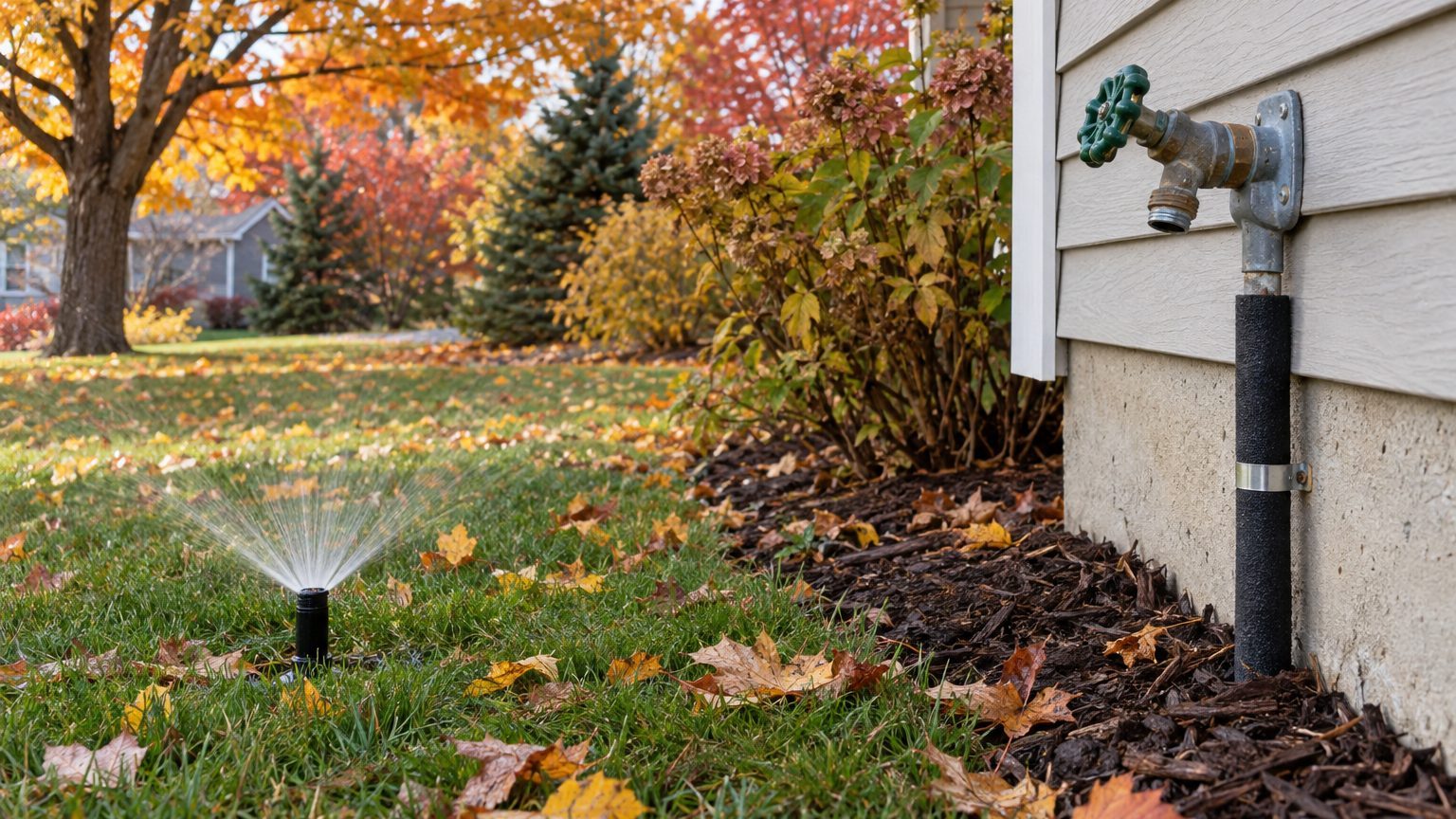
In lowland Hawaii, none of that is a freeze concern. NOAA’s normals for Honolulu show no days per year at or below 32°F, so the water in a spigot or a supply pipe does not freeze. Yet the hose habit is worth keeping anyway, for other reasons. A hose left connected and exposed to sun gets stiff and cracks, and it keeps constant pressure on the spigot, the washer and the vacuum breaker. A hose that is lying in the grass holds a small pond of stagnant water.
The decision to write down: pull the hoses off the spigots at the change of season, and close the interior shutoff valve if you are leaving the house for an extended trip. It is a valve turn, nothing more. A closed interior valve means a failed washer or a cracked hose cannot run for days unnoticed, which can be a bigger cost than any cold snap.
Anyone with a spigot near the summits, where frost does occur, should treat the faucet the way a mainland owner would. Disconnect first, then close the interior valve, then open the outside tap to drain, all before the first hard freeze. Beyond turning those valves, call a plumber.
What goes wrong here
The early cold snap that wrecks mainland yards before anyone has drained a line does not happen in lowland Hawaii. The coldest month still averages a daily low of 66.8°F at the Honolulu reference station, and frost belongs to Mauna Kea, Mauna Loa and Haleakala. The nearest equivalent is a property near those summits where an owner assumes the island’s mild reputation applies and leaves a hose on a spigot. If a pipe does split there, spring shows it as a stream of water inside a wall or a wet patch under the foundation, so close the valve and call a plumber.
The forgotten hose is the failure you are far more likely to meet. Left connected for months, it sags with water, goes stiff in the sun, and develops a pinhole near the fitting. In spring it looks like a spray against the siding or a faucet that drips steadily from the handle. The fix is a habit, not a repair: take hoses off, drain them, and coil them in shade. A cracked hose costs little, but the damp stucco or a rotted trim board behind a leaking connection costs a lot more.
The valve box that floods is the quiet one. Heavy rain fills the box, the water has no outlet, and the solenoids and wire splices sit submerged. In spring, it shows up as a zone that will not shut off, a zone that never turns on, or a box that smells like swamp. Standing water in a box can also breed mosquitoes. The fix to put on the calendar is a look inside every valve box at the change of season, clearing debris, making sure the bottom has gravel or a drain, and noting any fittings that look cracked.
Last on the list is the controller still set to the dry-weather schedule while rain falls on the property every few days. The signs are mushrooms, moss in the beds, and a bill that doesn’t match what the yard needs. A rain sensor and a seasonal reset solve most of it. For the grass side of the story, the guide to Winterizing a Lawn explains the cold-season prep that Hawaii mostly skips.
Common questions
Do I need to winterize my sprinkler system in Honolulu?
No. NOAA’s 1991-2020 Climate Normals for the Honolulu station show zero days per year at or below 32°F, and the coldest month’s average daily minimum is 66.8°F. A full blowout is unnecessary there. A fall check of heads, valves and controller settings is the useful substitute.
Is there any part of Hawaii where freezing is a real risk?
Frost occurs only on the high volcanic summits: Mauna Kea, Mauna Loa and Haleakala. NOAA’s data show no freeze in inhabited areas. If you have plumbing or an irrigation line high on those slopes, act before the first hard freeze, not after the first light one.
What does the USDA hardiness zone say about when to winterize?
Very little. The USDA Plant Hardiness Zone Map 2023 gives Hawaii a range of 9a-13a, built on the average annual extreme minimum temperature. It shows which plants can survive, not when to drain pipes. For Honolulu, the NOAA normals are the better guide, and other parts of the territory differ.
Should I still take hoses off my outdoor faucets?
Yes, though freezing is not the reason. Disconnecting hoses protects them from sun damage, relieves constant pressure on the spigot and keeps stagnant water out of the line. Closing the interior shutoff valve is a good move before a long trip. Anything beyond turning valves is work for a plumber.