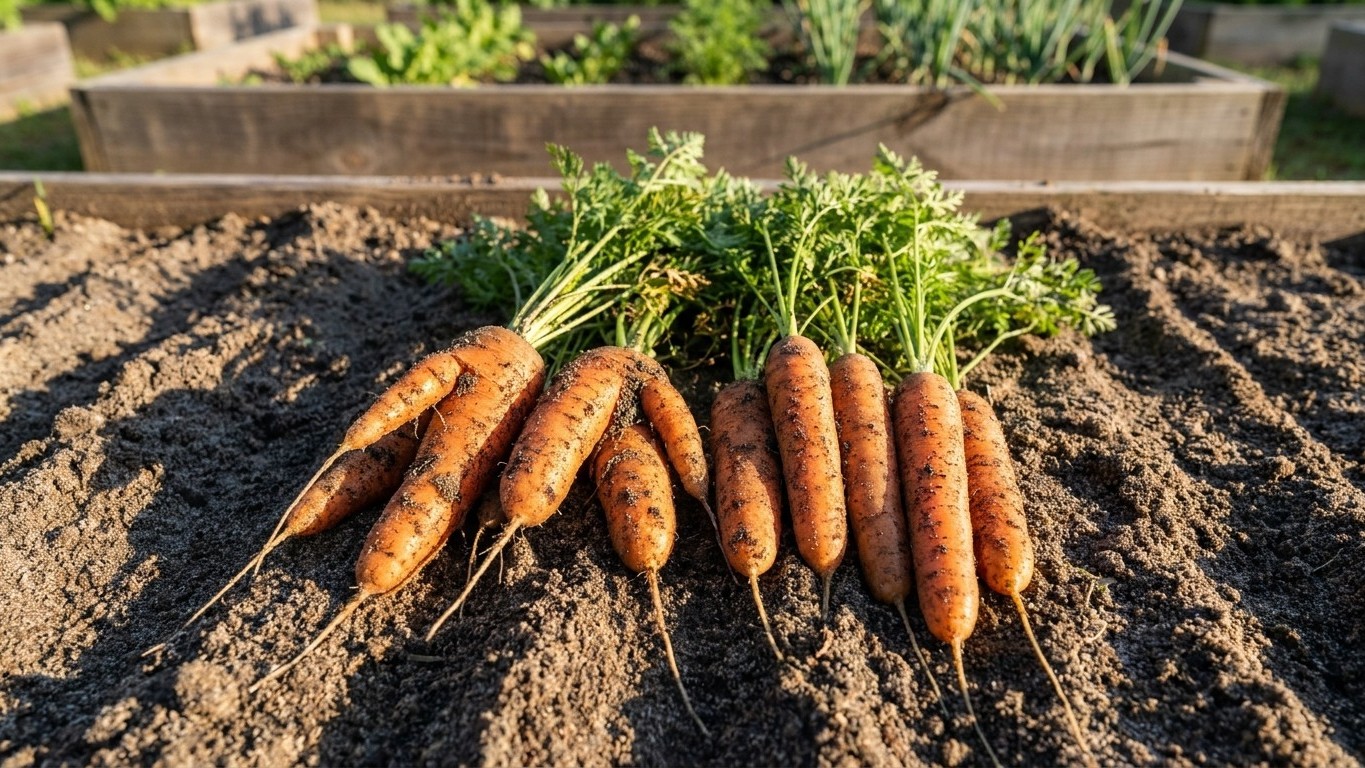

Count 70 to 100 days from the day the seed goes in the ground. Carrots are sown in place and never transplanted, so seeding is day one. Clemson Cooperative Extension puts harvest at about 65 to 75 days after planting, which makes the low end of that spread a first check, not a promise. Twist the tops off right after pulling, then store the roots at 33 °F with high humidity. With tops on, they hold 10 to 14 days. Trimmed, they keep for months.
The short answer
What the state soil says
The soil USDA lists as representative of New Mexico is the Penistaja series, an Aridisol. That means a dry-climate soil, usually alkaline and often carrying salts. USDA’s Soil Data Access database records the surface layer of the series, averaged across 47 mapped components, at 69 percent sand, 15 percent clay and 16 percent silt. Organic matter sits at about 1.4 percent, surface pH is about 7.5 (alkaline), and the drainage class is well drained.
Set that against what Utah State University Extension says carrots want: deep, sandy, well-drained soil rich in organic matter. Heavy or rocky soil makes the root fork. Two of those three boxes are checked by the Penistaja numbers. Sand dominates, water moves through, and nothing in the texture suggests the dense, sticky ground that bends a taproot. The box left empty is organic matter. At 1.4 percent, this ground holds little water and few nutrients on its own.
Will a carrot fork in it?
Not because of the texture. A carrot sown in ground like this has a clear path downward, so forking is the exception, not the rule. The caution is that these figures describe the mapped surface of one series, not a worked garden bed, and the pH is the series’ pH, never yours. A state spans hundreds of soil series. Treat Penistaja as a starting point, not a diagnosis. River bottoms, hill country, and any lot a builder has scraped or filled can behave nothing like it.
Where your ground turns out heavier or stonier than the state soil, Utah State’s advice is plain: work in plenty of compost and double dig. Double digging means loosening the layer below the topsoil as well, so the root meets no hard floor. If digging that deep is unrealistic, because of hardpan, rock, or just a bad back, a raised bed filled with loose, compost-rich mix solves the same problem from above. Switching varieties does not. Neither source names a variety that shrugs off heavy soil, so don’t buy your way out of a drainage problem.
Even in sandy ground, a little compost earns its keep. It helps a low-organic soil hold moisture between waterings, which matters for the splitting problem covered below. If carrots are new to you, the broader picture is in Growing Carrots in New Mexico, and the soil question gets its own treatment in Will Carrots Fork in New Mexico Soil?
The test that settles it in your own garden
The state’s soil is not your soil, and an hour with a shovel tells you more than any map. Run these steps in the bed where the carrots will go, in the order given.
- Dig a hole about as deep as the carrot you plan to grow is long. The seed packet gives the mature root length. Set the soil from the hole on a tarp so you can look through it.
- Read the walls of the hole. Look for a change in color or texture, a hard layer where the shovel stops, or a band that looks packed. Any of those is where a root will bend or split in two.
- Count the stones. Sift a few shovelfuls through your fingers. Stones, chunks of caliche, and construction debris all turn a straight root into a crooked one. Pick out what you find, and note whether the pile is small or large.
- Feel the texture. Squeeze a handful of moist (not wet) soil. If it falls apart the moment you open your hand and feels gritty, it is sandy. If it holds a shape and feels slick or sticky, clay is in charge. Roll it between your palms: a soil that forms a long, smooth rope is heavy.
- Watch the water. Fill the empty hole with water and let it drain, then fill it again. Sandy ground drinks quickly. If water still stands in the hole long after the second fill, drainage is poor and a raised bed is the safer route.
- Send a sample to a lab. Your county Extension office can explain how to submit one. The result gives you your own pH, organic matter and salt reading, which no state average can.
Reading what you found
A loose hole with few stones and fast drainage means you are close to the Penistaja picture, and compost is the main job. A hard layer or a lot of stone means double digging or a raised bed. Slow drainage and sticky texture point to a raised bed first. This guide gives no number for how long water should take to drain, because none is published here. What counts is the comparison: if it stands visibly longer than it does in a sandy spot, treat the bed as heavy.
What goes wrong here
Soil and climate cause most carrot trouble in New Mexico in two ways, through what the ground does to the root and through what the weather does to the seed and the water supply. Each problem below carries its fix.
Problems that start in the ground
- Forking in heavy or rocky patches. Even where the state soil is sandy, a garden can hold clay pockets, caliche, or builder fill. Utah State Extension says heavy or rocky soil makes the root fork. The remedy is plenty of compost and double digging, or a raised bed filled with loose mix.
- Thin, fast-drying ground. With organic matter around 1.4 percent in the representative soil, sandy beds can dry out quickly. Work compost in before seeding and keep the seedbed evenly moist, since carrots are sown in place and cannot be replanted without starting the clock over.
- Salty, alkaline surface. Aridisols often carry salts, and the representative surface pH is about 7.5. The sources here give no carrot pH target, so rely on a lab test for your own numbers. If salts show up, ask the lab for guidance and water deeply instead of in light sprinkles.
Problems that start with weather and water
- Poor germination in a hot spell. Carrot seed is slow, and a baked surface crust can stall it. The facts here carry no soil-temperature cutoff, so work by observation: sow when the forecast has no stretch of extreme heat, water lightly and often until sprouts show, and keep the seedbed from crusting.
- Splitting from uneven water. A long dry spell followed by a heavy soak makes the root swell faster than the skin can stretch. Keep moisture steady with mulch, a drip line, or a regular schedule, and pull mature roots promptly rather than letting them sit through a swing.
- Storage loss from leaving the tops on. Leaves keep drawing moisture out of the root, so a bunched carrot wilts and softens fast. Cut the tops off first and the same root keeps for months instead of 10 to 14 days. Then hold it at 33 °F with high humidity. That is just above freezing, not a cellar temperature. At something like 50 °F, carrots sprout and go soft in a fraction of the time.
Roots lost to animals look different from roots lost to soil or weather. If tunnels or chewed shoulders turn up, What Eats Carrot in New Mexico, and When covers what to look for.
Common questions
How many days until I can pull carrots in New Mexico?
Count 70 to 100 days from seeding. Clemson Cooperative Extension says to harvest about 65 to 75 days after planting. A local frost date is not published in the sources used for this page, so check the date with your county Extension office instead of relying on a number from memory.
Do I really have to cut the tops off before storing?
Yes, and do it soon after pulling. The leaves keep drawing moisture from the root, which is why bunched carrots with tops on keep about 10 to 14 days and trimmed ones keep months.
What is the right storage temperature?
Clemson Extension says to store carrots at 33 °F and high humidity to prevent wilting. That is barely above freezing. A warm basement or garage will not match it, so confirm the temperature with a thermometer before committing a whole harvest.
Does the state soil tell me whether my carrots will fork?
It gives a starting point. The Penistaja series is sandy (69 percent sand), well drained, and low in organic matter, which suits carrots apart from the compost it lacks. But a state spans hundreds of soil series, and your bed may be heavier, stonier, or filled ground. The hole test above settles it.