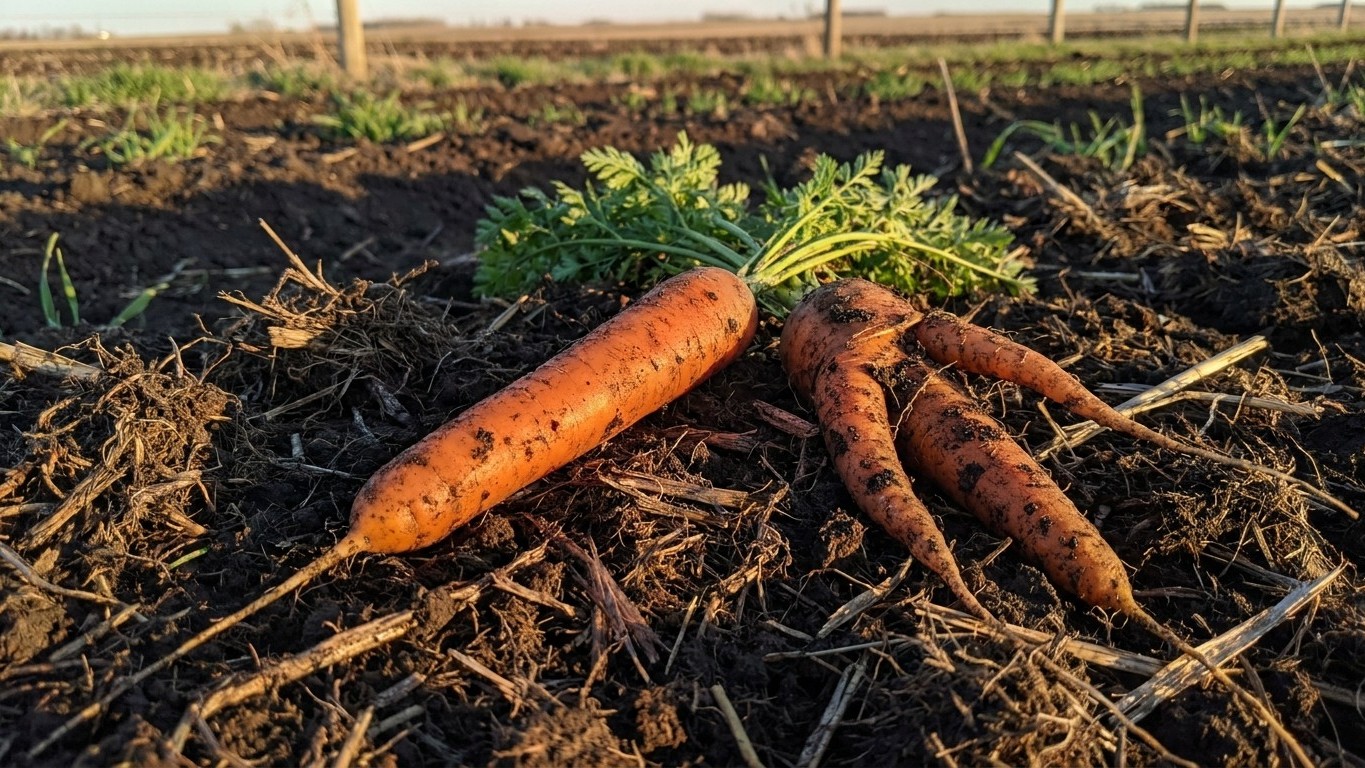

Count 70 to 100 days from the day the seed goes into the ground. Carrots are sown in place, so there is no transplant date to count from. Pull them when the shoulders have filled out to the size the seed packet promises. Then cut the tops off the same day and store the roots at 33 °F in high humidity. In North Dakota’s prairie loam, forking is the smaller worry, and warm storage does more harm.
The short answer
The soil USDA lists as representative of North Dakota is the Williams series, a Mollisol: the deep, dark prairie ground that made the Corn Belt. The surface layer runs 38 percent sand, 22 percent clay and 40 percent silt, which puts it in the loam to silt range. Organic matter sits around 4.0 percent, surface pH is about 7.2 (near neutral), and the series is well drained. Those figures are USDA’s representative values for the surface horizon of the series as mapped (549 components in the database), not a reading from anybody’s worked garden bed.
Will a carrot fork in it? Probably not, at least not because of the clay. Utah State University Extension says carrots want deep, sandy, well-drained soil rich in organic matter, and that heavy or rocky soil makes the root fork. Twenty-two percent clay is not heavy, and good drainage removes the main trigger. The 38 percent sand is a respectable share, though silt at 40 percent can set up like a crust when it dries. If a bed does turn out heavy, the answer is plenty of compost and double digging, or a raised bed. A different variety won’t fix it. The longer discussion lives in Will Carrots Fork in North Dakota Soil?
A caution belongs right here. A state spans hundreds of soil series, and the Williams series is a starting point, not a diagnosis. River bottoms, hill country and any lot a builder has scraped or filled can look nothing like it. The next section gives you a way to find out what your own bed is doing.
Pull by the count, then by the root
Because the clock starts at seeding, write the sowing date on a plant tag or in a notebook. Clemson Cooperative Extension puts harvest at about 65 to 75 days after planting, and the wider 70 to 100 day span reflects how much carrot types differ. Your packet’s days-to-maturity number is the one to trust, counted from the day of seeding.
The count is a guide, and the root has the final say. Brush the soil from the top of one carrot and check the shoulder width against the packet. A gap of a week or two on either side is normal. If you are unsure, pull one and taste it. This page carries no fall frost date, so look up your own area’s before planning a late harvest, and don’t leave a crop in the ground on a guess. For the full growing calendar, see Growing Carrots in North Dakota.
Why the tops come off first
Clemson’s advice is to store carrots at 33 °F and high humidity to prevent wilting. Bunched carrots, meaning plants with the tops still on, keep for about 10 to 14 days. Trimmed ones keep for months. The tops are the catch. The leaves keep drawing moisture out of the root long after it leaves the soil, so a carrot with its greens attached is slowly drying itself out. Cut the tops off first, and wait no longer than the day you pull.
Note the number, too. 33 °F is just above freezing. It is the temperature of a good refrigerator’s crisper drawer, not of a typical cellar. At 50 °F, a carrot sprouts and goes soft in a fraction of the time.
The test that settles it in your own garden
Your bed is not the state’s average, and a half hour with a spade tells you more than any map. Do these in order, ideally when the soil is damp but not soggy.
- Dig a test hole. Push a spade in where the carrots will go and lift out a clean block. Then go deeper with a digging fork. You are checking how far the loose, workable soil actually goes, because a carrot root needs a clear path straight down.
- Look at the layers. Dark, crumbly topsoil that fades gradually into lighter ground is a good sign. A sharp line, with a hard pan or a layer of rubble underneath, is where roots tend to split and twist.
- Count and note the stones. Break up the block and pick out what you find. Stones, buried bricks and chunks of old construction fill are exactly what forks a root. Their size matters as much as their number.
- Feel the texture. Squeeze a damp handful. If it holds a tight, shiny ball and rolls into a long ribbon between thumb and finger, clay is doing the work. If it falls apart gritty, you have sand. A soft, floury, silky feel points to silt, which is what the Williams series leans on.
- Watch the water. Fill the hole, let it drain, then fill it again and watch. Water that vanishes quickly means well-drained ground. Water still standing the next day means heavy soil or a compacted layer, and that is when a raised bed becomes the better plan.
- Send a sample for a lab test. Feel and drainage tell you about structure. They don’t tell you pH or nutrients. Your county extension office can point you to a soil test, and that gives you your own number. This page doesn’t state a pH for your garden, and the 7.2 above belongs to the mapped series.
If the hole passes, sow in place and keep the bed loose. If it fails on stones or drainage, build the bed up instead of fighting the ground. Either way, you will know before the seeds go in rather than after the roots come up crooked.
What goes wrong here
North Dakota’s ground is kind to carrots, but its weather is not always. These are the failures that tend to show up, with a fix for each.
- Forked or stubby roots. Heavy clay, buried stones and compacted layers all make the root split. Loosen the bed deeply with double digging, work in plenty of compost, and pull out stones. Where the test hole drained badly, a raised bed is the better answer. Forking is also affected by pests in some cases, and What Eats Carrot in North Dakota, and When covers the damage that can be mistaken for it.
- Poor germination in a hot spell. Carrot seed is slow and small, and a silty surface can seal into a crust under sun and heat. Keep the seedbed evenly damp until the seedlings are up, water lightly and often rather than deeply once a week, and shade the row with a board or a layer of burlap until sprouts appear. Check under it daily so you don’t smother them.
- Splitting from uneven water. A dry stretch followed by a soaking rain makes the root swell faster than its skin can stretch. Mulch the row to hold moisture steady, and water on a regular schedule through dry weather. Pulling a split carrot early and eating it first is better than leaving it to rot.
- Roots that go limp in storage. Tops left on, a dry fridge or a warm room all pull moisture out of the root. Cut the tops at harvest, keep the roots in high humidity, and hold them at 33 °F. A damp (not dripping) wrap helps in a household refrigerator.
- Sprouting and softening in a cellar. A cellar that sits near 50 °F is too warm for carrots. Roots there sprout and go soft much faster than the 33 °F target allows, so check with a thermometer before you commit the harvest to it.
Common questions
How many days from seeding until I can pull carrots?
Plan on 70 to 100 days from seeding, and read your packet for the exact count. Clemson Cooperative Extension gives about 65 to 75 days after planting. Carrots are never transplanted, so every count starts on the day the seed goes in the ground.
How long will carrots keep after I pull them?
Clemson Extension says bunched carrots, with the tops still on, keep for about 10 to 14 days at 33 °F and high humidity. Trimmed carrots keep for months under the same conditions. The difference is the greens, which keep drawing moisture out of the root.
Do I really need to cut the tops off?
Yes, and do it the day you pull. The leaves draw water from the root while they are attached, and the root wilts. Leave a short stub of stem so the crown isn’t cut into, and wash only if you plan to eat the carrots soon, since dirt holds up better than wet storage.
Is my garden soil like the Williams series?
It may be, and it may not. The Williams series is the one USDA lists as representative of North Dakota, but a state spans hundreds of soil series. Use the dig-and-drain test in your own bed, and send a sample to a lab for a pH number. Be aware that the 7.2 near-neutral surface pH quoted above belongs to the mapped series.