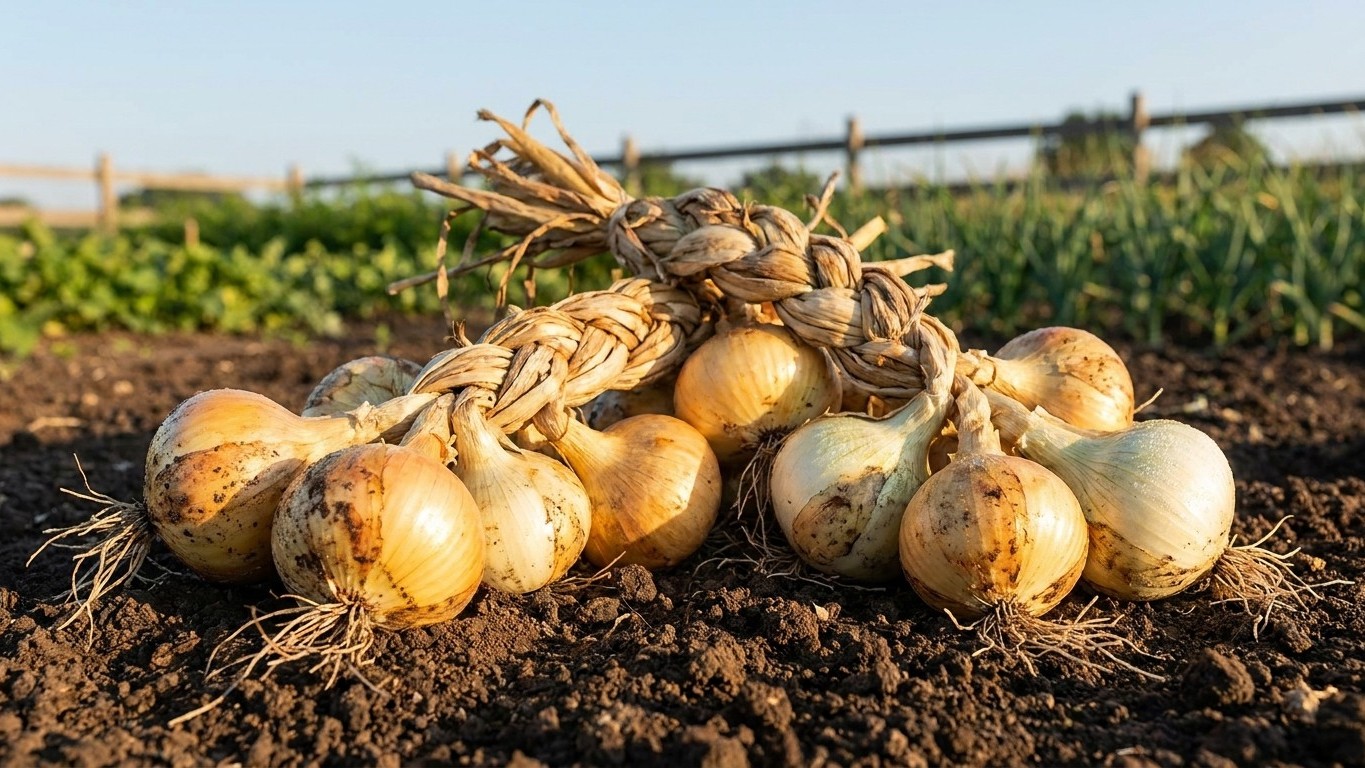

Lift onions in Maryland once the tops have turned yellow and flopped over, then cure them somewhere dry and airy until the necks are tight and the skins rustle like paper. Only then do they go into storage. The calendar is a poor guide, because onions don’t watch dates. They watch the length of the day, and Maryland’s days are long enough to finish most onions in summer. Pull them by the date on a seed packet and you lose either bulb size or keeping time.
The short answer for Maryland
The figures here come from Baltimore, at 39.17 degrees north, where the longest day of the year gives 14 h 45 of daylight. That number is calculated from the latitude with a geometric horizon, so it leaves out the roughly seven minutes of extra light that atmospheric refraction adds. It matters because bulbing is triggered by day length, not by warmth. According to Clemson Cooperative Extension, a short-day onion starts to bulb at about 12 hours of light. A long-day onion holds off until the day reaches 14 to 16 hours.
Put Baltimore against those thresholds and the harvest picture comes into focus. Days pass 12 hours in spring, so short-day types start swelling early and are ready first. The day tops out at 14 h 45 near the June solstice, which is inside the long-day range but only near the bottom of it, so long-day types get their trigger late and finish later. Both groups end the same way, with a bulb that stops growing and leaves that give up. That collapse is your signal, not a date.
Reading the tops
When the necks soften and the tops fall over, the plant has stopped moving energy into the bulb. Most gardeners wait until a majority of the tops are down, then stop watering for the last stretch so the outer skins can start drying in the ground. Pick a dry day. Loosen the soil with a fork, lift the bulbs rather than yanking them by the tops, and leave the tops attached. Cutting green leaves early opens the neck, which is the easiest way for rot to get inside.
Curing before anything else
Curing is not optional. Spread the bulbs in a single layer, or hang them in loose bunches, in a spot with moving air, shade and a roof, such as a covered porch, a garage with the door cracked, or a shed with a fan. Direct afternoon sun can scald the bulbs. Skip the calendar here too. The test is the neck: when it is tight, with no give when you squeeze it, and the outer skins are papery, the onion is cured. Trim the roots, cut the tops to an inch or so, and only then move the crop to storage. Clemson’s guidance for storage is 45 °F to 55 °F and 50 to 60 percent humidity.
For more on what grows well before any of this happens, see Onions in Maryland.
What will not work here
Late planting doesn’t delay the harvest. It shrinks it. Once day length triggers bulbing, the plant stops making new leaves, and the size it has reached by that moment is the size the bulb will be. Each leaf above the soil feeds one ring of the bulb. A transplant set out late, or one stunted by crowding, drought or leaf damage, has fewer leaves when the trigger arrives, and no amount of extra weeks in July will put them back. Onions don’t wait to catch up. The same goes for insects that chew leaves before bulbing, which is why What Eats Onion in Maryland, and When belongs on the same shelf as this page.
Several common habits fail at this latitude, and they fail in predictable ways:
- Waiting for a variety that needs more than 14 h 45 of daylight. Baltimore’s longest day never gets that long, so the plant keeps making leaves all season, never forms a real bulb, and then rots in the ground.
- Lifting by date. A planting calendar tells you when to start, not when to finish. Pulling before the tops fall gives you under-sized bulbs with wet, thick necks that will not cure.
- Storing straight from the ground. Uncured bulbs carry moisture in the neck and skin, and rot spreads from there to the rest of the crate.
- Keeping a sweet onion for winter. Sweet types are low in the compounds that protect bulbs in storage, so they soften and sprout well before spring.
- Sharing a cellar with carrots. Roots want cold and damp, and onions want 50 to 60 percent humidity. Put them together and one of the two crops loses.
The first item is a variety problem, which is covered in The Best Onion Varieties for Maryland. The rest are timing and handling problems, and all of them can be fixed with a little patience.
What changes across Maryland
Maryland is not one latitude. The state runs from the Pennsylvania line in the north to the Southern Maryland and Lower Eastern Shore counties in the south, a spread of less than two degrees of latitude. That is small next to a state like Texas, but a degree of latitude changes the longest day by a few minutes, and it changes the weather more. The figures above belong to Baltimore. Exact latitudes and day lengths for other Maryland towns are not published here, so the table shows direction rather than numbers.
| Where | Latitude | Longest day | What it changes |
|---|---|---|---|
| Baltimore (reference city) | 39.17 degrees north | 14 h 45 | Baseline for every figure on this page |
| Northern border counties and the west | Higher than Baltimore; check your own | Slightly longer; exact figure not published here | Long-day types get their trigger a little sooner; cooler springs can push the whole harvest later |
| Southern Maryland and the Lower Shore | Lower than Baltimore; check your own | Slightly shorter; exact figure not published here | Day length reaches the trigger later for long-day types, so short-day types fit better |
Daylight is only half of it. Weather decides how the harvest actually plays out. A wet June makes curing harder in any part of the state, and a garden at the southern end of the Bay will usually see tops fall earlier than one on the northern line. So treat Baltimore’s numbers as an anchor. If you garden near either edge, you may be a week or two off the reference city, and the tops will tell you before the calendar does.
Sweet now, or onions that last
Maryland’s middle position forces a choice. The bite of an onion comes from volatile sulfur compounds, and those same compounds are what protect the bulb in storage. A sweet onion has fewer of them. That makes it better raw and worse in the pantry. The University of Missouri Extension puts it plainly: “As a rule, ‘sweet’ onions do not store as well as the more pungent types.” No amount of careful curing turns a sweet onion into a keeper.
The day-length pattern lines up with the chemistry. Short-day types run sweeter, long-day types keep longer, and that is why southern gardens give you onions to eat soon, while northern ones give you onions that feed you into March. Maryland sits between the two, so you can grow either, but you should decide in spring which job each row is doing.
Here is what the pantry looks like in March. A crate of well-cured pungent onions, held at 45 °F to 55 °F and 50 to 60 percent humidity, will still be firm, with dry papery skins and the odd sprout to cull. A crate of sweet onions from the same garden will have been eaten by September, or it will be a soft, sprouting mess that you are scooping out of the bottom. If you want both, plant both and eat the sweet ones first. Never plan on a sweet onion that stores, because that one doesn’t exist.
Checking this against your own garden
Baltimore’s numbers are a starting point, not a verdict on your yard. A garden in Garrett County, on the Lower Shore or in the Southern Maryland counties can differ from the reference city in both day length and weather. Nothing on this page is a frost date, and the frost dates for your town are not published here. Here is what to verify this week:
- Your own latitude. Look up your address on any mapping tool and compare it with 39.17 degrees north. If you are well away from Baltimore, expect your day length to be a little different.
- Your local frost dates. Ask your county’s University of Maryland Extension office for the averages for your town, not the state as a whole.
- The variety’s day-length requirement. Check it against the 14 h 45 longest day. If it needs more, don’t plant it.
- Your curing spot. Find a shaded, roofed place with moving air, and check that it stays dry after a rainstorm.
- Your storage spot. Put a thermometer and a humidity gauge there now, and see whether it holds 45 °F to 55 °F and 50 to 60 percent humidity. Many basements are too damp.
The Clemson storage guidance is online at the Clemson Home & Garden Information Center.
Common questions
How do I know when onions are ready to lift in Maryland?
Watch the tops. When the necks go soft and most of the tops have fallen over and begun to yellow, the bulbs have stopped growing. Lift on a dry day and leave the tops on for curing.
How long does curing take?
There is no set number of days, because weather changes it. The test is the neck, which should be tight, and the outer skins, which should be dry and papery. Wet weather slows curing, so move the bulbs under cover if rain is coming.
What is the best way to store onions after curing?
Keep them dry and cool, at 45 °F to 55 °F and 50 to 60 percent humidity, with plenty of air around them. A mesh bag or an open crate works better than a sealed container. Keep them away from carrots and other roots that need damp storage.
Why do my sweet onions rot before winter?
Sweet onions have fewer of the sulfur compounds that protect pungent onions in storage. Eat them first, and keep the sharper bulbs for winter.