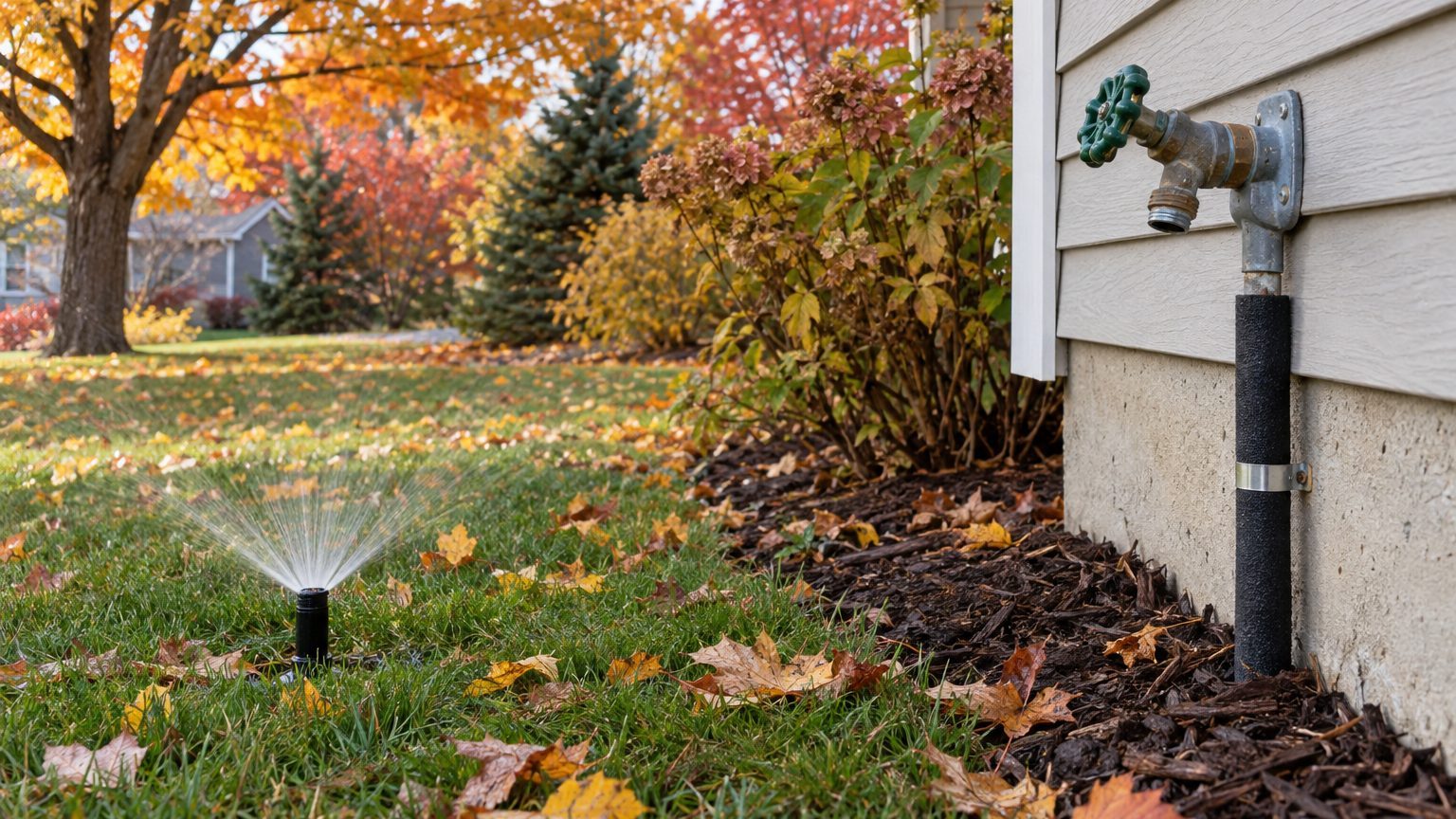

Connecticut’s coldest month brings an average overnight low of 24.4°F at Bridgeport, according to NOAA’s 1991-2020 Climate Normals, and that station sits in the mildest part of the state. Water trapped in a sprinkler line or a faucet stem has nowhere to go at that temperature. The job isn’t optional here. What you can adjust is the calendar, and the calendar depends on one event: the first hard freeze.
When to do it in Connecticut
Finish before the first hard freeze, not after the first light one. NOAA’s 1991-2020 Climate Normals for Bridgeport (station USW00094702) put the first 32°F freeze of fall inside a window of October 28 to November 10, the band where the probability runs from 30 to 70 percent. Plan to be done before the October 28 to November 10 window opens, and sooner the farther inland or north you live.
Why the coast sets the latest date, not the typical one
Bridgeport is a Long Island Sound station, and the water keeps it warmer than almost anywhere else in the state. Inland towns and the northwest hills freeze noticeably earlier in fall. A homeowner in the northwest corner who reads the Bridgeport range as a deadline is already behind. Treat it as the outer edge, and pull your own date forward as elevation and distance from the shoreline increase.
The USDA Plant Hardiness Zone Map (2023 edition) lists Connecticut as 6a-7b. That system is built on the average annual extreme minimum temperature, so it describes how cold the worst nights get, not when the first one arrives. It does confirm the spread: the cold end of the state is meaningfully colder than the shoreline, and the fall timeline shifts with it.
Light frost versus hard freeze
A light frost is a night that dips to freezing for a short stretch and recovers by morning. Buried pipe usually shrugs that off, because the soil holds heat. The vulnerable parts are the ones above ground or near the surface, including hose bibs, exposed backflow assemblies and shallow heads. A hard freeze is a night that falls well below 32°F and stays there for hours, long enough to push cold through the soil and into the lines.
Waiting for the first light frost to remind you is a bad strategy. Frost normals describe probabilities, not promises, and some years the first real freeze arrives ahead of the band. Since a 24.4°F coldest-month average low is well below freezing, there is no shortcut in Connecticut. A full blowout is the standard, not an extra. Finishing early costs you nothing, because lawns slow down on their own in late fall. The same weeks are the right time to wrap up Winterizing a Lawn, so one weekend can cover both.
Sprinkler lines: drain or blow out
Water expands as it freezes, and a closed pipe has no room to give. The ice pushes outward from the inside, splitting PVC, cracking fittings and shearing the plastic bodies of heads. Valves are the worst case, since they hold small pockets of water behind diaphragms and solenoids. The damage stays hidden all winter and shows itself in spring when pressure returns.
Three ways to empty the system
A manual drain means opening drain valves at the low points of each zone and letting gravity do the work. It only works if the system was built with those valves and with lines that slope toward them. Automatic drain valves open on their own when line pressure drops and release water at the low spots. They are convenient, but they can stick with grit, and they cannot help water sitting in a flat or reverse-sloped stretch.
A compressed-air blowout pushes the water out through the heads, one zone at a time, using an air compressor connected at the blowout port. It is the only method that clears water from sections you cannot see. In a state where the coldest month averages 24.4°F overnight, it is the method this climate calls for. Drains help, but air is the sure thing.
How a blowout goes, and when to hand it off
The sequence is simple in outline. Shut off the water supply to the irrigation system, then relieve the pressure and drain the backflow preventer. Set the controller to off, connect the compressor and run each zone in short bursts until the heads spit mist rather than water. Never let air run in one zone for a long stretch, because dry spinning heads overheat and the pipes take the strain. Keep your face and body away from the heads while the air is on, and wear eye protection.
The pressure matters too. Too much can burst lines, blow fittings apart and wreck the heads, which is the very damage you are trying to avoid. Follow the limits for your pipe type and your compressor’s manual rather than guessing. Systems fed by a well pump need that pump drained as well.
Hire a professional when the stakes outrun your information. If you cannot say, zone by zone, where the low points are and where the shutoff sits, book a professional blowout before the freeze window opens. The same applies if you don’t own a compressor sized for the job, if the backflow preventer is complicated, or if the system was installed by someone who left no map. A blowout done wrong costs more than one done by someone else.
Outdoor faucets and hoses
This is the quicker job, and it asks for nothing beyond turning things. The order matters, so work through it the same way each fall.
The sequence
- Disconnect every hose, splitter, timer and sprayer from the outdoor taps.
- Find the interior shutoff valve for that line (often in a basement or crawl space) and turn it off.
- Go outside and open the tap fully so the remaining water drains.
- Leave the tap open all winter.
Drain each hose and coil it indoors or under cover. A hose left outside with water inside it freezes solid, and the ice can crack the hose and, if still attached, pull on the connection. The full routine, with extra detail for different faucet types, sits in Winterizing Outdoor Faucets Before the First Freeze.
Why a frost-free faucet still fails with a hose attached
A frost-free faucet carries its valve seat on a long stem, so the shutoff happens well inside the heated wall, not at the visible spout. When the faucet is closed, water in the barrel is supposed to run out through the spout. A hose screwed on blocks that. The barrel stays full, the outdoor portion of it freezes, and the ice can split the pipe. Nothing shows at first because the tap seems fine. The leak waits inside the wall until spring, when you open the tap and water sprays behind the siding. For how these faucets are built and why they run on a slight downward pitch, see Frost-Free Outdoor Taps.
That slope is one reason this job has a hard boundary. Shut the interior valve first, then open the outside tap and leave it open. Anything beyond turning valves, like re-pitching a faucet, replacing a stem or cutting into a line, is plumber’s work. The same goes for a tap that drips after you shut it, which usually means a worn part inside the wall.
Get this done before the October 28 to November 10 window opens at the coast, and earlier inland. An insulated cover over the tap is a reasonable extra layer, but it is never a substitute for disconnecting the hose.
What goes wrong here
Connecticut’s failures cluster around timing and forgetfulness, not around exotic plumbing problems. Three show up again and again.
The early cold snap before anyone has drained
The Bridgeport window of October 28 to November 10 is a coastal number, and a cold snap can land well before it, especially inland. A homeowner who was planning to drain the system “when it gets close” finds a night in the low twenties has beaten the plan. In spring the signs are a head that geysers, a zone that comes up weak, a wet stripe across the lawn or a pressure gauge that will not hold. Prevention is plain: treat the coastal range as the latest date, not the target, and finish early. A hard freeze that has already hit does not mean you can skip the drain. It means check for damage when you restart. If a freeze reached indoor lines too, Frozen Pipes explains what to look for.
The forgotten hose
One hose left on one frost-free tap is the classic. Nobody notices until the first warm spring day, when water drips inside the wall or stains the ceiling below it. Put a reminder on the calendar and check each outdoor tap by hand. It takes a few minutes and avoids a repair that opens up a wall.
The valve box that floods
The green lidded boxes in the lawn hold your irrigation valves, and they collect meltwater, groundwater and debris. If water sits in the box and the valves are not emptied, the winter freeze cracks bodies and solenoids. In spring the signs are a zone that will not shut off, a zone that will not start, or a soggy dip in the lawn near the box. A proper blowout empties the valves, and clearing silt and leaves out of the box helps it drain. Re-grading a box that floods every year is a job for an irrigation contractor.
In spring, open each valve box lid and look inside before you restore the water. Open the supply slowly, then run each zone in turn and watch the heads. If you want more local timing on other seasonal chores, the Connecticut guides cover them by season.
Common questions
Can I wait for the first frost in my yard before I start?
No. A first light frost often passes with no harm, and a hard freeze can follow within days or weeks. NOAA’s Bridgeport normals put the first 32°F freeze between October 28 and November 10 at the 30 to 70 percent probability band, and cold arrives earlier inland. Finish before that window.
Is the schedule the same on the shoreline and in the northwest hills?
No. The Bridgeport figures reflect a coastal station that NOAA’s data show to be among the mildest in the state. Inland and northwest Connecticut freeze noticeably earlier, so fall tasks like draining and blowouts move earlier there too.
Do automatic drain valves mean I can skip the blowout?
They reduce the risk but do not remove it. Valves can stick, and water can sit in sections that do not slope toward a drain. With an average coldest-month low of 24.4°F at Bridgeport, a compressed-air blowout is the margin of safety, and a professional can tell you whether your system really drains itself.
What if the freeze arrives before I have finished?
Finish anyway, as soon as the weather allows, and leave the water supply to the system shut off. Then check for leaks, wet spots and weak zones at spring start-up. Water in a line that froze and thawed without splitting still leaves the system vulnerable to the next freeze, so the drain remains worth doing.