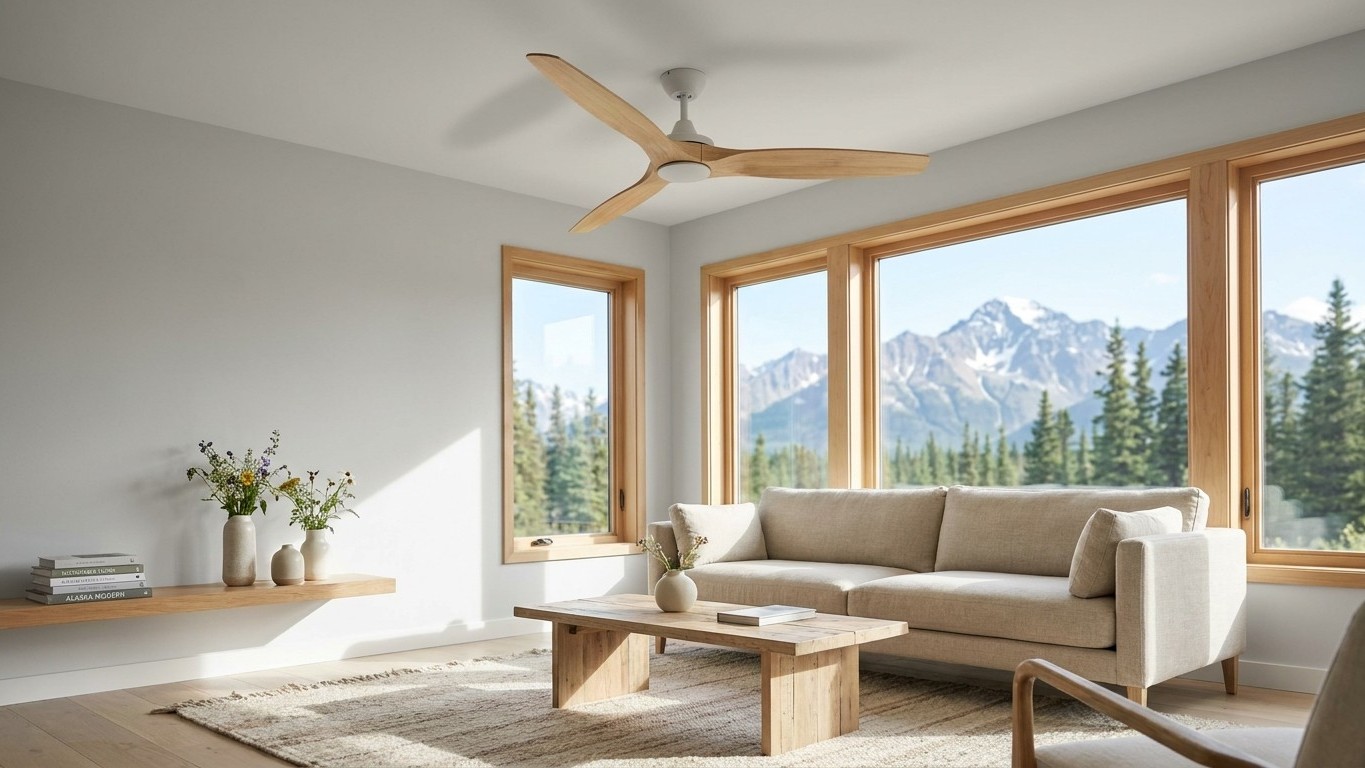

Air conditioning in Oregon is common but not universal, and it comes in two very different forms: ducted central systems and individual units that mount in one window or one room. Which kind a house has decides how it is sized, how it runs and what needs looking after. Below: what is installed, how much heat the year brings, what the summer rain says, and the upkeep that follows.
What homes in Oregon actually cool with
The U.S. Energy Information Administration’s Residential Energy Consumption Survey (RECS) 2020 puts 76% of Oregon homes on some form of air-conditioning equipment. A central unit serves 49% of homes. An individual unit, meaning a ductless mini-split, a window or wall unit, or a portable, serves 30%. Ceiling fans run in 57%.
Those shares don’t need to add up to the 76%. A home can have a central system and a window unit in the attic bedroom, so it counts in both lines. The survey publishes the individual-unit share directly, and that is the one to use.
Why does the split matter? The gap between “has air conditioning” and “has a central unit” is the share of homes running on individual equipment, and in some states that gap is the whole story. Connecticut has air conditioning in 90% of homes but central in only 34%. Alabama sits at 94% and 81%. Oregon falls between those poles: central is the larger share, but 30% on individual units is far from a rounding error.
Neighbors can read quite differently in the same survey. What Do Homes in Idaho Cool With? and What Do Homes in Montana Cool With? cover those states on the same footing, since the survey covers only the United States.
How much cooling the year actually asks for
The heat load for Oregon is 11.9 days a year reaching 90°F or more, from the NOAA 1991-2020 Climate Normals. That is a count of days at a single reference station (Portland), not an average temperature and not a statewide measure. It can’t speak for places far from Portland.
Equipment mix and heat load don’t always match. A state can be hot and run mostly on individual units, or mild and be almost entirely central. What’s installed follows when the houses were built and whether they already had ductwork, not how many scorching afternoons the weather produced.
Oregon doesn’t match neatly. A count of 11.9 hot days would not, by itself, predict that 76% of homes use air-conditioning equipment, and the 30% on individual units points to many houses cooled one room at a time. The likely explanation is housing stock and ductwork, plus the fact that a window unit is a cheap way to cover a handful of bad days. The figures here can’t tell us which houses are which.
The 57% with ceiling fans fits the picture. With a short hot season, moving air is often the first and sometimes the only line of defense.
Wet heat or dry heat, and what it changes
Summers here are dry. NOAA’s 1991-2020 normals for the Portland station show about 2.7 inches of rain across June, July and August, against 36.9 inches over the whole year. June brings 1.63 inches, July 0.51 and August 0.54, which makes July the driest month. These are normals for that station over thirty years, not a forecast.
That figure is inches of precipitation. It is not relative humidity or dew point, and I won’t convert it into either. How humid a given afternoon feels is a separate measurement this page doesn’t have.
The mechanism still matters. An air conditioner does two jobs: it lowers the temperature and it pulls moisture out of the air. Removing moisture takes run time, because water only condenses on the coil while air is moving across it. In a dry summer the machine’s work is nearly all temperature. In a wet one, a large share is drying, which is why an oversized unit leaves a house cold and clammy in a damp climate and is merely wasteful in a dry one.
Given a dry summer and a light heat load, here is what to prioritize:
- Sizing first. Oversizing is the costly mistake. A unit that is too big wastes energy on short bursts and wears itself out cycling.
- Run time second. Longer, steadier cycles beat frequent short ones. Let the unit settle in rather than resetting the thermostat several degrees at a time.
- Fan setting third. On most units, “auto” lets the fan stop when cooling stops. Constant fan can push moisture back into the room from the coil.
- Ceiling fans as a partner. With only a few very hot days, a fan lets you set the thermostat higher while the room feels comfortable.
Sizing a room unit, from the published chart
This is the question people actually type: what size unit for my room? ENERGY STAR publishes a cooling capacity chart for room air conditioners, reproduced here exactly as it appears at energystar.gov.
| Area to be cooled (square feet) | Capacity needed (BTU per hour) |
|---|---|
| 100 up to 150 | 5,000 |
| 150 up to 250 | 6,000 |
| 250 up to 300 | 7,000 |
| 300 up to 350 | 8,000 |
| 350 up to 400 | 9,000 |
| 400 up to 450 | 10,000 |
| 450 up to 550 | 12,000 |
| 550 up to 700 | 14,000 |
| 700 up to 1,000 | 18,000 |
| 1,000 up to 1,200 | 21,000 |
| 1,200 up to 1,400 | 23,000 |
Read it as a lookup, line by line. A 320-square-foot room sits on the “300 up to 350” line, so 8,000 BTU per hour. The chart stops at 1,200 up to 1,400 square feet, and it should not be stretched past that. It also can’t be boiled down to a figure per square foot, since the steps are not linear.
The chart is a starting point published by ENERGY STAR for a room unit. It is not a way to size a central system. With 49% of Oregon homes on central equipment, that point deserves saying plainly. A ducted system is sized by a load calculation done for the whole house, and no table of square footage replaces it.
Bigger is not safer. An oversized unit cools the room fast, shuts off, and never runs long enough to pull moisture from the air. With a dry summer and a light heat load, err toward the line that fits, not the line above it.
What actually needs looking after here
Start with the equipment mix. For the 30% of homes on individual units there are no ducts, so there is nothing to leak. A window or wall unit needs its filter cleaned, its sides sealed against the opening and its coil kept free of lint. A mini-split’s indoor filter needs the same attention.
For the 49% on central systems, the filter comes first. ENERGY STAR says: “Inspect, clean, or change air filters once a month in your central air conditioner, furnace, and/or heat pump.” That sentence covers all three pieces of equipment together, so a reader with a heat pump should not assume it’s advice for furnaces only.
The reason is airflow. ENERGY STAR states: “Airflow problems can reduce your system’s efficiency by up to 15 percent.” A system can be in perfect working order and still underperform, and a dirty filter is the cheapest cause to fix.
Ducts are the second central-system issue, and this caveat belongs only to ducted homes. From ENERGY STAR’s duct sealing guidance: “In a typical house, however, about 20 to 30 percent of the air that moves through the duct system is lost due to leaks, holes, and poorly connected ducts.” A room that never cools is not always a weak unit. The cool air may be leaking into an attic or crawlspace before it reaches the vent.
A seasonal pass, in order:
- Before the first warm spell: check or replace the filter, and clean the outdoor unit of leaves and debris if you have central air.
- Window and wall units: install them, then check that the seal around the frame is tight and the drain isn’t blocked.
- Ducted homes: look at any ductwork you can reach in an attic or crawlspace for sections that have come apart.
- Through summer: repeat the filter check monthly, in line with ENERGY STAR’s schedule.
- In fall: take out or cover window units, and switch your attention to the heating side, covered in Heating a Home in Oregon, since heat pumps and furnaces share that filter.
Common questions
What share of Oregon homes use air conditioning?
The 2020 Residential Energy Consumption Survey reports 76% of Oregon homes using air-conditioning equipment. A central unit is used in 49%, and an individual unit in 30%.
Does 11.9 hot days a year mean Oregon summers are mild?
It means that at the Portland reference station, the 1991-2020 normals show 11.9 days a year at 90°F or more. It’s a count of days at one station, not an average temperature, so it says little about other parts of the state.
What size window unit does a 320-square-foot room need?
On ENERGY STAR’s published chart, 320 square feet falls in the “300 up to 350” line, which lists 8,000 BTU per hour. That is a starting point for a room unit, not a calculation for a central system.
How often should I change the filter?
ENERGY STAR says to “Inspect, clean, or change air filters once a month in your central air conditioner, furnace, and/or heat pump.” For window units and mini-splits, follow the maker’s cleaning instructions, which usually point to regular filter care too.