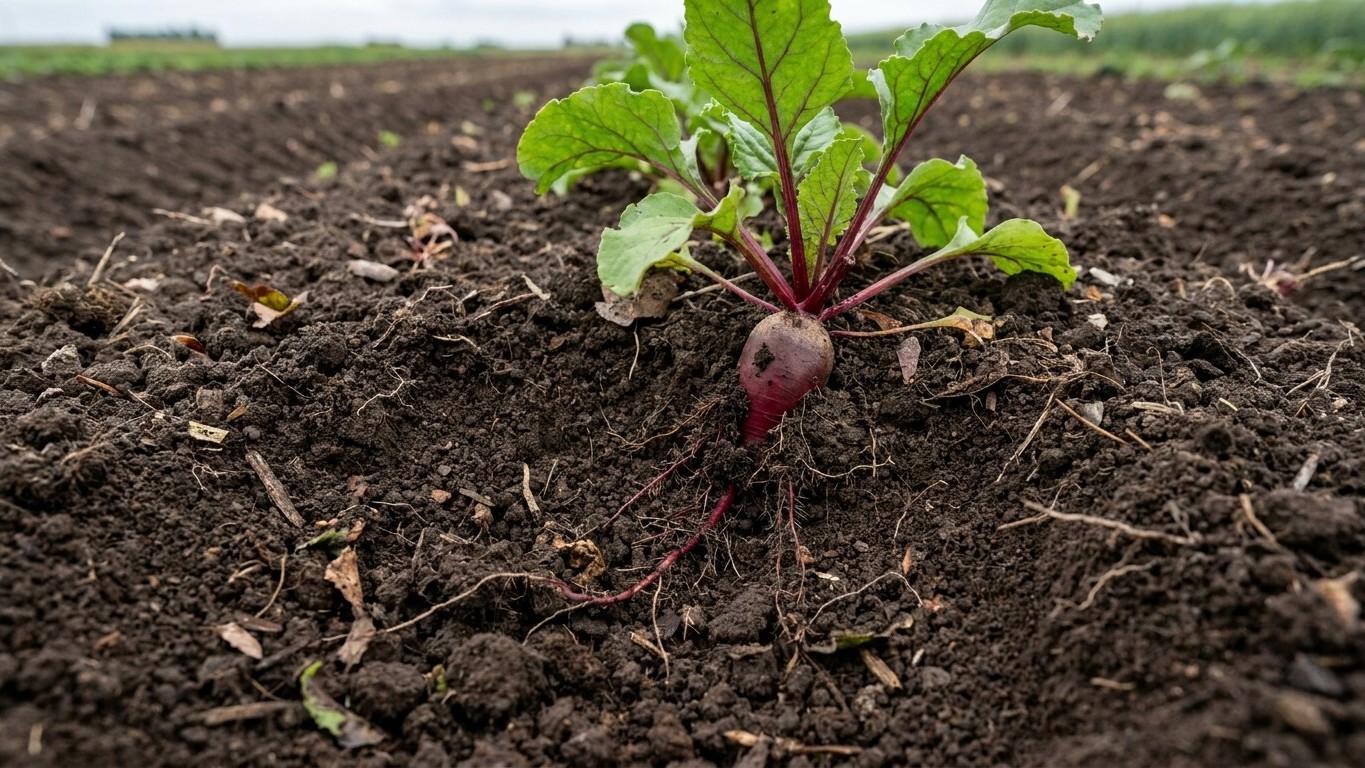

Pull spring-sown beets about 60 to 80 days after seeding, when the roots are the size you want to eat. In the Salt Lake Valley that lands between late May and early July, ahead of the worst heat. Storage runs against instinct. Topped roots keep best at 33 to 36 °F, and the standard 32 to 34 °F range actually produces more black spot and rot. Cut the tops off first, and save the biggest roots for the cellar. For the broader picture, see Growing Beets in Utah.
The short answer
Start with the ground. USDA lists the Mivida series as Utah’s representative soil, an Aridisol: a dry-climate soil, usually alkaline and often carrying salts. The representative surface values are 72 percent sand, 9 percent clay and 19 percent silt, with organic matter around 1.5 percent and a pH of about 8.1. It is well drained. Utah State University Extension describes the beet’s wish list as deep, sandy, well-drained soil rich in organic matter. Mivida meets the first and third parts of that and falls short on the middle one. Water runs through it quickly and the 1.5 percent organic matter holds little back, so a beet seedling here depends on whoever holds the hose.
Treat all of that as a starting point. Utah spans hundreds of soil series, and a river-bottom garden, a bench with hillside soil or a lot that a builder scraped and filled can look nothing like Mivida. The numbers above are USDA’s representative values for the mapped surface layer, not a reading from a worked garden bed, and 8.1 is not your pH until a test says so. Beet Soil in Utah: What the Root Will Meet covers how to read your own result. USU Extension is the authority to check it against.
Heat is the second half of the answer. The reference city here is Salt Lake City, and the number of days a year it passes 90 F is not published in the data behind this page, so I won’t guess at one. What the source does give is a threshold: heat above 85 F combined with water stress makes the root woody. Any 90 F afternoon clears that bar easily. Woodiness is a late failure, tied to hot weather arriving while the root is still swelling. It has nothing to do with the early failure of bolting, which the next section covers.
Beets are sown in place, so the 60 to 80 days count from seeding, never from a transplant. Pulling on time keeps the root out of the hot weeks. The cold part comes afterward. USDA Agricultural Handbook 66 puts topped beets at 33 to 36 °F and 98 percent relative humidity, and says plainly that storage at 32 to 34 °F brings more black spot and rot than slightly warmer air does. Most root crops reward the coldest spot you can find. Beets do not. The handbook’s full text is at the USDA Agricultural Research Service.
The six weeks that decide it here
Sowing two to three weeks before the last frost is the usual advice. For Salt Lake, the NOAA NCEI climate normals put the last spring freeze between April 12 and April 29, using the 30 to 70 percent probability band for a 32 F freeze. Count back two to three weeks and seeds go in somewhere from about March 22 to about April 15. Add the first six weeks and the critical window runs from late March through late May, depending on the sowing date. Add 60 to 80 days from seeding and the pulling window opens in late May and closes around the Fourth of July. That is arithmetic on the dates above, not a measured harvest record.
Salt Lake sits in a mild valley, and most of Utah does not. Higher towns have later last frosts and everything slides back with them. Southern Utah is warmer and everything slides forward. This page carries no frost date for your town, so find your own and count from it.
What a Utah spring does to a seedling
Spring here swings. A warm, bright afternoon can follow a frosty morning, and dry stretches, often with wind, can arrive in the middle of what the calendar calls the wet season. This is a dry-climate state, and a seedbed dries from the top down faster than it looks. On a sandy, well-drained soil like Mivida the swings hit harder, because there is little stored water to buffer them.
That is where the bolting risk sits. USU Extension says water stress during the first six weeks causes premature flowering. A plant that flowers early puts its energy into a seed stalk instead of a root. The danger zone is not summer. It is April and May, when the seedlings are small, the surface is crusting and nobody thinks of beets as thirsty. Check the bed, not the forecast, and water on a schedule you keep up through all six weeks.
Once those six weeks are over, the failure changes. The long days that follow bring the stretch of 85 F weather that can turn a swelling root woody if the water lapses again. Two failures, two windows, two different fixes. The early one is about steady moisture for a small plant. The late one is about finishing the crop before the heat peaks.
What goes wrong here
Most losses trace back to the sandy, fast-draining soil, the swinging spring or the storage conditions. In rough order of the season:
- Bolting from early thirst. Water stress in the first six weeks sends plants to flower. Remedy: keep the seedbed evenly moist from sowing through about week six, and check sandy beds more often than you think necessary.
- Woody roots from late heat. Temperatures above 85 F combined with water stress toughen the root. Remedy: sow early enough that roots size up before summer, pull on schedule and keep water steady if a hot spell arrives early.
- Thin, fast-drying soil. Organic matter near 1.5 percent holds little water. Remedy: add composted organic matter, but no more than 1 inch per 100 sq ft, per USU Extension, and test your own soil first.
- Storing too cold. A cooler held at 32 to 34 °F produces more black spot and rot. Remedy: aim for 33 to 36 °F with humidity around 98 percent, and keep pits or cellars between 31 °F and 41 °F.
- Leaving the tops on. Bunched beets with leaves keep 10 to 14 days at 32 °F and above 98 percent humidity, and no longer. Remedy: top them first for anything you plan to keep past two weeks.
- Storing the small ones. Small roots lose water and shrivel faster than large ones. Remedy: eat the small roots first and put the big ones away.
Leaf damage is a separate problem with separate causes. What Eats Beet in Utah, and When sorts those out by season.
Common questions
How many days from seeding until I can pull beets in Utah?
Plan on 60 to 80 days from seeding. Beets are sown where they will grow, so the count never starts from a transplant. For a seeding in late March to mid April in Salt Lake, that points to late May through early July. Higher, colder towns run later.
Does Utah’s state soil tell me what my garden has?
Not by itself. The Mivida series is sandy, alkaline and well drained, but the state has hundreds of soil series, and a garden near a river or on filled ground can differ completely. Use the Mivida numbers to see which way Utah ground tends to lean, then get a soil test for your own bed.
Is colder really worse for storing beets?
Near freezing, yes. USDA Handbook 66 reports more black spot and rot at 32 to 34 °F than at slightly warmer settings, and sets the target for topped roots at 33 to 36 °F with 98 percent humidity. Top them before storing, because bunched beets with the leaves on last only 10 to 14 days.
Which beets should I store and which should I eat first?
Store the large roots and eat the small ones fresh. Large roots shrivel more slowly because they lose water more slowly. In a pit or cellar, the handbook’s limits are no lower than 31 °F and no higher than 41 °F, so a cellar that swings below freezing on a Utah night is a bigger threat than one that runs a few degrees warm.