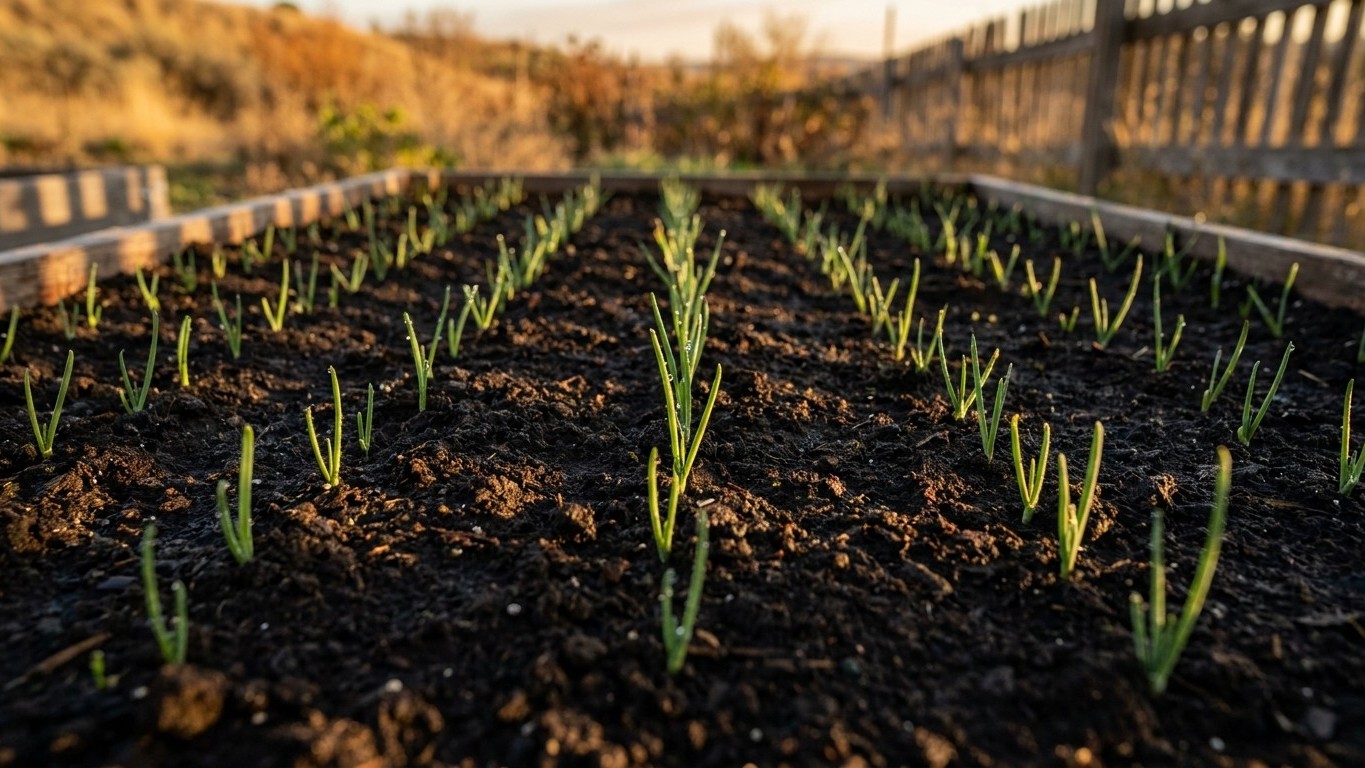

Voles and mice in the mulch. Wireworms and onion maggots in the soil. Thrips and wheat curl mites on the leaves, and grasshoppers in a dry July. That is the Montana roster, and each pest shows up at a different point in the garlic calendar. Garlic goes in during autumn and comes out the following summer, so the crop sits in the ground through every season a pest can exploit. Knowing the order of arrival tells you which defense to set up first.
The short answer for Montana
The clock starts at the first fall freeze. In Billings, that falls between October 1 and October 14, according to the NOAA NCEI 1991-2020 Climate Normals, which put the chance of a 32°F freeze in a band from 30 to 70 percent across that window. Pest pressure follows a sequence anchored to that date, and it runs in three waves:
- Autumn through winter: voles, mice and pocket gophers go after freshly planted cloves and the mulch that covers them.
- Spring thaw to early summer: wireworms, onion maggots and the stem and bulb nematode become active as the soil warms.
- Midsummer toward harvest: thrips, wheat curl mites and grasshoppers feed on leaves while the bulbs size up.
A frost date is a midpoint, never a safe date. In one year out of two the first freeze lands later than the window above, and a warm, open November gives rodents extra weeks to forage before snow arrives. Billings is also one of the milder valleys. Mountain valleys elsewhere in Montana can frost in any month, so the same pest calendar slides earlier or later depending on where your bed sits.
Why does the freeze matter for pests at all? Cold soil sets the schedule for almost everything underground. Insect larvae slow down or retreat deeper, rodents shift from foraging on open ground to tunneling under snow, and the garlic itself puts down roots, then stops. The pests aren’t following a date on the calendar. They’re following soil temperature, and the first freeze is the most reliable marker of when that temperature turns.
Working it out for your own garden
A state this size is not one climate, so the Billings window won’t fit every garden. The arithmetic is simple enough to redo for your own district, though.
Counting back from your first freeze
Start with the first-freeze midpoint for your nearest weather station. The county figure isn’t published here, and your local extension office can supply it (more on that at the end). Count back from that date to find your planting window, a method laid out step by step in When to Plant Garlic in Montana: Counting Back From the First Frost. Cloves need time to root before the ground locks up, and rooted cloves are far harder for a vole to pull out and a thaw to heave.
Next, mark two more points on the same line. The first is the day the ground starts to freeze, when you lay mulch. The second is the day the snow melts in spring, when wireworms and maggot flies start moving. A garden at higher elevation uses the same arithmetic and gets different answers: an earlier freeze, an earlier planting date, earlier mulch, and a thaw that arrives late. A garden beside a big lake gets the opposite shift, because the water holds heat into autumn and slows the spring warm-up. Elevation and large bodies of water can move these dates by weeks, which is why copying a neighbor two valleys over is risky.
Counting forward to harvest
Once the thaw date is set, count forward. Onion maggot flies lay eggs near the base of alliums in spring, and the larvae tunnel into the developing bulb. Thrips tend to build in hot, dry weather, scraping the leaves and leaving silvery streaks. Wheat curl mites feed in the leaf folds and can distort the foliage. Grasshoppers are less predictable, because their numbers swing with dry years, but they can strip leaves in a hurry when they hatch heavy.
Harvest comes the following summer, once the lower leaves begin to brown. That stretch, from the first browning to lifting, is when you should dig a test bulb and check for tunneling, soft spots or swollen, misshapen cloves. Anything you find now is something you’ll want to keep out of next year’s seed stock.
What changes across Montana
Montana’s pest calendar bends with its geography. The table below sorts the main zones by what moves their dates and what tends to follow.
| Area | What shifts the calendar | Pressure to expect |
|---|---|---|
| Yellowstone Valley around Billings | Lower elevation; first freeze in the October 1 to October 14 band | Longer autumn for rodents; wireworms in beds cut from sod |
| High mountain valleys (Gallatin, Big Hole, the West Yellowstone area) | Elevation and cold air pooling; frost possible in any month | Deep snow cover favors voles; short season leaves little margin to root |
| Flathead Valley | Flathead Lake slows both the autumn cool-down and the spring warm-up | Wetter springs suit onion maggots and slugs |
| Eastern plains | Wind, open ground and Chinook thaws followed by hard freezes | Grasshoppers in dry years; heaving cloves exposed to digging animals |
| Northwest corner (Libby area) | Heavy snowpack and cool, moist conditions | Long vole cover under snow; fungal problems alongside insects |
Two of those rows deserve a closer look. The high mountain valleys are the places where a Billings date does the most harm, because cold air settles into the bottoms and frost can show up when the rest of the state is still frost-free. Gardeners there should treat the Billings window as a ceiling, not a target. The eastern plains are the opposite problem: a Chinook can melt snow in January and drop temperatures hard a day later, and cloves that were planted too shallow or too late to root get pushed up into the open.
Comparing notes with gardeners in other states helps only so far. Nebraska’s plains winter doesn’t line up with a Montana mountain valley, so its pages on When to Plant Garlic in Nebraska: Counting Back From the First Frost and Garlic Varieties That Suit Nebraska Winters make a useful contrast for method, not a source of dates for your bed.
The mistakes this climate punishes
Montana winters are long enough that small errors in autumn become visible losses by June. The most common one is planting too late to root. A clove that goes in just before a hard freeze has no anchor, and repeated thaw and freeze cycles can push it toward the surface. Once exposed, it’s an easy meal for voles, mice and ground squirrels. Planting too shallow does the same thing slowly, and it also leaves the clove closer to the reach of pocket gophers working the upper soil.
Mulch is the second trap, and it’s an ironic one. A thick layer helps garlic ride out winter, but if you spread it while the ground is still warm, you hand rodents a ready-made nest. Wait until the soil has started to freeze, then mulch. Keep it away from the immediate stem area in spring so it doesn’t hold moisture against the shoots, where maggots and slugs like it.
Third, don’t replant garlic that carried trouble. The stem and bulb nematode travels inside seed cloves and survives in soil, and it produces stunted, yellowing plants with swollen, distorted bases. Start from clean seed, and choose a type proven in cold ground (the Garlic Varieties That Suit Montana Winters page covers that). If you find nematode symptoms, rotate that bed out of alliums for several years rather than hoping the problem fades.
Fourth, bed preparation. Ground recently converted from sod often holds wireworms, which chew into cloves and bulbs from below. Beds where onions grew the previous year can carry onion maggot pupae. Rotating to a new spot each year is the cheapest pest control Montana gardeners have, and a short break from alliums breaks the cycle for most of these.
Last, don’t dismiss a dry summer. Grasshopper numbers and thrips outbreaks both climb when the weather is hot and dry, and stressed garlic has less to give. Steady watering through bulb sizing keeps plants strong enough to absorb some damage. The overall point is simple: the garlic plan for Growing Garlic in Montana works best when pest control is built into the calendar from the first clove, not added after the first damage shows up.
Checking this against your county
Everything above treats Montana as a handful of broad zones, and your county may sit between them. For first-freeze dates by station, local pest alerts and diagnosis of damaged plants, contact your county office of Montana State University Extension. Bring a sample of the damaged leaf, bulb or soil if you can. Extension staff can tell you which pests are active in your area this season and whether a problem you found is an insect, a nematode or a disease.
Common questions
Do deer eat garlic in Montana?
Deer generally avoid garlic because of its strong smell, so garlic is rarely their first choice. They can still trample a bed or nibble young shoots when other food is scarce, and fencing meant for the rest of your garden will cover the garlic as well.
When is garlic most at risk from pests?
Two windows stand out. The first is the stretch from planting through winter, when voles, mice and gophers can take cloves. The second is spring through early summer, when maggots, wireworms and nematodes become active in warming soil. The exact timing depends on your elevation and your local first freeze.
How do I tell nematode damage from a nutrient problem?
Nematode-infested plants are typically stunted and yellow, with swollen, twisted stems and soft or cracked bulbs. A nutrient problem tends to look more uniform across the bed. If you suspect nematodes, have your extension office confirm it before you save any seed from that planting.
Can I replant cloves from my own harvest?
Yes, as long as the bulbs were clean. Skip any bulb with tunneling, soft spots, distortion or signs of mites or nematodes, and plant the healthiest ones in a new bed, not the one where they grew.