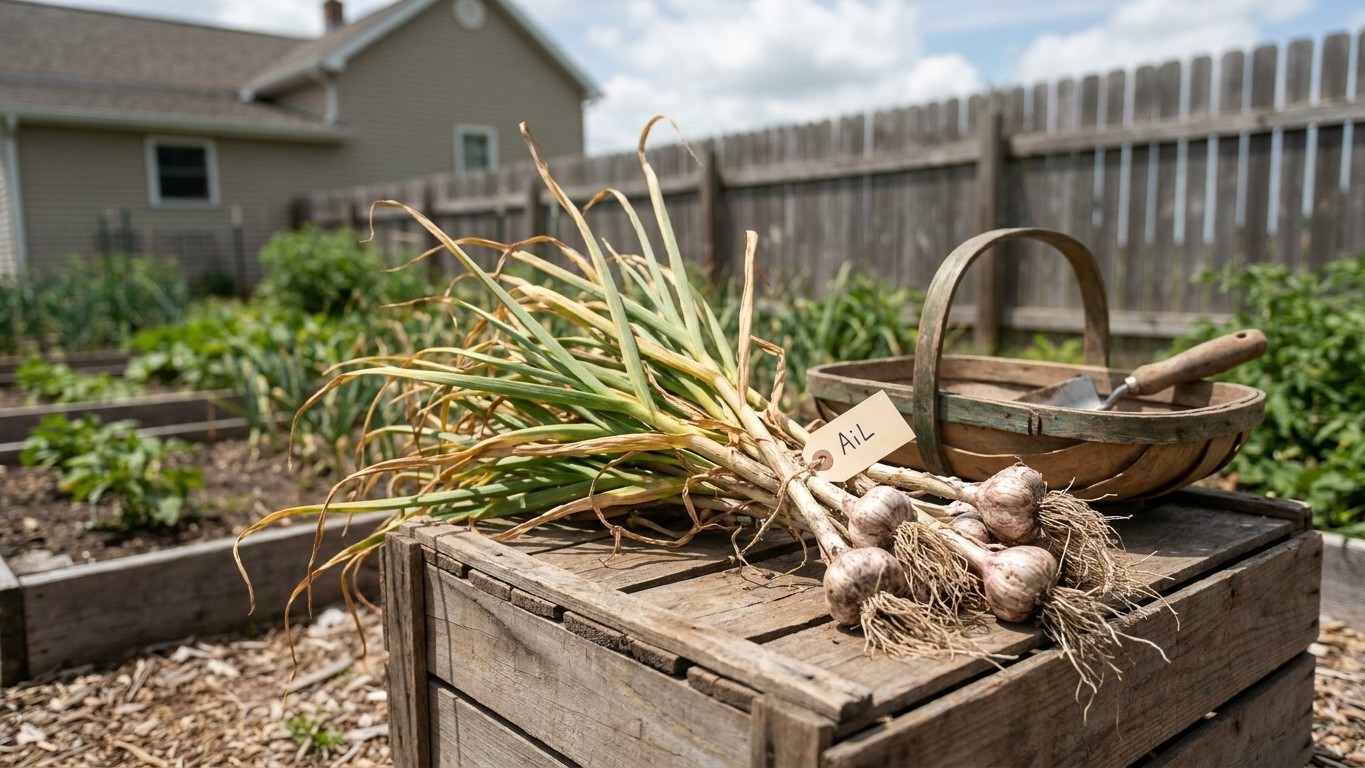

Garlic goes into Nebraska soil from late September to early October, a few weeks ahead of the season’s first hard freeze. NOAA’s 1991-2020 climate normals put that freeze, measured at Omaha, between October 15 and October 26, and the planting window is built around giving cloves root time before the ground cools, not around dodging frost itself. Check your county’s own frost record through UNL Extension before you commit to a date, since Omaha’s airport figure runs earlier or later than many rural gardens.
The short answer for Nebraska

Plant Garlic in Nebraska from late September through early October, whether you’re setting out a softneck type or a hardneck one. That window applies to every cultivar in the closed list below, because the reason for planting then has little to do with a single frost date and everything to do with giving the clove enough weeks of active root growth before soil temperatures drop too far for roots to work.
The anchor point is NOAA’s 1991-2020 climate normals, which put Omaha’s average first fall freeze between October 15 and October 26. That is a midpoint, not a guarantee: in roughly half the years on record, the first freeze at that station falls after October 26, and in the other half it arrives before October 15. Treat the range as a planning tool, not a deadline you need to beat.
Garlic planted in the late-September-to-early-October window gets three to five weeks of root growth before the average freeze date, and continues slower root development for some time after the first light frost, since a 32°F morning does not kill garlic roots outright. What ends root growth for the season is sustained cold, not one frosty night, which is why the planting window sits ahead of the frost range rather than tight against it.
Which cultivars follow this window
Fourteen cultivars carry this same set-out window in our variety records, split between softneck and hardneck types:
- Softneck: Early Red Italian, Inchelium Red, Italian Late, and Lorz Italian
- Hardneck: Bavarian Purple, Blue Music, Chesnok Red, Duganski, Fall Festival, Georgian Crystal, Georgian Fire, German Red, German White, and Ivan
If you haven’t settled on a cultivar yet, Garlic Varieties That Suit Nebraska Winters breaks down how the two types differ once they’re actually in the ground.
Working it out for your own garden
Start from your own area’s average first fall freeze, not Omaha’s, if you garden anywhere else in the state. The NOAA figure above comes from one station, and readings there are typically taken over open, paved ground that runs warmer at night than a lawn or garden bed a few miles away. A rural garden, or one at higher elevation, often sees its first freeze one to two weeks earlier than the nearest airport station reports.
Work the arithmetic backward from whatever freeze window applies to your own ground. Garlic wants roughly three to five weeks of active root growth while soil is still workable, before day length and cooling temperatures slow it down for winter. Applied to Omaha’s October 15 to October 26 range, that subtraction lands the planting window in the last week of September to the first week or two of October, which is exactly why every cultivar in the catalog above carries the same late-September-to-early-October instruction. It was built from this same math, not chosen at random.
If your local frost record runs a week or two earlier than Omaha’s, because you’re at higher elevation or further from the buffering effect of a river valley, shift the whole window a week or two earlier too. If it runs later, in a sheltered spot along a river bottom, you can afford to wait into the back half of the window without losing rooting time. There’s no single day that works for the whole state, which is the reason the range spans roughly two weeks rather than naming one date.
Soil temperature is the number that actually governs rooting, not the air-temperature freeze date NOAA publishes, but county-level soil temperature stations are scarce across Nebraska. In the absence of that data, the first-freeze date is the closest public benchmark to count from, which is why catalogs and extension guidance anchor planting instructions to it despite the mismatch between air and soil readings.
Why the range matters more than a date
Picking a single day out of that range, say the third of October, invents precision the underlying data doesn’t support. NOAA’s normals describe a probability band for when freezing air arrives, not a fixed switch that flips on one afternoon. Planting anywhere inside the late-September-to-early-October window gives cloves the root-growth time they need in a typical year. The difference between planting on the 25th of September and the 5th of October matters far less than getting the general window right and not skipping it in either direction.
What changes across Nebraska
Omaha’s frost window is the only NOAA figure in this article, and it describes the state’s southeastern corner, along the Missouri River, better than it describes anywhere else. Move west or north and the growing season shrinks, because elevation climbs and the river’s moderating effect on nighttime temperatures disappears.
Elevation, soil, and river valleys
The Panhandle, around Scottsbluff and the higher ground near the Wyoming and Colorado borders, sits well above Omaha in elevation and typically records its first fall freeze earlier than the Omaha figure suggests, sometimes by two weeks or more in a cold year. A grower there should shift the whole planting window earlier to match, and should check local station data through UNL Extension rather than count back from Omaha’s dates.
The Sandhills, across north-central Nebraska, sit on sandy, fast-draining soil with wide swings between day and night temperature. Clear skies and low humidity let heat radiate out quickly after sunset, so a Sandhills garden can see frost settle into low ground well ahead of a river-valley garden only a hundred miles away.
The Missouri River valley in the far southeast, where Omaha’s station sits, and the Platte River valley running through the center of the state both buffer nighttime cooling somewhat, which is part of why Omaha’s own frost date runs on the later side relative to inland and upland parts of the state. A garden right in one of these valley bottoms can often hold to the back half of the late-September-to-early-October window without penalty. A garden on high, open ground away from any river should lean toward the front half instead.
Soil texture compounds these differences. Heavier clay soils common in eastern Nebraska hold warmth longer into fall than the sandy soils of the Sandhills or the western Panhandle, which is one more reason a single statewide planting date has never worked for garlic here.
The mistakes this climate punishes
This page assumes you’ve already picked a site and worked the soil as described in Growing Garlic in Nebraska. What follows are the timing mistakes that actually cost a crop once cloves are in Nebraska ground, not general garlic advice that applies everywhere.
Planting too late for the roots to catch
Waiting past early October to “make sure” the weather has turned cold is the most common mistake growers make in this state. Garlic pushed into the ground with only a week or two before a hard freeze doesn’t have time to build the root system it needs to survive winter and resume growth in spring. A clove with an established root system before winter comes on outperforms a late-planted one by a wide margin, even if both technically survive to spring.
Planting too shallow where frost heave is real
Nebraska’s winters run cold enough, roughly 26.1 weeks a year with air temperatures below 40°F, well past the six to eight weeks the University of Georgia Extension (publication C854) lists as the minimum garlic needs to split into cloves, that vernalization is never the risk here. The risk is frost heave: repeated freeze-thaw cycles working shallow-planted cloves up out of loosened soil over the course of winter. A clove planted at proper depth and covered with a mulch layer stays put. One planted shallow, or left unmulched, can end up sitting exposed on the surface by March.
Ignoring the disease-favorable stretch
Soil-borne fungal diseases don’t need a hard frost to matter, and several of the ones that affect garlic have published temperature ranges that overlap with parts of Nebraska’s growing season. The table below counts how many months, from September planting through July harvest, the region’s mean air temperature falls inside each disease’s published range, based on the UC IPM Pest Management Guidelines for Onion and Garlic (UC ANR Publication 3453).
| Disease | Published range | Months in range | Note |
|---|---|---|---|
| White rot (Sclerotium cepivorum) | 50-75°F | 5: Sept, Oct, Apr, May, June | Includes 1 month at optimum |
| Fusarium basal rot (Fusarium oxysporum f. sp. cepae) | 59-90°F | 4: Sept, May, June, July | |
| Pink root (Setophoma terrestris) | 75-85°F optimum | 1: July | At the published optimum |
| Southern blight (Sclerotium rolfsii) | 86-95°F optimum | 0 | Outside optimum, not absent |
These are air-temperature means measured at one reference station set against published soil-temperature thresholds, so treat the count as a rough overlap, not a forecast. Soil temperature lags air temperature and swings less month to month, and a monthly average sitting inside a disease’s range does not mean every day that month favored it. None of this means a given disease is guaranteed here, or that a month outside the range rules it out. Infected planting stock carries these fungi regardless of weather, which is the real reason to buy certified disease-free cloves rather than planting supermarket garlic.
Checking this against your county
Everything above is built from one NOAA station near Omaha, and Nebraska is a big state with real differences in elevation, soil, and river influence from corner to corner. Before you commit cloves to the ground, check your own county’s frost data through UNL Extension, which maintains local offices with records closer to your actual garden than any single statewide figure can offer.
If you can’t find a county-specific frost date, ask the extension office directly. That’s a more reliable starting point than adjusting the Omaha number by guesswork, and it’s the same resource that can help confirm which named cultivars, from the softneck and hardneck groups listed above, are actually stocked by seed suppliers serving your part of the state.
Common questions
What happens if I plant garlic too early, before September even ends?
Cloves planted while the soil is still warm from summer can push green top growth before winter instead of just roots below ground, which wastes stored energy the bulb needs later. If a warm stretch tempts you to get ahead of the window, hold off rather than planting by the calendar alone.
Can I plant garlic after the first frost has already hit?
You can, but you’re working against the calendar at that point, since NOAA’s frost window at Omaha is a midpoint and the ground keeps cooling after it passes. A clove planted after frost has less time to root before deep winter cold sets in, so expect smaller bulbs the following summer and mulch heavier than you would for an on-time planting.
Do I need to adjust the planting date for a warmer or colder winter than usual?
Not really. Nebraska’s winters run cold enough in an average year, and in a mild one, to satisfy the chilling period garlic needs regardless, so the date you choose in fall should be set by root-growth time, not by guessing how cold the coming winter will be.
How do I tell which of the listed varieties is softneck or hardneck if the label doesn’t say?
Check the seed source’s catalog listing before you buy. Every cultivar in the closed list above is labeled softneck or hardneck at the source, and that classification is a fixed trait of the variety that the Nebraska climate doesn’t change.
If you follow the almanac, here is when to plant garlic by the moon. It is a tradition, not a proven method.