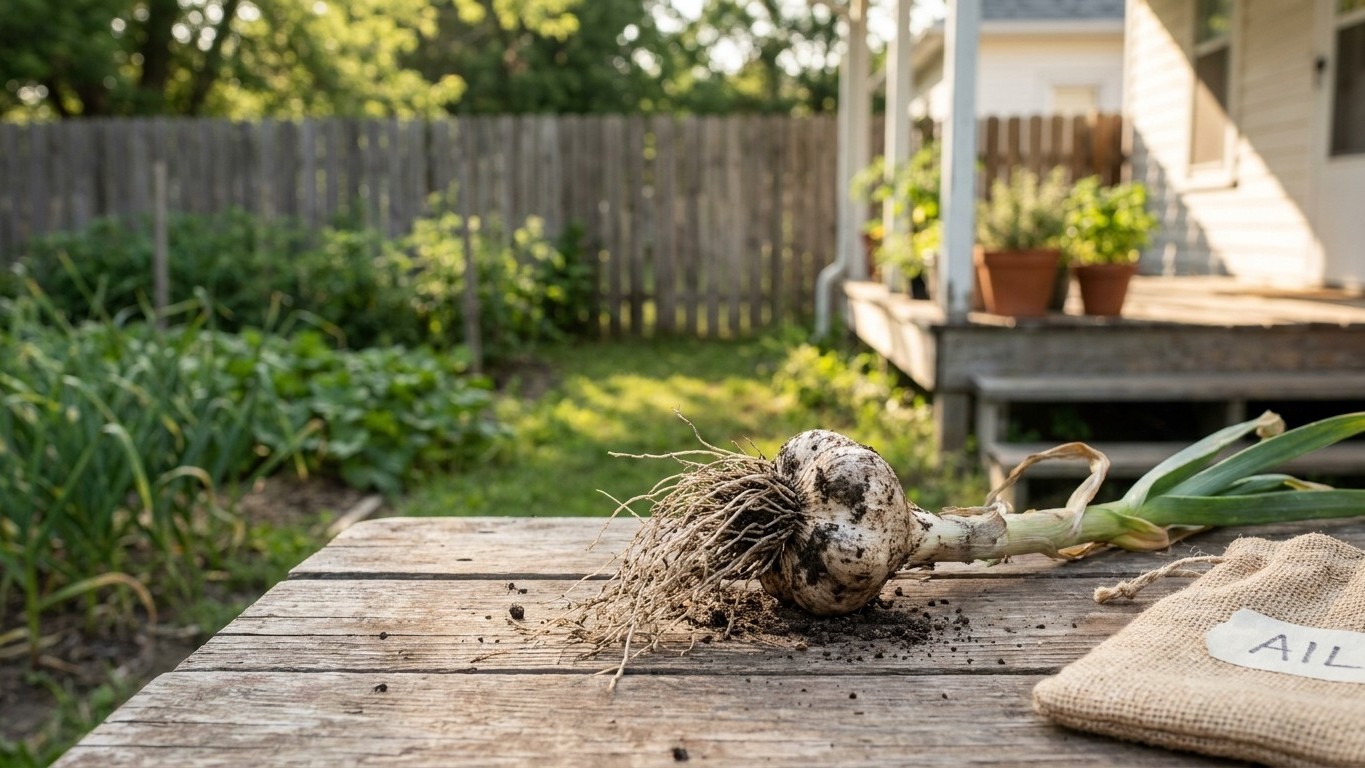

Yes, any garlic you like will make it through a Nebraska winter — the cold here goes deep enough to split every softneck and hardneck bulb properly, so variety isn’t what you need to worry about. What matters is getting cloves into the ground late September to early October, before the soil locks up, so roots have time to grab hold. Pick your variety for flavor and storage, then mark your calendar for that window and get mulch ready to go down right after planting.
The short answer for Nebraska

Garlic for Nebraska gardens goes in the ground late September to early October, regardless of whether you’re planting a softneck like Inchelium Red or a hardneck like German White. That window comes from working backward off the first fall freeze that NOAA’s 1991-2020 climate normals record for Omaha, October 15 to October 26. Cloves need roughly three to four weeks of soil contact before a hard freeze to push out roots without top growth, and the catalogue planting dates for every variety in this territory land inside that same stretch.
Cold is not the limiting factor here. University of Georgia Extension publication C854 lists six to eight weeks of soil temperatures below 40°F as the minimum a garlic clove needs to split into a full bulb rather than stay a single round. Omaha’s own record runs to an average of 26.1 weeks below 40°F across the year, well past that minimum, which is why both softneck and hardneck types work here without special handling.
What moves is not whether the state gets cold enough, but when the ground freezes hard enough to stop root growth. A grower who has already worked through the basics of the crop in Growing Garlic in Nebraska already knows garlic wants a full season of root development before spring top growth starts. The planting window is the piece that has to be pinned to your own location, not copied off a bag of seed garlic grown somewhere else.
Working it out for your own garden
The arithmetic is simple once you have the two numbers. NOAA’s 1991-2020 normals give Omaha a first fall freeze between October 15 and October 26. That is a probability band, not a guarantee: it marks the years when the first freeze is about as likely to land before that stretch as after it, so in roughly one year out of two, the real freeze comes later than October 26. Counting back three to four weeks from the early end of that band, not the late end, lands you at late September to early October, which matches the set-out date on every cultivar in this territory’s catalogue list.
Why the buffer matters more than the date
Garlic planted too close to the freeze date does not die outright, but it goes into winter with underdeveloped roots. A clove needs that three-to-four-week runway to anchor itself before the ground turns solid, and skipping the buffer to squeeze in a later planting is the single most common way this window gets misjudged. If you want the fuller breakdown of how the freeze data turns into a workable calendar, When to Plant Garlic in Nebraska: Counting Back From the First Frost walks through the same math with more room to spare.
The frost figure above is measured at the Omaha airport station. NOAA’s own caution on these normals is that suburban and rural gardens typically see their first fall frost earlier than an airport reading, often by one to two weeks, and more at elevation. That means a garden outside the immediate Omaha metro should treat the October 15 start of the band as optimistic and plant toward the early end of the late-September-to-early-October window rather than the late end.
All fourteen cultivars sold for this territory carry the same catalogue instruction: set out late September to early October. The table below groups them by neck type, since that distinction affects handling more than any date does.
| Variety | Neck type | Set-out window |
|---|---|---|
| Early Red Italian | Softneck | Late Sept–early Oct |
| Inchelium Red | Softneck | Late Sept–early Oct |
| Italian Late | Softneck | Late Sept–early Oct |
| Lorz Italian | Softneck | Late Sept–early Oct |
| Bavarian Purple | Hardneck | Late Sept–early Oct |
| Blue Music | Hardneck | Late Sept–early Oct |
| Chesnok Red | Hardneck | Late Sept–early Oct |
| Duganski | Hardneck | Late Sept–early Oct |
| Fall Festival | Hardneck | Late Sept–early Oct |
| Georgian Crystal | Hardneck | Late Sept–early Oct |
| Georgian Fire | Hardneck | Late Sept–early Oct |
| German Red | Hardneck | Late Sept–early Oct |
| German White | Hardneck | Late Sept–early Oct |
| Ivan | Hardneck | Late Sept–early Oct |
What changes across Nebraska
Omaha’s frost data is a starting point, not a state-wide figure, and Nebraska’s geography spreads that starting point in both directions. The Panhandle, at meaningfully higher elevation than the Missouri River valley, runs colder earlier in the fall, which pushes the safe planting window ahead of the dates calculated from an Omaha-based freeze record. Gardeners there should plant toward the early end of the late-September range rather than wait into October.
The Sandhills region, with its sandy soils and open exposure, drains and cools faster than the heavier soils common around the eastern river valleys. Sandy ground also freezes to depth more quickly once cold arrives, which shortens the practical rooting window even when the air temperature dates look similar to Omaha’s.
Southeastern Nebraska, close to the Missouri River and to Omaha itself, is the part of the state the NOAA figures in this piece actually describe. Gardeners there can use the October 15 to October 26 freeze band with the least adjustment. Everywhere else, treat that figure as a reference point and shift earlier by the amount your own county typically runs behind or ahead, which your county extension office can usually tell you from its own station records.
The mistakes this climate punishes
Two mistakes account for most of the failed garlic beds in this climate, and they pull in opposite directions depending on the year.
- Planting too late. Cloves set out after the early-October end of the window run short on the three to four weeks of root time they need before hard freeze, especially in a colder-than-normal year or in a district that runs ahead of the Omaha reference dates.
- Planting too shallow, then skipping mulch. Garlic that goes in at a shallow depth without a mulch layer is exposed to the freeze-thaw cycling that Nebraska winters produce, which can heave partly-rooted cloves right out of the soil.
- Assuming warm fall soil is safe. A mild September, common enough in this region, can encourage planting earlier than the catalogue window, and warmer soil in that stretch is exactly the range some soil pathogens favor.
Where disease pressure actually sits
UC IPM Pest Management Guidelines for onion and garlic (UC ANR Publication 3453) lists white rot, caused by the fungus Sclerotium cepivorum, as active across a 50-75°F range. Measured against this region’s growing-season air temperatures, that range overlaps five months, September, October, April, May and June, including one month at the published optimum. Fusarium basal rot, caused by Fusarium oxysporum f. sp. cepae, has a published range of 59-90°F that overlaps four months here: September, May, June and July.
Three things temper what those overlap counts mean. The published thresholds are soil temperatures, and soil lags behind air temperature and swings less than the air does. A month’s mean air temperature falling inside a disease’s range does not mean the whole month sat inside it, some days run well above or below that mean. And these figures come from one reference source applied to this region’s general climate, not a survey of every county. None of this means white rot or Fusarium basal rot are guaranteed here, and none of it means they’re impossible outside these months either. Infected planting stock carries both pathogens regardless of the calendar, which is the real reason to buy clean seed garlic rather than saved cloves of unknown origin.
Checking this against your county
The frost dates and cold-week figures in this piece come from the Omaha weather station, and Nebraska is too large a state for one station to describe. Before you commit to a planting date, check your own county’s typical first freeze against UNL Extension, which maintains local contacts and station data across the state. A phone call to your county office will tell you whether your area historically runs ahead of or behind the Omaha figures used to calculate the ranges above.
Common questions
Can I plant garlic in spring instead of fall in Nebraska?
Spring-planted garlic generally produces smaller bulbs because it misses the extended cold period that triggers clove division, and it also loses most of the root-development time fall planting provides. Fall planting timed to the first freeze window is the standard approach for every cultivar sold in this territory.
What happens if I miss the fall planting window?
Cloves planted late can still survive winter if the ground hasn’t frozen solid yet, but expect smaller bulbs at harvest since root establishment was cut short. A heavy mulch layer put down immediately after a late planting helps buy back some of that lost time by keeping the soil workable a little longer.
Do I need to mulch garlic over a Nebraska winter?
Yes, mulch matters here more than in milder climates because of freeze-thaw cycling, which can heave shallow-rooted cloves out of the ground over winter. A layer of straw or shredded leaves put down once the soil starts to cool holds moisture and moderates the temperature swings that cause heaving.
Is hardneck or softneck garlic better for Nebraska?
Both classes handle this state’s winter cold without trouble, since the region’s average weeks below 40°F run well past what either type needs. The choice comes down to kitchen use and storage length rather than winter survival, softnecks generally store longer in the pantry, hardnecks are usually easier to peel.