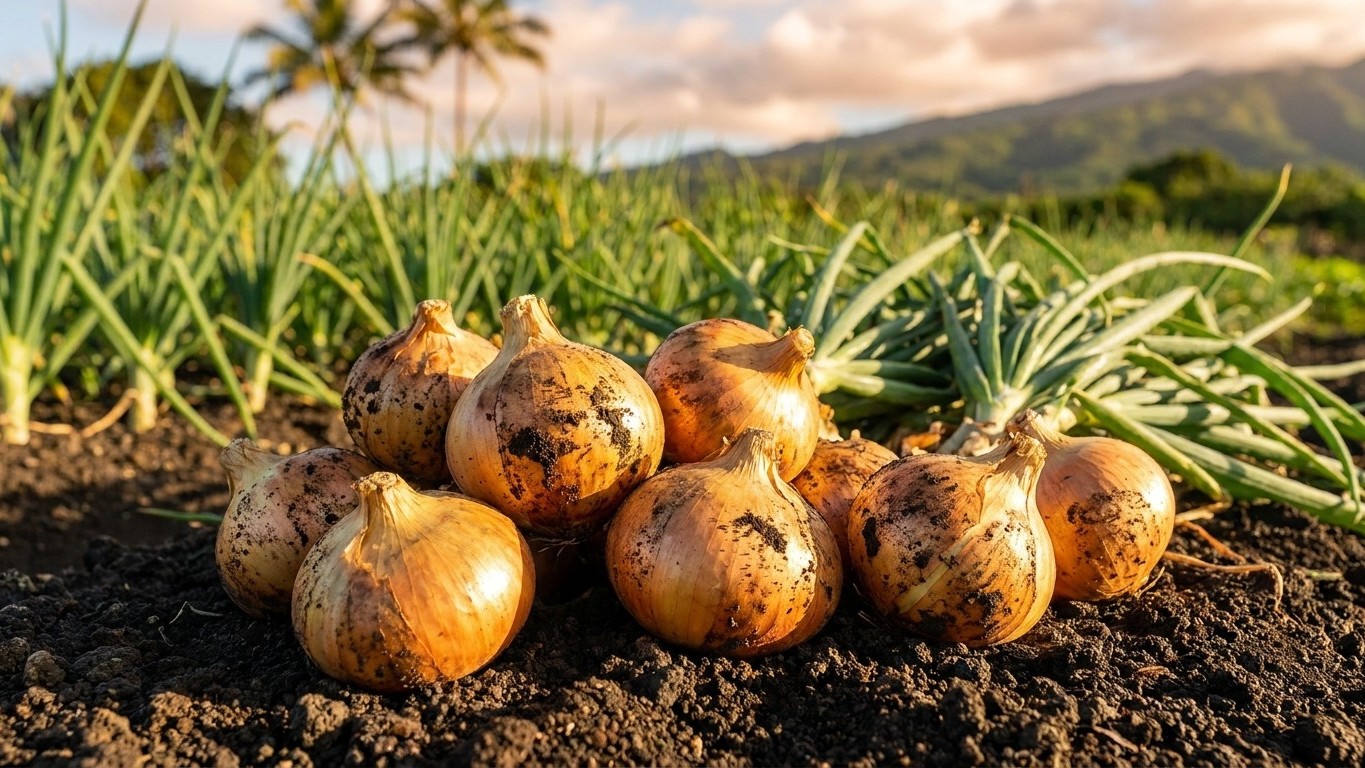

Lift onions once the tops have fallen over and started to yellow, then cure them somewhere dry and airy until the necks are tight and the skins papery. Only then do they go into storage. In New Brunswick the calendar matters less than the plant itself. Day length sets when bulbs form, weather decides how fast the tops finish, and skipping the cure means a good crop rots by midwinter.
The short answer for New Brunswick
The reference point here is Moncton, where the climate station (MONCTON A) sits at 46.11 degrees north. On the longest day of the year, the sun is up for 15 h 34 there. That figure is calculated from the latitude with the standard sunset formula and does not count the roughly seven extra minutes that atmospheric refraction adds. It matters because bulbing is triggered by day length, not by warmth. Long-day onions wait for 14 to 16 hours of daylight before they stop making leaves and start swelling a bulb, and Moncton clears that bar. Short-day types start at about 12 hours, which is why they bulb early and stay small this far north. For the variety side of the story, see The Best Onion Varieties for New Brunswick.
Reading the tops
Once the bulb has formed, the plant stops pushing new leaves. The necks soften, the tops flop over, and the lower leaves yellow. That is the signal to lift, and it arrives on the plant’s schedule, not a date on the wall. Choose a dry day, loosen the soil with a garden fork so you are not tearing roots, and pull the bulbs with the tops still attached. Handle them like eggs. A bruise or a nick in the skin becomes the entry point for rot a few months later.
Curing before anything else
Curing is a drying step, not storage. Spread the bulbs in a single layer, off the ground, under cover where air moves freely. A porch, a garage with the door open, or a shed with a window all work. Rain on the bulbs sets the process back, so in a wet fall bring them under a roof. Skip the washing, too. Brush off loose soil by hand and leave the rest.
The test is the neck, not the calendar. When it is thin, tight, and dry, with no moisture when you squeeze it, and the outer skins rustle like paper, the bulb is cured. A thick, soft neck means water is still moving through the bulb, and that is where decay starts. Trim the tops only after this point.
Where cured bulbs go
Clemson Cooperative Extension puts it plainly: “Ideal conditions are between 45 °F and 55 °F, and 50 to 60 percent humidity” (Clemson Home & Garden Information Center). Onions want it dry, the opposite of carrots and other roots. A single damp cellar cannot hold both well. Give the onions their own spot, even if that is a mesh bag hung in a cool, dry corner of the basement.
What will not work here
Planting late does not delay the harvest. It shrinks it. An onion makes leaves until day length triggers bulbing, and whatever size the plant has reached at that moment is the size of the bulb. A seedling set out weeks behind schedule hits that trigger as a small plant and produces a small bulb, however much you feed or water it afterward. Each leaf above ground becomes one ring of the bulb, so there is no catching up.
The same logic explains the shortcuts that fail in a New Brunswick garden:
- Short-day varieties. They start bulbing at about 12 hours of daylight, long before the plant is big. At 46.11 degrees north, with 15 h 34 on the longest day, they bulb early and stay small.
- Lifting while the tops are still green and upright. The bulb is still swelling and the neck is open, so it will not cure properly and will not keep.
- Storing straight from the ground. Uncured bulbs carry moisture in the neck, and rot travels from there into the bulb.
- Curing in rain or heavy dew. Wet skins never dry and the neck stays thick. Move them under cover.
- Keeping onions in the root cellar with carrots. A damp cellar suits roots, but onions want 50 to 60 percent humidity.
- Storing damaged bulbs with sound ones. Nicks, soft spots, and pest damage turn into rot. Use those bulbs first, and read What Eats Onion in New Brunswick, and When to see which damage you are looking at.
The short-day varieties are the one error you cannot fix at harvest. By then the bulb is already the size it is going to be. Every other item on the list is a mistake you can still avoid in the next ten days, which is why curing and storage deserve as much attention as growing. For the full picture of the crop here, start with Onions in New Brunswick.
What changes across New Brunswick
The Moncton figures describe Moncton. New Brunswick runs from the Bay of Fundy shore in the south up to the Chaleur Bay coast and the Quebec border in the north, and the exact latitude span is not published here. What is certain is that the longest day gets longer the farther north you go and shorter toward the south. A degree of latitude shifts that day by only minutes, so a gardener at either edge of the province is still in long-day territory. The group does not change.
| Where | Latitude | Longest day | What it changes |
|---|---|---|---|
| Moncton (reference) | 46.11 degrees north | 15 h 34 | Baseline for every figure on this page |
| Farther north in the province | Higher than 46.11, check your own | Longer than 15 h 34 | Bulbing is triggered even more surely, but the season is shorter, so late planting costs more |
| Farther south, toward the Fundy coast | Lower than 46.11, check your own | Shorter than 15 h 34 | Still long-day country, with slightly more room before the season turns |
What moves from one end of the province to the other is the weather around the harvest. A northern garden meets cold nights and wet fall weather sooner, so the window for curing outdoors closes sooner, and the tops finish on a different schedule. A coastal garden can stay damp and foggy, which slows curing even when the days are mild. In both cases, the same rule holds: wait for the tight neck, and bring bulbs under cover when the weather turns.
Checking this against your own garden
Everything above assumes Moncton. Before you plan around it, spend an hour confirming the details that are yours alone. New Brunswick has no county extension offices in the American sense. The nearest equivalent is your regional office of the provincial agriculture department, and they can tell you what local growers see in a given season. This week, you can check the following:
- Your latitude. Any online map shows it for your address, and if you are well north or south of 46.11 degrees, expect a longer or shorter longest day than 15 h 34.
- Your local first and last frost dates. They are not published here, and a statewide or provincial figure should never stand in for your own garden.
- Which variety group you planted. Check the seed packet or plant tag for “long-day” or “short-day.”
- Your curing spot. Walk it on a damp morning and see whether air actually moves through it and whether rain can blow in.
- Your storage spot. Put a cheap hygrometer there and see whether it sits near 50 to 60 percent humidity and 45 °F to 55 °F.
- Your plant sizes. If the plants were small when the days got long, expect small bulbs and plan to use them first.
A number from a reference city is a starting point, not a verdict. Your own notes, kept season after season, will tell you more than any single figure.
Common questions
How do I know when onions are ready to lift?
Watch the tops. When they have fallen over and started to yellow, and the necks feel soft, the bulb has finished growing. Lift on a dry day and leave the tops attached for curing.
How long does curing take?
No fixed number of days applies, because weather decides it. The finish line is physical: a thin, tight, dry neck and papery outer skins. If the neck is still thick or moist, keep curing.
Can I store onions in the root cellar with my carrots?
Not well. Carrots want damp air, while onions want 45 °F to 55 °F and 50 to 60 percent humidity, per Clemson Cooperative Extension. If you only have one cellar, keep the onions in a mesh bag on the driest, airiest shelf.
Why did my onions stay small even though I fed and watered them?
Most likely the plants were small when day length triggered bulbing, because they were planted late or were a short-day variety. Bulb size is set by the plant size at that moment, and extra care afterward cannot change it. Use small bulbs first, since they keep less well than large, well-cured ones.