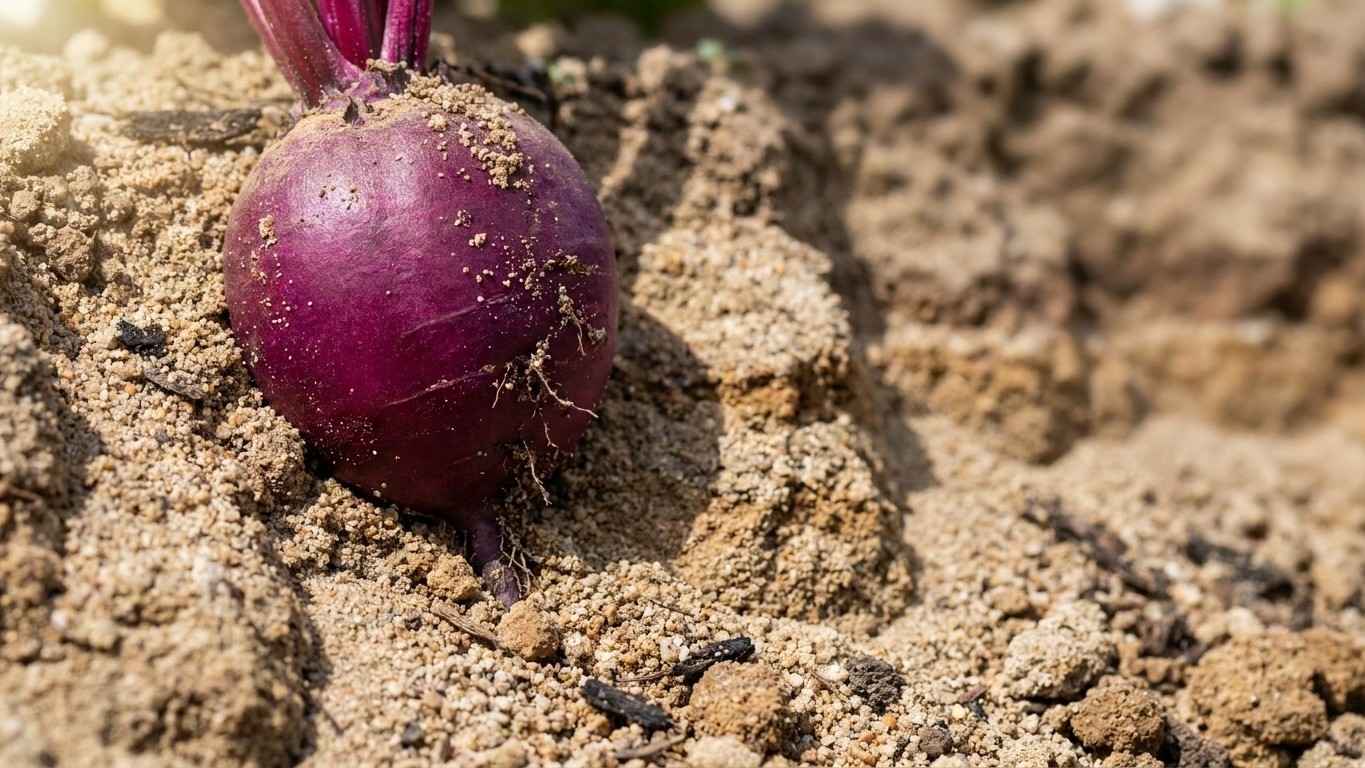

Pull beets 60 to 80 days after seeding, once the roots are the size you want. For winter storage, lift the big roots before the ground freezes, cut the tops off, and hold them at 33 to 36 F in very humid air. Colder is not better. The USDA storage handbook says beets held at 32 to 34 F develop more black spot and rot than beets held a little warmer. That is the opposite of how most root crops behave.
The short answer
Start with the ground. According to the provincial soil survey, the most common soil under Manitoba’s agricultural land is a Chernozem, the deep, dark grassland soil of the prairies, rich in organic matter and naturally fertile. It covers 41 percent of the mapped surface, with Gleysolic soils next. The median surface horizon is a loam to silt: 45 percent sand, 24 percent clay and 31 percent silt, with about 5.5 percent organic matter, a pH near 7.6 (alkaline) and imperfect drainage. Those numbers come from Agriculture and Agri-Food Canada’s Canadian Soil Information Service, across 2,535 mapped soil components.
Canada has no official provincial soil the way each US state does, so treat this as a dominant profile, not a single emblematic series. A province spans hundreds of soils, and this is a starting point, not a diagnosis. River bottoms, muskeg and any ground a builder has scraped or filled can be nothing like it. The survey also covers farmland only, so the far north is not represented. The pH here is a median of mapped soils, not your pH. A soil test gives you your own number, and our page on Beet Soil in Manitoba: What the Root Will Meet explains how to read it.
Set that profile against what beets want. Utah State University Extension describes the ideal as deep, sandy, well-drained soil rich in organic matter, with no more than 1 inch of composted organic matter worked in per 100 sq ft. The dominant Manitoba profile gives you depth and plenty of organic matter. It is not sandy, though. With 24 percent clay and imperfect drainage, water lingers after a heavy rain and the root zone stays wetter than the ideal. That cuts both ways. A soil that holds moisture helps a beet through a dry week, but it can sit soggy in a wet one. And with 5.5 percent organic matter already in the ground, piling on compost adds little, and Extension’s 1 inch ceiling is a limit, not a target.
Heat is the other half of the equation, and here I have to be plain: the number of days a year Winnipeg passes 90 F is not published in the data behind this page, so I won’t guess at one. What matters is the mechanism. Extension says heat above 85 F combined with water stress makes the root woody. Woodiness is a late-season failure that shows up as the root swells. It is a different problem from early bolting, which is covered below. A beet sown in early May reaches its harvest window in July, which is exactly when a hot, dry spell can toughen it. If you pull on time, you dodge much of that.
The six weeks that decide it here
Beets are sown in place, so the clock starts at seeding. Extension’s advice is to sow two to three weeks before the last spring frost. The average last frost at the Winnipeg Richardson airport station, from Environment and Climate Change Canada’s climate normals, is May 23. Count back and you get roughly May 2 to May 9 for sowing. Add 60 to 80 days from seeding, and the first roots are ready around the start of July, with the rest of the row sizing up through the end of that month.
Read that May 23 date for what it is: a mean, not a safe date. In one year out of two the last frost falls later. It also comes from a single station, and northern or upland districts can run weeks behind it. The normals cover an older 30-year period than the one the US figures on this site use, so don’t line the two up too tightly. Treat the date as the midpoint of a window and sow into the early part of that window with your eyes open.
Now the part that matters. Extension says water stress during the first six weeks causes premature flowering, which is bolting. Six weeks after a May 2 to May 9 sowing lands between about June 13 and June 20. So the stretch from early May to mid-June is where bolting gets decided. The data behind this page carries no rainfall figures for those weeks, so I won’t claim a pattern. What can be said is that a prairie spring tends to swing, with cool, wet stretches interrupted by warm, windy, drying ones. Those windy dry spells are the threat. A seedling with a short root, in a surface layer that is 45 percent sand, can dry out faster than you’d expect on a day that doesn’t feel hot.
The practical move is steady moisture through that early window, checked with a finger a couple of inches down, not by looking at the surface. Mulch once the seedlings are established. The same attention matters again as the roots swell in July, but for a different reason. Early thirst makes the plant flower. Later heat plus thirst makes the root woody. Different weeks, different failures, so keep watching the ground the whole season. For the full growing calendar, see Growing Beets in Manitoba.
What goes wrong here
- Bolting after a dry early spell. Water stress in the first six weeks after seeding pushes the plant to flower and the root stalls. Keep moisture even from sowing through about the third week of June, mulch after emergence, and don’t let a windy dry week pass unchecked.
- Woody roots from heat and dryness later on. Heat above 85 F with water stress toughens the root. This one belongs to July, not spring. Water deeply during hot spells, and don’t leave roots in the ground well past the 80-day mark hoping they will keep sizing up.
- Soggy ground after heavy rain. Imperfectly drained, 24 percent clay soil holds water longer than beets like. Build raised rows or ridges if your bed sits low, and avoid working the soil when it is wet enough to stick together.
- Too much compost. With about 5.5 percent organic matter in the dominant soil, heavy amendment gains you little. Stay under 1 inch of composted material per 100 sq ft, and get a soil test before adding anything else.
- Treating May 23 as a safe sowing date. It is the average, and frost comes later in one year out of two. Sow in the early part of the window and keep seed in reserve for a second sowing.
- Storing too cold. At 32 to 34 F you get more black spot and rot than at 33 to 36 F. Aim for the upper half of the range, and keep any pit or cellar between 31 and 41 F, never below or above. A cheap thermometer settles the argument.
- Keeping the leaves on. Bunched beets last only 10 to 14 days. For anything longer, top them first and store them at 33 to 36 F and 98 percent humidity.
- Saving the small roots. Small roots shrivel faster than large ones, which lose water more slowly. Eat the small beets first and put the big ones away. Leaf miners and other pests can also ruin a root before you ever store it; see What Eats Beet in Manitoba, and When.
Common questions
How long from sowing to pulling?
Sixty to eighty days from seeding. Beets are sown directly in the bed, so the count never starts from a transplant. A sowing around May 2 to May 9 puts the first roots at about the start of July.
Is May 23 safe for planting?
No. It is the average last frost at the Winnipeg Richardson station, which means the frost comes later in one year out of two. Northern and upland districts run behind that station by weeks. Treat the date as the middle of a window.
What temperature should stored beets be kept at?
For topped beets, 33 to 36 F and 98 percent humidity. Storage at 32 to 34 F produces more black spot and rot than slightly warmer storage, so a degree or two above freezing beats the coldest setting. A pit or cellar should never fall below 31 F or rise above 41 F. These figures come from the USDA Agricultural Handbook 66.
Which beets should I store, and which should I eat first?
Store the big roots and eat the small ones first. Large roots lose water and shrivel more slowly than small ones, so they keep much better. Remove the tops before storing, because beets left bunched with their leaves last only about 10 to 14 days.