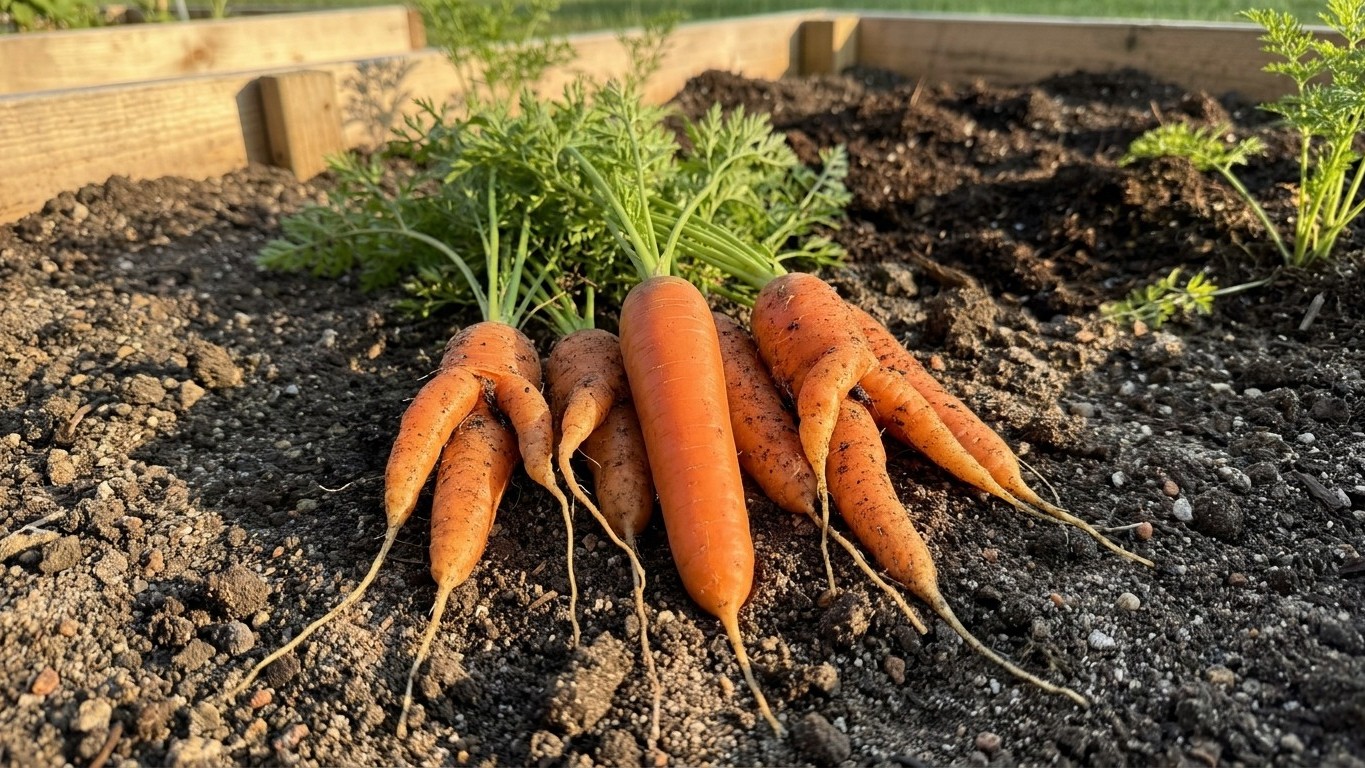

Pull carrots when a test root has reached the width on the seed packet. That usually means 70 to 100 days from seeding, since carrots are sown in place and never transplanted. Clemson Cooperative Extension puts harvest at about 65 to 75 days after planting. Storage decides what happens next. Carrots with their tops on last only 10 to 14 days. Trimmed, cold and humid, they last far longer. Either way, these timings are ceilings, not promises.
Keeping them, and for how long
Counting from seeding day
Every day count for carrots starts the afternoon the seed goes into the ground. Nothing gets moved later, so there is no second clock. A packet that says 75 days means 75 days from sowing, and a cool, wet spring or a dry August can push that later. The reliable check is to loosen the soil beside one carrot, ease it out, and look at the shoulder. When it matches the packet’s stated width and the color is deep, the rest are ready. If not, firm the soil back and wait a week.
The ground itself shapes what comes out of it. Utah State University Extension describes the ideal carrot soil as deep, sandy, well drained and rich in organic matter, and warns that heavy or rocky ground makes the root fork. Indiana’s representative soil, the Miami series, is a loam to silt: 30 percent sand, 20 percent clay and 49 percent silt, with about 2.0 percent organic matter and moderate drainage. The surface pH is about 6.5, slightly acid. That is more clay and less sand than a carrot prefers, so ground like this tends to hold water and grip roots. It is also a state average, not a diagnosis. River bottoms, hill country and scraped subdivision lots can be very different.
A jar test settles it at home. Shake a scoop of bed soil with water in a straight-sided jar and let it settle. Sand drops first, silt next, clay last, and the layer thicknesses show your mix. A county extension office can run a proper soil test for pH and organic matter. If the clay layer is thick, the fix is a raised bed or double digging with plenty of compost, not a different variety. The full reasoning is in Will Carrots Fork in Indiana Soil?, and the broader growing picture is in Growing Carrots in Indiana.
The cold-and-humid target
Clemson Cooperative Extension’s Home & Garden Information Center gives the storage target plainly: store carrots at 33 °F and high humidity to prevent wilting. Note how close that sits to freezing. It is not a cellar temperature, and it is not a pantry. A root is mostly water and keeps respiring after harvest, and warmth speeds that up. At 50 °F, carrots sprout and soften in a fraction of the time they would last near 33 °F.
Humidity matters for a different reason. Dry air pulls moisture out through the skin, and the carrot goes rubbery. Clemson’s wording, “to prevent wilting,” points to that loss. A cold spot with dry air still produces limp carrots, just more slowly than a warm one.
Why the tops come off first
Clemson states that bunched carrots, meaning plants with the tops still on, can be stored for about 10 to 14 days. That is the ceiling, reached only if the cold and humidity are right. Leaves keep transpiring, and they draw moisture out of the root to do it. A root with its greens attached is slowly feeding a plant that no longer has soil under it.
So cut the tops off at the shoulder before storing anything. Without that drain, a trimmed carrot kept cold and humid can last months at best. That is a best case for sound roots, not a guarantee, and every degree of drift shortens it. Eat the compromised ones first: roots that were nicked by the spade, split after a heavy rain, or chewed by pests. Damage invites rot, and one soft carrot in a bag can spoil its neighbors. For what typically chews on roots and when, see What Eats Carrot in Indiana, and When.
Where in the house that actually is
A number like 33 °F only helps if a real room matches it. Most rooms do not. The living space is far too warm, and a carrot left on a kitchen counter or pantry shelf starts to soften within days. A heated basement or utility closet is warmer than it feels and tends to sit well above the target.
The refrigerator comes closest, specifically the crisper drawer. It is cold, enclosed, and holds humidity better than the open shelves. The caveat is the back wall. In many fridges the air near the cooling vent runs cold enough to freeze produce, and a frozen-then-thawed carrot turns mushy. A perforated plastic bag, or a lidded container with a damp paper towel inside, keeps moisture in without sealing the roots in a puddle. Keep carrots away from apples and pears, whose ripening gas turns carrots bitter.
A garage or unheated porch looks tempting for a big harvest, but these spaces follow the weather. In an Indiana winter, a garage can swing below freezing overnight and climb well above the target on a sunny day, so the carrots freeze and thaw repeatedly. Early in the fall, the same space can be too warm for days at a stretch. A second refrigerator out there can work, as long as it is set to hold steady.
The fix is a check, not a guess. Leave a thermometer in the spot for a couple of days before filling it, reading it morning and evening. You are looking for a reading just above freezing that holds steady. Skip it, and you may learn the answer a month later, when a bag of carrots is sprouting or slimy. A small hygrometer in the same spot will show whether the air is humid enough. If the readings wander, move the carrots to the crisper drawer and put only what fits there.
Common questions
How many days after seeding are carrots ready?
Clemson Cooperative Extension suggests harvesting about 65 to 75 days after planting. Many packets for sown-in-place carrots run 70 to 100 days, so use the packet for your type. Pull one test carrot and check the shoulder width against the packet.
Can carrots stay in the garden bed instead of coming out all at once?
For a while, yes. Mature carrots can wait in the soil until the ground freezes solid, and a layer of mulch keeps the soil workable for digging. The longer they sit, though, the more exposed they are to pests and to splitting after heavy rain. Lift the whole crop before the soil locks up.
Should I wash carrots before putting them away?
Brush off the clinging soil first. If you rinse them, dry the roots thoroughly before bagging, because a wet surface in a closed bag invites rot. Whatever you do, cut the tops off before they go into the cold.
Why did my stored carrots go limp or start sprouting?
Limp roots have lost moisture, usually from dry air or from tops left on. Sprouting and softness point to storage that was too warm. At 50 °F, carrots deteriorate far faster than near 33 °F. A limp but sound carrot often recovers after a soak in cold water, while a soft, slimy one should go in the compost.