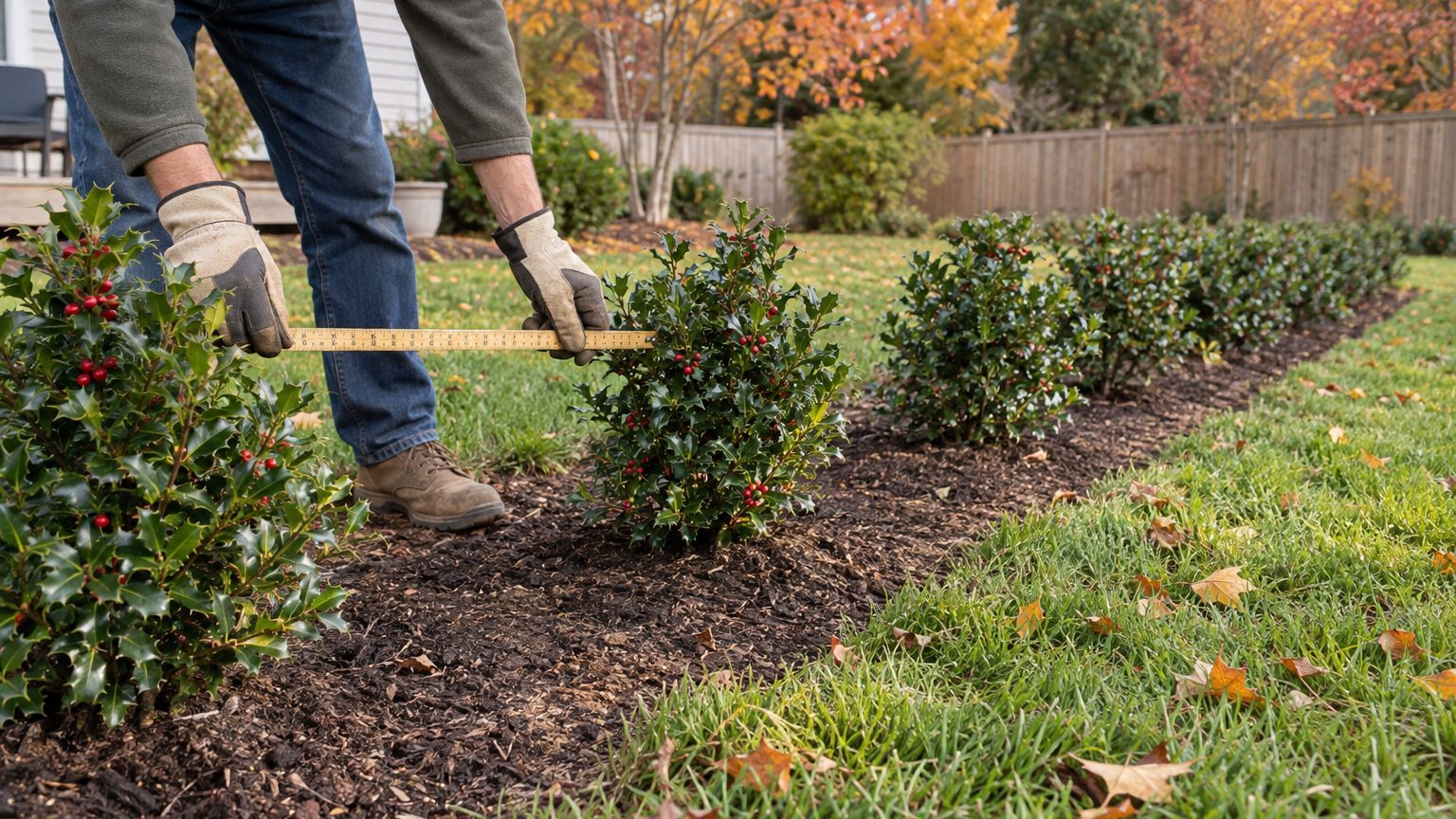

Space holly hedge plants at half to two-thirds of the mature width printed on the plant tag. Half gives the fastest screen. Two-thirds keeps the plants healthy longest. The tag width matters more than the species, because hedge cultivars are selected narrower than wild holly and held there by clipping. Holly grows in USDA zones 5 to 9, and the same math works in every one of them.
How far apart to plant holly
Start with the label, not the species. Unclipped holly of the type species reaches 5 to 8 feet wide, and that is the ceiling of what a plant can do when nobody trims it. Use that number as spacing and you will wait years for the gaps to close. Hedge cultivars are narrower, and shearing keeps them narrow, so the width on the tag of the plant in your hand is the one to use.
The arithmetic takes ten seconds. Multiply the tag’s mature width by one-half, then by two-thirds. Say the tag reads 4 feet wide. Half is 2 feet, and two-thirds is about 32 inches. The spacing for that cultivar is 24 to 32 inches apart, center to center. Take the close end of the range on a sheltered, well-drained site where you want a screen soon. Take the wide end if the row will face wind or shade, or if you want the plants to stay healthy as long as possible.
| Mature width on the tag | Half (fast screen) | Two-thirds (longest-lived) |
|---|---|---|
| 3 feet | 18 inches | 24 inches |
| 4 feet | 24 inches | 32 inches |
| 5 feet | 30 inches | 40 inches |
| 6 feet | 36 inches | 48 inches |
Measure from the center of one plant to the center of the next. Edge-to-edge measuring leaves the plants too close once the trunks thicken.
Holly is not a sprinter. It adds 6 to 12 inches a year, and a finished hedge stands anywhere from 5 to 15 feet tall. That slow pace tempts people to crowd the row. The next section explains why that backfires. If you are comparing holly with other hedge plants, the Hedges section covers each species on its own terms.
What planting them closer really buys you
A tighter row closes sooner. After that, the plants compete with each other for as long as the hedge lives. Roots fight over the same strip of soil. Lower branches lose light and drop their leaves. Air stops moving through the middle of the row and stays damp after rain. Damp, still air is where canker and blight get in.
Holly has its own weak points that crowding makes worse. Leaf miner is the pest to watch, and a dense, overlapping hedge is harder to inspect leaf by leaf. Winter scorch burns foliage on exposed sites. Plants already stressed by root competition head into a windy winter with less in reserve. The price of squeezing the spacing is a hedge that goes bare at the base.
Patience buys something concrete. Plants set at the wide end of the range develop full, leafy bases because each one has light on its lower branches. Air moves through the row, so leaves dry faster. The hedge can be clipped year after year without the interior going dark.
Holly does give you a safety net that few hedge plants offer. It carries dormant buds under the bark, so it regrows from bare brown wood. An overgrown or leggy hedge can be cut back hard in late winter, while the plants are dormant, and it will sprout again. Your county extension office can tell you when late winter actually arrives where you live, since it shifts by weeks across the country. Conifer hedges rarely forgive this kind of cutting. You can see how different their spacing logic is in How Far Apart to Plant Arborvitae for a Hedge and How Far Apart to Plant Eastern hemlock for a Hedge.
The safety net does not mean you should plant tight and fix it later. Hard renovation costs you screening time, and a properly spaced row never needs it so early.
One row or two
One row is what most yards need. It sits along a property line, a driveway, or a foundation, and it takes only the width of the mature plants. For a cultivar with a 4-foot tag, that is about 4 feet of ground, plus room to get a hedge trimmer around it.
A staggered double row is two lines of plants, each plant in the back row sitting behind the gap in the front row. It closes faster and screens better, because there is no straight line of sight between trunks. The cost is more plants compared with a single row at the same spacing, and more width. With the 4-foot cultivar from the earlier example, plan on a wider strip at maturity. Because the second row covers the gaps in the first, each row can sit at the wide end of the spacing range.
When does a double row make sense?
A double row is the right call where privacy matters a lot and the yard has room to give up. Think of a screen against a road, or a wall of green between you and a neighbor’s second-story window. A tall screen aimed at the upper end of the 5 to 15 foot range is where the extra plants earn their keep.
A single row is the right call on narrow lots, along fence lines where the setback is tight, and anywhere the budget matters more than speed. A single row of well-spaced holly also costs less to maintain, since there are fewer plants to inspect for leaf miner and fewer to prune.
Either layout works with the same rule. The spacing in each row still comes from the tag width, and the double row does not give you license to cram the plants any closer.
Working out how many plants you need
The formula is run length divided by spacing, plus one. The extra plant is for the end of the row, since a line of plants has one more plant than it has gaps. Take a run and divide by the spacing. Divide the run length by the spacing, then add one. Convert the spacing to feet before you divide.
A corner changes the count slightly. Measure along the line of the hedge as one continuous run and count the corner plant once. If you figure each leg separately and add one to each, you will buy an extra plant at the corner. Add the legs to get the run. Plant the corner itself on the bend, and keep the spacing the same on both sides of it.
The setback from the boundary is the other thing that changes the plan. A plant reaches its full width whatever the plan says, so the center of each plant needs to sit at least half the tag width inside the line. Add more so you can reach the outer face with shears. Many towns and counties also set their own rules on how close a hedge may be planted to a boundary or a sidewalk, so check before you mark the row.
One more item for the count. Holly berries need a male plant nearby, and a hedge made of a single clone never fruits. If you want berries, ask the seller which plants are male and which are female, and work a male into the row.
Common questions
Can I plant holly closer for a faster privacy screen?
You can plant at half the tag width, which is the closest spacing that still makes sense. Going tighter than that speeds up the first year or so and then shortens the life of the hedge, with thin bases and damp air in the middle of the row.
Where will a holly hedge grow?
Holly grows in USDA zones 5 to 9. On exposed sites, winter scorch can burn the leaves, so a spot out of the harshest wind is a better bet.
Do I need a male and a female plant?
Only if you want berries. Berries need a male plant nearby, and a hedge of one clone never fruits. If you want a plain green hedge, a single cultivar works fine.
When should I cut back an overgrown holly hedge?
Do it in late winter, while the plants are dormant. Holly regrows from old wood, so even a hard cut back to bare brown stems will sprout again. Your county extension office can tell you the right timing for your frost dates.