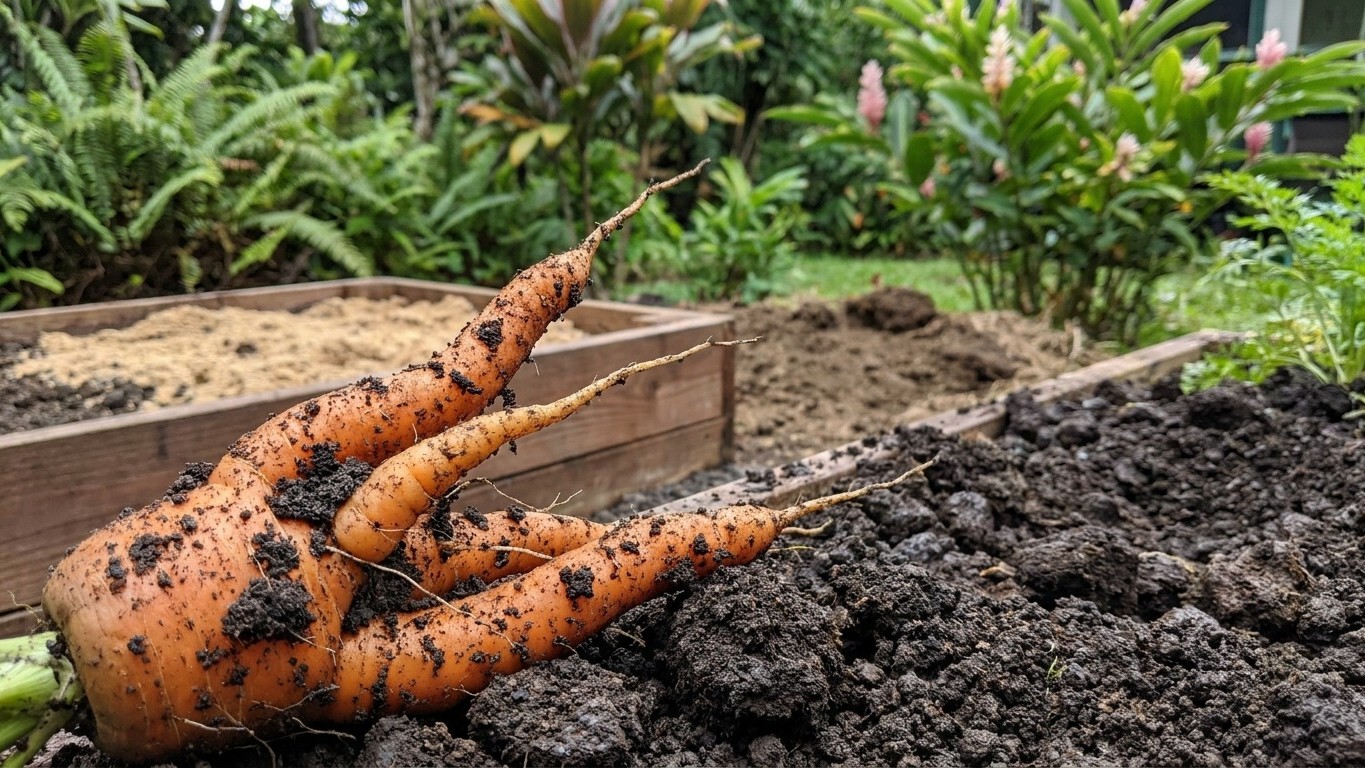

Pull carrots about 65 to 75 days after planting, according to Clemson Cooperative Extension. Seed packets often run 70 to 100 days. Either way, the count starts at seeding, because carrots are never transplanted. In Quebec that usually means pulling from late summer into fall, before the ground freezes hard. Cut the tops off right away and store the roots near 33 °F in high humidity. Anything warmer shortens their life fast.
When are carrots ready to pull in Quebec?
The days-to-maturity number on a packet is a window, and the roots decide where in it you land. Clemson Extension puts harvest at about 65 to 75 days after planting. Packets commonly stretch to 70 to 100 days. Cool weather, thin soil and crowding all push a row toward the long end. Because carrots are sown in place, every one of those days is counted from the day the seed went in the ground.
The most reliable check is to pull one. Brush the soil off the crown at the top of the row. If the shoulder is roughly as wide as the packet describes, the rest of the root is usually the right size too. A carrot left too long does not spoil, but it can turn woody and split after a heavy rain following a dry spell.
Quebec’s most common mapped soil is a Podzol, the acid, leached soil that forms under conifers. It covers 36 percent of the mapped surface, according to Agriculture and Agri-Food Canada’s Canadian Soil Information Service. The typical surface is loam to silt, with 51 percent sand, 15 percent clay and 34 percent silt. Organic matter averages about 6.2 percent and the soil drains well. Surface pH has a median near 5.5, which is slightly acid. That profile tends to give straight roots that lift without a fight. Utah State University Extension says carrots want deep, sandy, well-drained soil rich in organic matter, and that heavy or rocky ground makes the root fork.
That profile describes the province, though, and your garden may not match it. River bottoms, wet ground and any lot a builder has scraped or filled can behave completely differently. A simple test settles it at home. Dig a hole a spade deep, scoop up a handful of damp soil from the bottom and squeeze it. If it holds a tight, slick ribbon, it is heavy and forking is likely. A lab soil test gives your actual pH. The full picture is in Will Carrots Fork in Quebec Soil?, and the broader growing calendar is in Growing Carrots in Quebec.
In fall, there is no need to rush every root out at once. Carrots hold fine in cool soil, so pull what you will use and watch the forecast for the first run of nights that could freeze the ground solid. A thick layer of straw or leaves over the row buys some extra time. Pull before the soil locks up, because a frozen carrot cracks and turns soft.
Check roots as they come up. Tunnels from larvae and chewed shoulders are signs of pest damage, and What Eats Carrot in Quebec, and When explains what caused them. Damaged roots rot first in storage, so set them aside for the kitchen this week.
Keeping them, and for how long
Clemson Cooperative Extension, in its home and garden factsheet on carrots, beets, radishes and parsnips, gives a short instruction: store carrots at 33 °F and high humidity to prevent wilting. The source gives no humidity percentage, so treat “high” as nearly saturated air. A carrot is mostly water, and dry air pulls it out through the skin.
That 33 °F is just above freezing. It is much colder than a cellar in early autumn, and it is not a room-temperature target either. A reader who stores carrots at 50 °F will lose them to sprouting and softening in a fraction of the time.
Why do the tops have to come off first?
The leaves keep drawing moisture out of the root after harvest. A carrot with its tops still on is slowly wilting from the crown down, even in a cold, damp spot. Twist or cut the greens off as soon as you pull the roots. You can brush off loose soil, but skip washing if you plan to store them for weeks, since wet skin invites rot. Let any surface mud dry for an hour or two in the shade first.
How long do bunched carrots keep?
Clemson Extension says bunched carrots, meaning plants with the tops still on, can be stored for about 10 to 14 days. That is a maximum under the best conditions, and a warm kitchen counter will shorten it. Trimmed roots can keep for months at the same temperature and humidity, but that is also a ceiling. Warmer air, drier air or a bruised root will bring it down.
For fresh eating, many gardeners leave some of the row in the ground and pull as needed. That works well in cool weather and keeps roots crisp. Once the soil is about to freeze, the whole row has to come out, and from then on the storage numbers apply.
Pack trimmed roots in a way that holds humidity without sealing in condensation. A perforated plastic bag works. So does a box or bucket of slightly damp sand or sawdust, with the roots set so they do not touch. Check the container every week or two and remove any carrot that has gone soft or slimy before it spreads.
Where in the house that actually is
Few homes hold 33 °F everywhere. The question is which spot comes closest in a Quebec house, and the answer changes with the season.
Which room comes closest?
A domestic refrigerator is the nearest thing to the target. It runs cold and dry, though, so carrots left loose in a fridge shrivel. A crisper drawer helps, and so does a perforated bag or a damp paper towel around the roots. Most kitchen fridges run a bit warmer than 33 °F, and some freeze the back wall, so a thermometer matters more than the dial setting.
A heated room is too warm for anything but a few days. That covers the kitchen, the pantry beside the furnace and a finished basement. A garage swings with the weather. It may sit near the right temperature on a cool October night, then drop below freezing in a Quebec January and turn every carrot to mush. An unheated cold room or a basement corner against an outside wall, away from the furnace and water heater, often holds the steadiest cool temperature. It also tends to be humid enough for sand-packed roots.
What should a thermometer tell you?
Do not guess. Leave a thermometer in the spot for several days before you fill it with carrots, ideally one that records the high and low. Skipping that step can cost the whole crop. A corner that reads right at noon may be freezing at 3 a.m., or may creep up when the furnace cycles on. If the reading wanders much above 33 °F, shift the carrots to the fridge or store a smaller amount where it is coldest and use them first.
If the low touches freezing, move the box or cover it with a blanket or straw. A carrot that has frozen and thawed turns soft and does not recover.
Common questions
Do I count days from seeding or from when the carrots sprout?
Count from seeding. Carrots are sown directly in the garden and never transplanted, so the days on the packet start the day the seed goes into the soil. Germination can take a while in cool ground, and that wait is already included in the count.
Can I leave carrots in the ground over winter in Quebec?
Not reliably. Once the soil freezes hard, roots crack and soften, and digging them out becomes difficult. Pull the remaining roots before the ground locks up, then trim and store them. A thick mulch of straw or leaves can extend the picking season a bit, but it does not replace storage.
Why did my stored carrots go limp or sprout?
Limp roots usually mean dry air or tops left on, since the leaves pull moisture from the root. Sprouting points to warmth. At 50 °F, carrots soften and sprout in a fraction of the time they would last near 33 °F. Cut the tops, raise the humidity with damp sand or a perforated bag, and check the temperature in the storage spot.
How long will my carrots last if I do everything right?
Clemson Extension says bunched carrots keep about 10 to 14 days. Trimmed roots keep much longer, in the range of months, but that is the best case at about 33 °F in high humidity. Check the stored roots regularly and use any that start to soften.