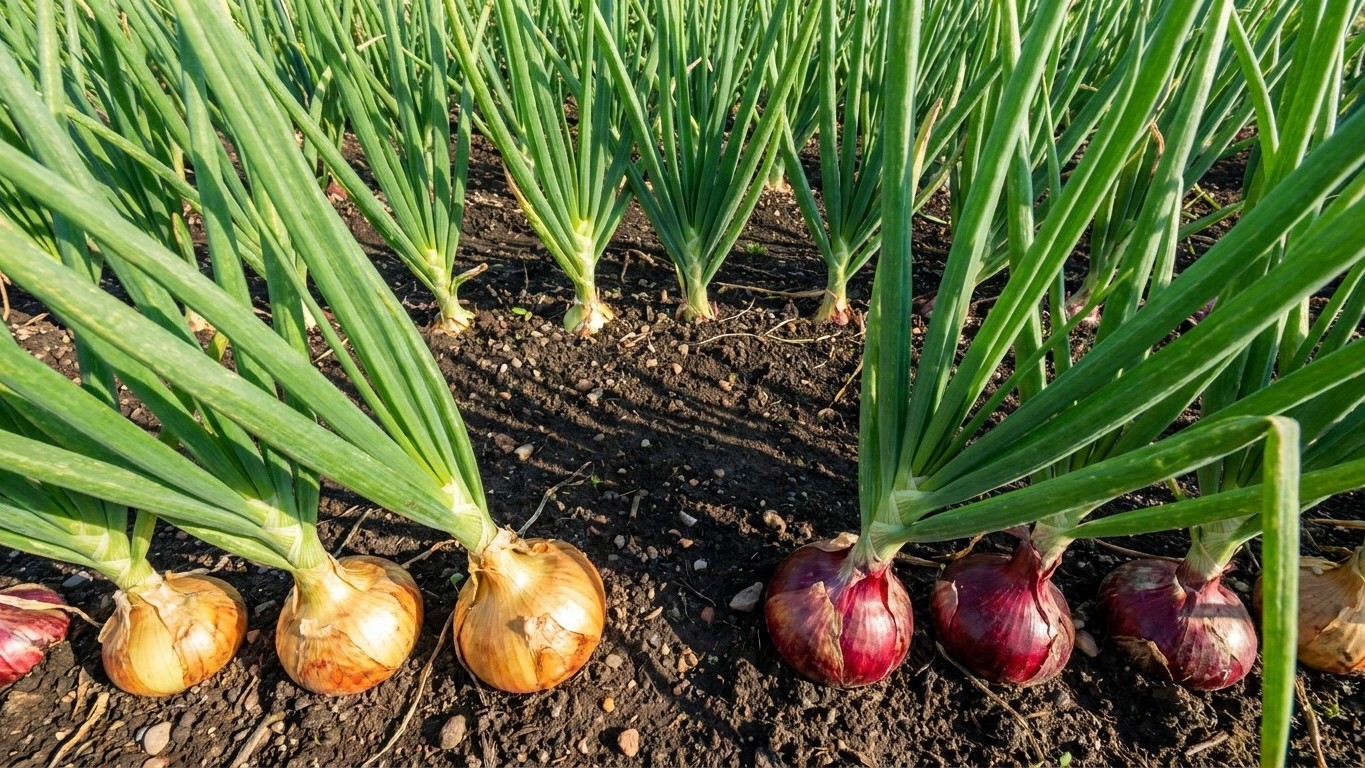

Lift onions in Alberta once the tops have yellowed and fallen over, which usually happens from late August through September. Then cure them: spread the bulbs somewhere warm, dry and airy until the necks are tight and the skins feel papery. Only cured bulbs go into storage. Skip that step and the bulbs rot from the neck down, no matter how good the storage space is. This guide covers the timing, the curing, and where in a house the bulbs can wait out winter. For the full growing picture, start with Onions in Alberta.
Keeping them, and for how long
Onions store best cool and dry. Clemson Cooperative Extension’s Home & Garden Information Center puts it this way: “Ideal conditions are between 45 °F and 55 °F, and 50 to 60 percent humidity.” The number to write down is 45 °F to 55 °F with 50 to 60 percent humidity. Its factsheet on onions, leeks, shallots and garlic is at hgic.clemson.edu.
The humidity figure surprises people who also grow carrots, beets and potatoes. Root crops want the opposite, cold and damp, so they stay plump. Onions in damp air sprout and grow mold on the outer scales. A single cellar cannot hold both groups well. If you grow both, give the onions their own corner, crate or room, away from the root vegetables.
How long they last depends on the bulb and on how well the conditions hold. Any storage time you read, whether in months or weeks, is a ceiling under ideal conditions, and a home setup rarely stays ideal all winter. Pungent, tight-skinned onions with a high dry-matter content keep longest. Mild, sweet types hold water and sugar, so they soften within weeks or a few months and should be eaten first. Pick storage-minded types from the start and you gain months. The best onion varieties for Alberta page sorts the keepers from the eat-now kinds.
Curing comes before any of this. Bulbs go into storage only once the necks are tight and the skins are papery, never straight from the ground. A bulb with a fat, green, moist neck is an open door for rot organisms, and a single bad onion can spoil the ones touching it.
Storage life also depends on what happened in the garden. Bulbs bruised during lifting, nicked by a fork, or tunneled by insects will not last, even in a perfect room. The pest guide for Alberta onions explains which damage to look for. Set those bulbs aside for the kitchen this week.
Check the stored crop every couple of weeks. Look for soft spots, sprouting and a sour smell. Pull anything suspect right away. Sprouting means the room is too warm or too damp, or both, and the bulbs need to be eaten soon.
Where in the house that actually is
The target range of 45 °F to 55 °F is a narrow window, and most rooms miss it. A domestic refrigerator runs colder than the bottom of that range, and its crisper drawer is humid on top of it. A whole winter’s crop would not fit anyway. A heated living space sits above the 55 °F ceiling, so bulbs there break dormancy and sprout early. An attached garage swings with the weather. It can be fine in October, then freeze on a cold Alberta night in January. Frozen onions thaw into mush.
The room that comes closest in most Alberta houses is an unfinished or lightly heated basement, ideally a cold room or a corner against an insulated wall. A cool, dry back bedroom or a closet on an outside wall can work, but only if it stays below the upper limit. The spot should be dark, dry, and away from the furnace, water heater and any ductwork. Avoid a damp corner or a laundry area, since the humidity range is a ceiling for onions. Basements can run humid in summer and dry in winter, so an easy reading in October proves little about January.
Check it before you rely on it. Put a thermometer, ideally one that also reads humidity, in the spot for a week or more before the crop goes in, and look at both the highest and lowest readings, not just the average. Skipping this step is how a whole winter of onions ends up sprouting by December, or soft by February. If the numbers drift outside the range, move to a different room rather than hoping the bulbs tolerate it.
Airflow matters as much as the temperature. Mesh bags, slatted crates, open baskets, and old nylon stockings with a knot between bulbs all keep air moving. A deep, solid box does not. Spread the bulbs no more than a few layers deep, and keep them off the bare concrete floor, where dampness wicks up. Keep the onions away from potatoes too, since potatoes give off moisture and want a damper, colder room.
When are onions ready to lift in Alberta?
Day length starts the clock. Onions switch from making leaves to making a bulb based on how long the day is, not on how warm it is. The reference city for these figures is Calgary, at 51.11 degrees north (Environment and Climate Change Canada’s Calgary International station). Its longest day offers about 16 h 20 of daylight, calculated from that latitude at the June solstice. Short-day onions begin bulbing at about 12 hours (Clemson Cooperative Extension), so they bulb early and stay small this far north. Long-day varieties wait for 14 to 16 hours, which a Calgary June delivers easily. Gardeners well north or south of Calgary should check their own latitude, because the day length and the timing shift with it.
Once the bulb is made, the plant finishes on its own schedule. Watch the tops. They turn yellow, soften at the neck, and flop over. When most of the tops in the row have fallen, the crop is ready. Easing off watering as the first tops yellow helps the necks dry down. The calendar window is roughly late August into September, but the tops are a better guide than the date.
Don’t wait for a hard freeze to make the decision. Bring the crop in before one can reach the bulbs. Pick a dry day, loosen the soil with a fork set well back from the row, and lift the bulbs by hand. Handle them like eggs. A bruise is a rot spot waiting to happen.
How do you cure onions in Alberta?
Curing is a drying job. The aim is to seal the neck and dry the outer skins so they protect the bulb for months. Lay the onions in a single layer, tops still attached, in a spot that is warm, dry, shaded and moving air. A covered porch, an open garage, a shed with the door cracked, or a spare room with a fan all work. Alberta falls bring cool nights and the occasional rainy week, so bring the crop under cover rather than leaving it on the ground. Direct sun can scald the bulbs.
Check every few days rather than counting on a fixed number. The onions are cured when the necks are tight and dry, with no give when squeezed, the outer skins rustle like paper, and the roots have shriveled to wiry threads. A neck that still feels thick or moist needs more time.
Then trim. Cut the dry tops to a short stub, snip the roots, and brush off loose soil. Don’t wash the bulbs. Sort as you go: any onion with a thick neck, a bruise, a soft spot or insect damage goes in the kitchen basket, not in storage. The rest go into mesh bags or crates for the cool, dry room.
Common questions
Can I store onions in the refrigerator?
Not for the long haul. A refrigerator runs colder than the 45 °F to 55 °F range, and its humidity is too high for onions. A cut onion keeps there for a few days wrapped, and that is where the fridge fits.
Should I cut the tops off before curing?
No. Leave them on while the bulbs dry. The necks tighten and the skins turn papery as the tops dry. Trim once the neck is tight and the skins are papery.
Can onions and potatoes share a storage spot?
It is better to separate them. Potatoes want a colder, damper room, while onions want a drier one at 50 to 60 percent humidity. Stored together, the onions pick up moisture and the potatoes suffer from the wrong conditions. A different shelf in a different room solves it.
What should I do with onions that have thick necks or soft spots?
Use them first. A thick neck means the bulb did not finish maturing, and it will not keep. Cut away any soft spots and cook the rest soon. Never put a bruised or rotting bulb back with the keepers.