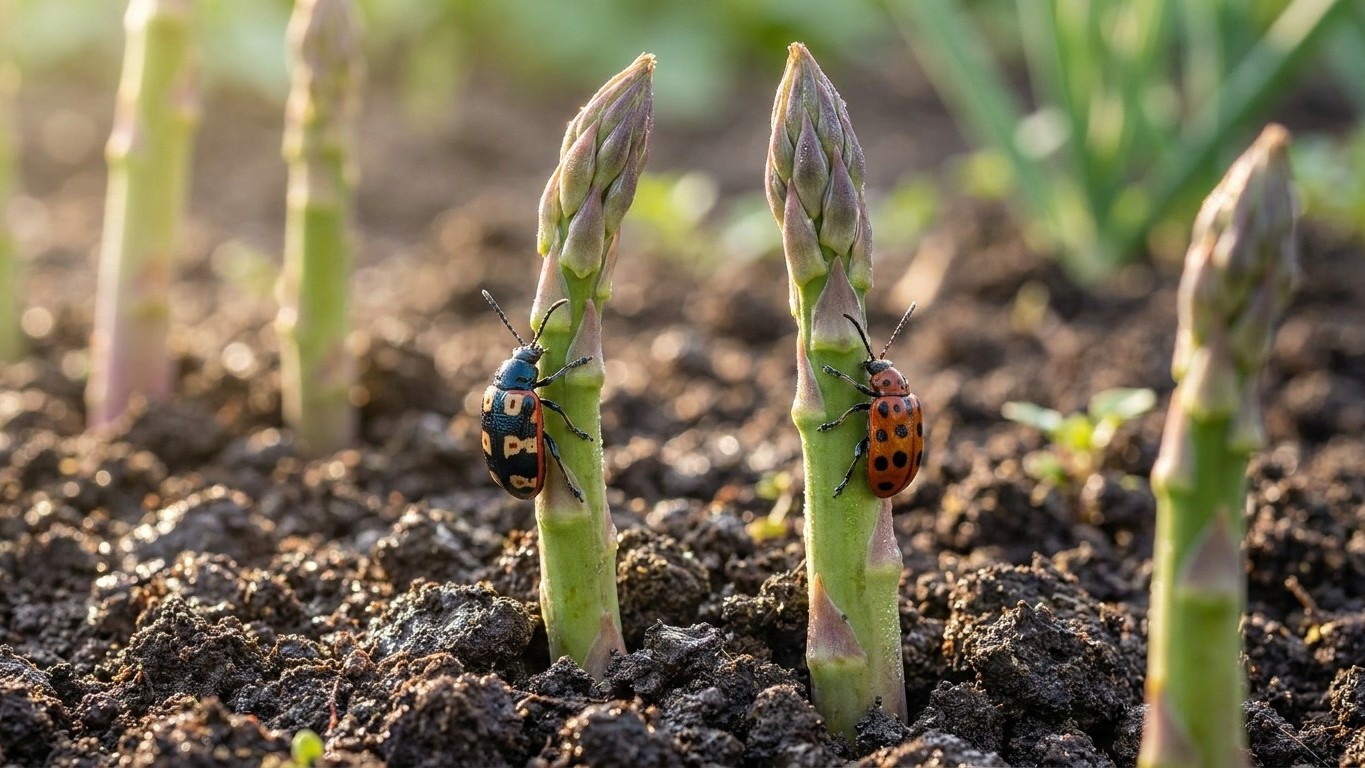

Asparagus in Kansas gets eaten in two waves. Chewing insects and browsing animals go after the spears in spring, then other chewers work on the ferns once cutting stops. A third group feeds at or below the crown. The timing follows the last spring freeze and your harvest window, so a calendar and a few symptoms will narrow things down before you ever need a name.
Which pests attack asparagus in Kansas
Kansas State University Research and Extension, through its county offices, is the service that tracks which insects are active in Kansas gardens. On asparagus, the damage falls into five groups:
- Chewing insects that feed on the spears and spear tips in spring
- Chewing insects that strip the ferns after harvest ends
- Soil-level and crown feeders that thin out or erase emerging spears
- Sap-feeding insects that distort and yellow the ferns in summer
- Browsing animals that clip spears and ferns
Insects that bore into fruit trees, roll squash vines or tunnel into corn ears have no use for asparagus. If you spot one near the bed, it is passing through. Spraying for it protects nothing and can harm the beneficial insects that do help.
The five groups matter more here than in an annual vegetable bed. Asparagus goes in as crowns and is not harvested until year 3, then produces for 10 to 15 years, according to Utah State University Extension. Whatever settles into the bed in the first season has a decade and a half to build up. A tomato bed gets a fresh start each spring. An asparagus bed does not.
Specific insect names, and which are active in your part of the state, are a question for the county office. Kansas runs from humid eastern counties to dry western ones, and the list changes along that line. The groups above still hold anywhere in the state, because they describe what the damage looks like and where on the plant it happens.
When each one shows up, and what it does first
Start the clock with the last spring freeze. At the reference weather station, NOAA NCEI’s 32°F freeze probabilities put the last spring freeze between April 4 and April 18. Suburban and rural gardens usually see it one to two weeks later. Crowns go into 8-inch furrows in early spring (see When to Plant Asparagus Crowns in Kansas), and spears begin coming up as the soil warms after that freeze window.
Spear chewers arrive with the first spears. The first thing you see is scarred or pitted skin, a nibbled tip, or a spear bent into a hook. They stay active through the harvest window, which begins in year 3. In a new bed nothing is being cut yet, so thin spears with ragged tips are your only clue.
Crown and soil-level feeders show up as gaps. A row with missing spears, or spears that come up thin and weak, in the first weeks after the freeze window is the early sign. Dig gently at a gap before you decide anything, since a crown set too deep in a poorly drained spot looks the same from above.
Fern chewers and sap feeders take over once cutting stops. Stop cutting when most spears are thinner than a pencil, and let the ferns grow, since they feed the crowns for next year. Chewed ferns look ragged, thin or stripped in patches. Sap feeders leave yellowing, stunted or twisted growth, sometimes with a sticky film on the foliage. Summer stress compounds it. The reference station averages about 13.2 inches of rain across June, July and August, with July the driest month at 3.98 inches (NOAA NCEI climate normals), and days at or above 90°F pull water out of the ground quickly. Thirsty ferns tell you less than you would hope, so read the soil before blaming an insect.
Browsing animals work at any time, but spears are the target in spring and fresh fern growth in summer. The sign is a clean, angled snip, often with several spears gone overnight, and little or no chewed residue on the plant.
Telling the damage apart from everything else
Many asparagus problems that look like insect damage are weather, water or a disease. A frost-hit spear goes limp, dark and water-soaked, and a freeze in the days after the reference April window is a common cause in Kansas gardens. The table below gives the sign that separates each look-alike. It points to what to check next and does not diagnose your plants.
| What you see | Possible causes | What helps tell them apart |
|---|---|---|
| Limp, dark, water-soaked spear tips | Freeze injury; occasionally rot | Check the overnight lows from the previous few nights. Freeze injury hits many spears at once, usually on the same side of the bed |
| Pitted or scarred spear skin, nibbled tips | Chewing insects; mechanical damage | Look for the insect, its droppings or eggs on the spear. Hoe or mower scars are straight and clean with no residue |
| Yellowing ferns across the whole bed | Dry soil; nutrient shortage; disease | Dig a trowel’s depth near the crowns. Dry soil points to water. A soil test settles the nutrient question |
| Orange or brown powder on ferns | Fungal disease | Rub the spot with a finger. A powder that comes off on your skin is not an insect |
| Thin, weak spears, gaps in the row | Crown feeders; poor drainage; crowns set too deep or too shallow | Dig at a gap. Wet, dark soil around the crown points away from insects |
| Bent or snapped spears | Wind; foot traffic; animals | Look for tracks or a consistent lean in the same direction |
The most common diagnostic error is spraying before you find the insect. If you cannot find the insect, its droppings or its eggs on the plant, treat the problem as unconfirmed, because water stress, freeze injury and disease all produce the same yellow, ragged look from a few feet away.
The representative surface soil of the Harney series, the Kansas state soil, is loam to silt (9 percent sand, 24 percent clay, 67 percent silt), well drained, with about 2.0 percent organic matter, according to USDA NRCS Soil Data Access. A garden on river bottom, hill country or builder-scraped ground can behave very differently. Take a photo, a sample of the damaged tissue and a soil test to your county extension office, which can tell you what you actually have.
What actually works here, and what is a waste of time
A physical barrier or a change in routine, placed at the right time, beats a spray. With a harvest that begins only after the early-spring freeze window, the calendar does more than any product, because spears are eaten in the days between emerging and being cut.
Cutting spears on a regular schedule during the harvest window removes the tissue insects are using. Removing old, dead fern stalks after they brown, before spring growth, takes away shelter for insects that spend the winter in the debris. A fence around the bed protects against browsing animals, and it has to be up before the first spears emerge, since one night’s feeding can take the whole flush.
Hand-picking works on a small bed. Knock insects into a container of soapy water in the morning, when they are slow, and check the undersides of spears and ferns. It keeps beneficial insects alive.
Drainage is the long-term lever. Utah State University Extension says most soils will do for asparagus provided they are well drained, and a crown that sits in saturated soil is weaker and more vulnerable to everything else (see Will Kansas Soil Hold an Asparagus Bed for Fifteen Years?).
Several common habits waste time. Spraying the whole bed on a schedule without identifying anything kills helpful insects and may miss the actual feeder. Spraying during the harvest window puts a residue on spears you will eat within days. Feeding the ferns heavily to outgrow the damage does not stop the chewing. Only your county extension office knows what is registered in Kansas and under what conditions.
Where to check this for your own county
Start with your county office of K-State Research and Extension. Every Kansas county has one, and the agents there see local pest reports week by week during the growing season. They also know which look-alike problems are common in your part of the state.
Pest presence varies inside a state, and often inside a county. Western and eastern Kansas differ in rainfall, heat and soil, and a bed on a river bottom differs from one on a hilltop. What is documented statewide does not tell you what is in your bed.
A rain gauge shows what each storm actually delivered, since the station’s 13.2 inches across June, July and August is a normal and not a forecast. A soil test tells you what the ground holds, which the state soil series cannot do. For the wider picture on the crop itself, see Growing Asparagus in Kansas.
Bring a dated photo and a bagged sample of the damaged tissue, along with your notes on where and when you first saw it. Keep the sample in a sealed container, and call the office before you go so the right person is there.
Common questions
Can I harvest in the first or second year to see whether pests are a problem?
No. Asparagus is not harvested until year 3. Cutting earlier weakens crowns that are still building up for a decade or more of production. Inspect the bed instead.
Do chewed ferns hurt next year’s spears?
Ferns feed the crowns after cutting stops, so heavy fern loss can weaken the plant. Your county extension office can tell you how much damage is worth acting on in your area and what is legal to use.
Does Kansas soil make pest problems worse?
Soil affects the crown more than it affects the insects. The representative Kansas soil, the Harney series, is well drained, and well-drained ground is what asparagus needs. Your own garden may differ, so a soil test is the next step.
How should I store spears that have minor damage?
Trim off the damaged part and store the rest cold. The UC Davis Postharvest Technology Center gives the target as 32 to 35°F with 95 to 100 percent relative humidity. Above 50°F spears toughen quickly, and at about 31°F or lower they freeze and go soft. Standing the cut ends in water, or wrapping them damp, keeps the humidity up in a home refrigerator.