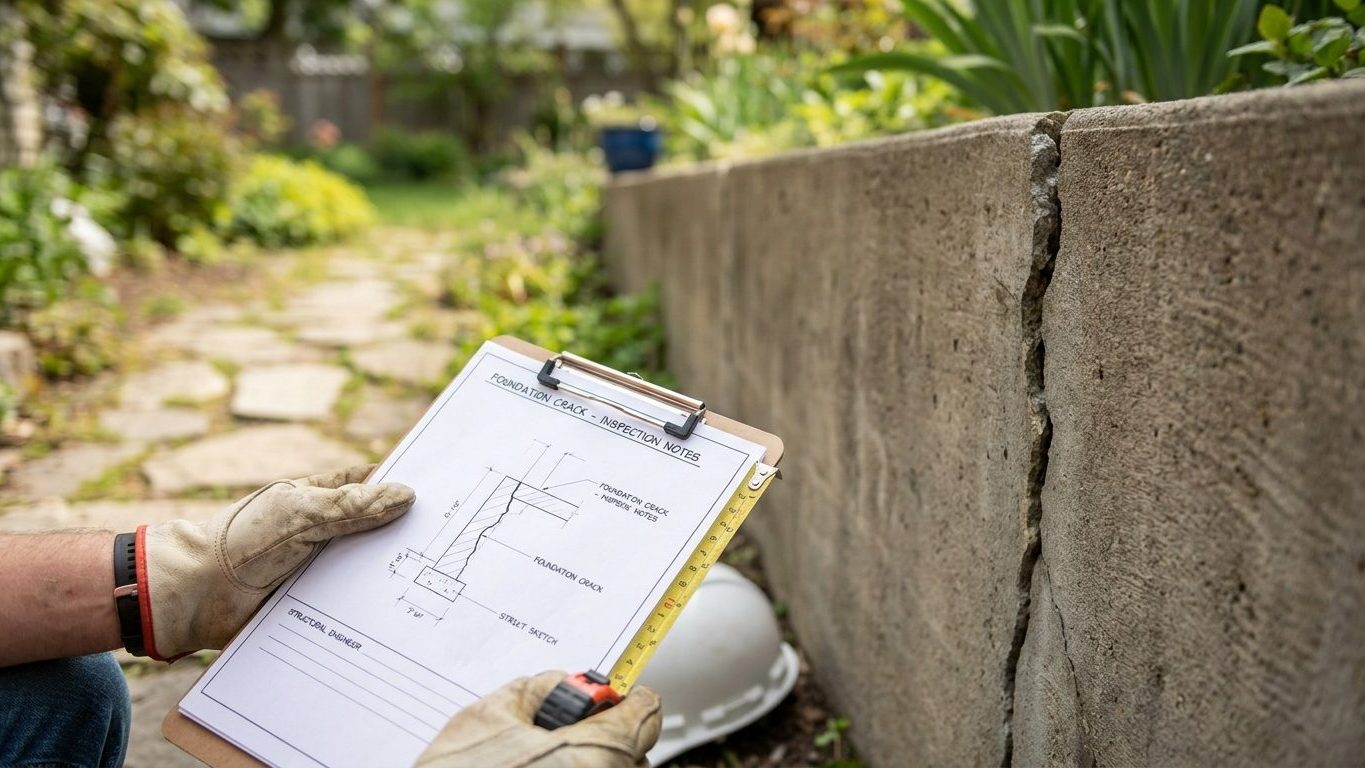

A diagonal crack that’s wider at the top than the bottom, a door that’s started sticking in its frame, or a floor that visibly slopes toward one wall: any one of these is where guessing stops and a structural engineer gets called. The fix from here isn’t a repair crew, it’s an independent assessment from someone with no stake in what gets sold afterward. Call a licensed structural engineer directly, not the in-house engineer of a foundation repair company, before any contract gets signed.
What is actually going on

An engineer’s whole value is that they don’t sell the fix. A structural engineer inspects a foundation, writes a report on what’s causing the movement, if there is movement, and states what, structurally, needs to happen next. They don’t pour concrete, install piers, or spray sealant on a wall. That separation is the entire reason to pay for the visit: a company that profits from the repair has every incentive to find a problem large enough to justify one, and plenty of homeowners have paid to fix a crack that never needed fixing at all.
Foundations move for reasons that have nothing to do with the crack itself. Soil under a footing expands and contracts with moisture. A footing poured to an uneven depth settles unevenly later. Tree roots pull water from soil on one side of a house and leave the other side alone. None of that shows up as a number you can read off a wall. It shows up as a pattern, and reading the pattern is the actual job.
The short list that matters
A handful of signs are worth remembering, because together they change the conversation from cosmetic to structural.
- A crack running diagonally, especially one visibly wider at one end, points to differential settling rather than simple curing shrinkage.
- A stair-step crack following the mortar joints in a block or brick wall moves the same way and means the same thing.
- Doors and windows that have started sticking, when they didn’t before, often move before a wall visibly cracks at all.
- A floor that slopes, or a new gap opening between a wall and the ceiling, is the same movement showing up somewhere other than the wall.
That list doesn’t tell you how serious the movement is, only that movement is a live possibility rather than old, settled history. Only a structural engineer can tell the difference between a crack that finished moving years ago and one that’s still opening, and no width measurement, however precise, substitutes for that judgment. Crack size alone doesn’t settle whether a specific crack is safe to leave alone. That call belongs to someone who has looked at the whole wall, the whole house, and the soil under it, not a photo of one section.
Why foundation type changes the picture
The kind of foundation under the house changes what these same signs look like. A slab shows movement as cracked tile grout or a drywall seam that keeps reopening, not a visible crack in a wall face. A crawl space shows it as a floor joist pulling away from a sill plate or a support post going slightly out of plumb. If it isn’t clear which foundation type is under the house, Slab, Crawl Space or Basement: What You Have walks through how to tell them apart, and that identification matters before anyone gets called out.
What an engineer’s report gives beyond the yes-or-no on structural risk is a starting point for everything downstream: whether the fix is a drainage change, a foundation repair, or nothing at all. Without that report, every repair contractor is diagnosing the same problem a homeowner is, just with a signed contract already in hand.
What to look at, and in what order
Work from cheapest and least invasive toward the one step that actually settles anything. Each step rules something in or out before the next one is worth the trouble.
| Step | What it involves | What it rules in or out |
|---|---|---|
| Walk the perimeter and interior | Note where cracking, sticking doors, and sloped floors show up in the same area of the house | Rules out isolated cosmetic cracking, like a drywall nail pop, that doesn’t line up with anything else |
| Check level of floors and frames | Use a basic level or plumb line on visible floors, door frames, and window frames | Confirms whether a slope is consistent across a room, which points to movement, versus limited to one old spot |
| Look at grading and downspouts | Note where downspouts discharge and whether ground slopes away from the house, without digging anywhere | Rules water in or out as a contributing factor before anyone talks about structure at all |
| Track the pattern over time | Photograph the same crack or gap at intervals, watching whether the pattern changes, not measuring it in inches | Rules out a static, old crack; rules in active movement that needs attention sooner |
| Structural engineer’s assessment | An independent inspection and written report on cause and recommended action, if any is needed | The only step that produces an actual answer rather than a suspicion |
An engineer is not a repair contractor
A repair contractor’s “free inspection” produces an estimate for a repair that company sells. It isn’t a neutral diagnosis, because the person writing it up is paid only if the answer is “yes, you need this.” A structural engineer’s report is paid for on its own, independent of any repair, and it’s the document a homeowner can hand to three different repair companies and get bids against, rather than trusting the first one that showed up. That grading check from the earlier step matters here too, since a good deal of what looks like foundation trouble traces back to water management around the house, covered fully in The Ground Around the House Is the First Fix.
Watch it, or get someone in
Some things are reasonable to keep an eye on. Others aren’t.
What can be monitored
A hairline crack in drywall that appeared shortly after a house was built, and hasn’t changed since, generally reflects ordinary lumber shrinkage and framing settling, not foundation movement. A thin, vertical crack in a poured concrete foundation wall that’s stayed the same size across a season or two, with no water coming through it, is something to note and recheck rather than act on immediately. Light efflorescence, the white powdery mineral deposit left after water evaporates, is worth watching if there’s no active dampness behind it.
What needs someone in now
A crack that’s visibly grown since it was first noticed, a door that has started sticking within the last several months when it never did before, a floor that’s developed a slope, or a wall that’s begun to bow inward all belong in the same category: call a structural engineer, not a repair company, and do it before signing anything. The same goes for a crack that runs through both an interior wall and the matching spot on the exterior, since that usually means the movement runs through the structure rather than sitting on the surface.
These are three different callouts, and mixing them up wastes time and money. A structural engineer answers whether the house is moving and why. A drainage contractor manages where water goes once that question is settled, regrading soil or extending downspouts. A waterproofing salesman sells a system, usually interior, for keeping water out of a basement, and has no business being the one who decides whether a wall is structurally sound. If the person recommending a repair is also the one who gets paid to perform it, that recommendation needs a second, independent opinion before it goes anywhere.
What has to happen first
Sequence is where money gets wasted on this subject more than anywhere else. Diagnosis has to come before repair, and outside water management has to come before anything done on the inside.
Outside before inside
A basement waterproofed from the inside while gutters still dump water against the foundation, or grading still slopes toward the house, treats the symptom and leaves the cause running. Gutters and downspouts get sorted first. A sump pump, where the site has one, gets checked and kept working before any interior finish goes back up. None of that requires a structural engineer, and none of it should wait for one either, since it’s the water side of the problem rather than the structural side.
Water before finishes
Insulation, drywall, and flooring installed over a basement or slab that hasn’t been confirmed dry, and structurally sound, has to come out again if a leak or a movement issue shows up later. That’s true whether the wall was going to get insulated or the floor was going to get new flooring: both wait until water and structure are settled questions, not open ones. For the full picture of how water drives most of what goes wrong with a foundation, and where each of these fixes fits into the order, see “/foundations/”>Foundations and Basements: Almost Everything Here Is Water.
An engineer’s report, when one’s needed, is the document that unlocks everything after it. It tells a homeowner whether the next call is a drainage contractor, a foundation repair company, or nobody at all. Skipping it and going straight to a repair bid means paying to fix a problem nobody has actually confirmed exists.
Common questions
How much does a structural engineer visit cost?
This varies by region and by the engineer, and no local figure is given here. Ask for a flat fee for the inspection and written report before scheduling, so the visit is a fixed cost rather than an open-ended one.
Do I need an engineer before I even call a foundation repair company?
Getting the engineer’s report first means walking into any repair conversation with an independent diagnosis in hand, rather than depending on the seller’s own assessment. It also gives something concrete to compare against if more than one repair company gets asked to bid.
Can I just fill the crack myself and see what happens?
Filling an undiagnosed crack hides the one thing that mattered: whether it was still moving. Once it’s filled, there’s no way to tell later whether movement continued underneath the patch, which is exactly the information an assessment needs.
Is a home inspector’s opinion on a crack good enough?
A general home inspector can flag a crack as worth a closer look, but that isn’t the same as a structural assessment. A home inspection is broad and visual, not a structural engineer’s independent, house-specific report.