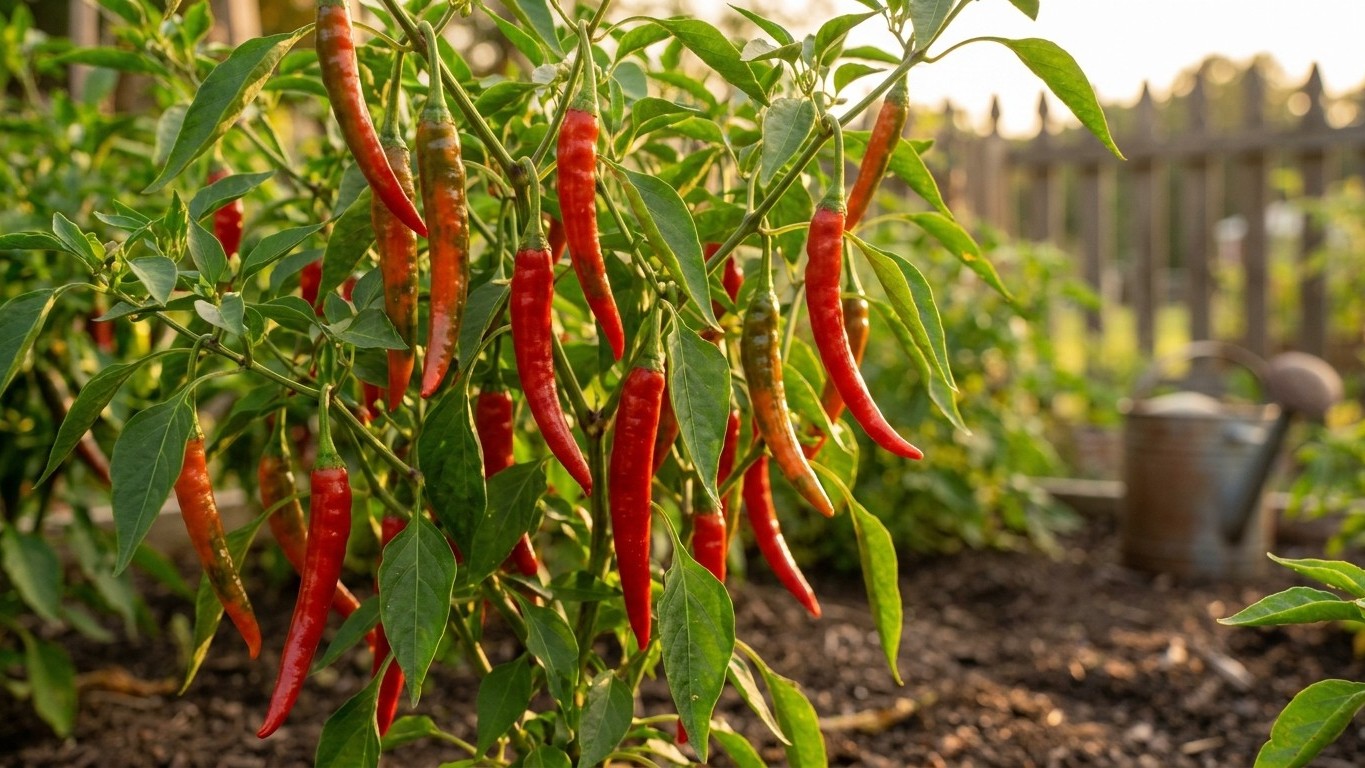

Pick peppers when the fruit reaches full size, feels firm and has a glossy skin. In Quebec that means harvesting once the fruit is ready, before the first frost. Clemson Extension counts 70 to 85 days from transplanting. Once picked, peppers should not go in the refrigerator. A domestic fridge runs colder than peppers tolerate, and below about 45 °F they pit and soften.
Keeping them, and for how long
Why does the fridge damage peppers?
Peppers are a warm-climate crop, and their fruit is sensitive to chill. Below about 45 °F (roughly 7 °C), the skin develops sunken pits and the flesh turns soft and watery. The damage can show up only after the pepper warms back up on the counter, which is why people blame the pepper instead of the fridge. Decay organisms then move into the damaged spots. The crisper drawer does not help, because it is still colder than the pepper wants.
Clemson Cooperative Extension puts the optimal storage conditions at 45 to 50 °F (about 7 to 10 °C) with 80 to 90 percent relative humidity. Under those conditions it gives two to three weeks. The humidity matters as much as the temperature. In drier air the skin wrinkles and the fruit loses firmness, even when the temperature is right.
How long do picked peppers really last?
Two to three weeks is a ceiling. It describes fruit picked at the right stage, free of damage, and held in near-perfect conditions. A pepper with a sunscald patch, a bruise or an insect hole will not get there. If holes are the problem in your garden, What Eats Pepper in Quebec, and When covers which pests to look for and when they show up.
A few habits stretch the time you do get. Cut the fruit with a short piece of stem instead of pulling it, since a torn shoulder is an open door for rot. Handle peppers gently. Skip washing until you are ready to use them, because surface moisture speeds decay. Sort the pile every few days and use the softest ones first.
When are peppers ready to pick in Quebec?
The clock starts at transplanting. Utah State University Extension says transplants need 8 to 10 weeks indoors, and they should go out when the soil reaches 60 °F (about 16 °C), after frost. Environment and Climate Change Canada’s climate normals put the mean last spring frost at May 6 at the Montréal/St-Hubert A station. That is the midpoint of a window. In one year out of two the last frost comes later, and northern or upland districts run weeks behind that station. Counting 70 to 85 days from a transplant date near the end of May lands the first full-size fruit in August.
Fruit set can push that date back. Utah State Extension says pepper flowers fail to set fruit when nights fall below 55 °F (about 13 °C) or days climb above 90 °F (32 °C). The hot end is uncommon in Montréal. At the Montréal/Pierre Elliott Trudeau Intl A station, 2.8 days a year reach 32 °C, and 9.3 days a year reach 30 °C. Cool nights are the more likely trouble, and no regional average tells you what your own garden does after dark. Keep a thermometer outside in June and July and watch the lows. Once a flower does set, Utah State puts the wait at 35 to 45 days from flowering, so watch the fruit rather than the calendar. For the full list of causes, see Why Peppers Fail to Set Fruit in Quebec.
Color is a matter of taste. Green peppers are edible once they are full size and firm. Leaving them on the plant to turn red, yellow or orange builds sweetness but takes extra weeks, and the plant keeps carrying that fruit. In a Quebec fall, that extra time runs into the first frost. When frost is in the forecast, pick everything that is full size, whatever its color. The rest of the growing picture is in Growing Peppers in Quebec.
Where in the house that actually is
The target of 45 to 50 °F is awkward in a real house, because most rooms miss it on one side or the other. The fridge is too cold. The kitchen counter, a sunny windowsill or any heated living space is too warm. Peppers kept there soften and shrivel much faster than the two to three weeks would suggest. Keeping them near a bowl of ripening fruit is a bad idea too, since that fruit gives off ethylene gas, which hastens ripening and decay.
The garage looks promising and often disappoints. In a Quebec fall it swings with the weather, mild on a sunny afternoon and close to freezing overnight. Peppers that get frozen turn translucent and collapse, and one cold night is enough. A garage can work in early September if you check it. By October it is a gamble.
The room that usually comes closest is an unheated but frost-protected space inside the house envelope. A cold cellar is the classic choice. A basement corner on an outside wall, away from the furnace and the water heater, is the next best. Many Quebec basements run cooler than the rest of the house through the fall, and their humidity is often higher, which suits peppers better than a dry kitchen does.
Put a min-max thermometer next to the peppers for two days before you trust a spot. Skip that step and you could lose the whole harvest to a room that looks cool and is not. Read the high and the low, not just the number on the display. If the room settles above 50 °F, use the peppers sooner than the two-to-three-week ceiling. If it dips below 45 °F, move them. A small hygrometer is worth having as well. In a dry spot, a loosely closed perforated bag holds moisture around the fruit without trapping so much that it rots.
Common questions
Can I put peppers in the fridge if I have nowhere else?
You can, but expect a shorter life and some pitting. If the fridge is the only option, use those peppers first, and do not judge the harvest by them. For fruit you cannot use in time, chopping and freezing is a better answer than a long stay in the crisper.
How do I know a pepper is ready to pick?
Look for full size for the variety, a firm feel and glossy skin. A pepper that feels thin, soft or dull is not there yet, or has been left too long. Cut it from the plant with pruners or scissors, leaving a short stem. Pulling can snap the branch.
Does picking early make the plant produce more?
Regular picking keeps the plant from carrying a heavy load of mature fruit, which lets it keep flowering. Letting every pepper hang until fully colored slows that cycle. Late in the season, the reverse applies: pick it all before frost.
When should I transplant, and how early should I start seeds?
Start seeds 8 to 10 weeks before you plan to transplant. Put plants out after frost, once the soil reaches 60 °F (about 16 °C). The mean last spring frost at the Montréal/St-Hubert A station is May 6, but that is only the middle of the range, so check the forecast and your own soil. Colder districts should wait longer.