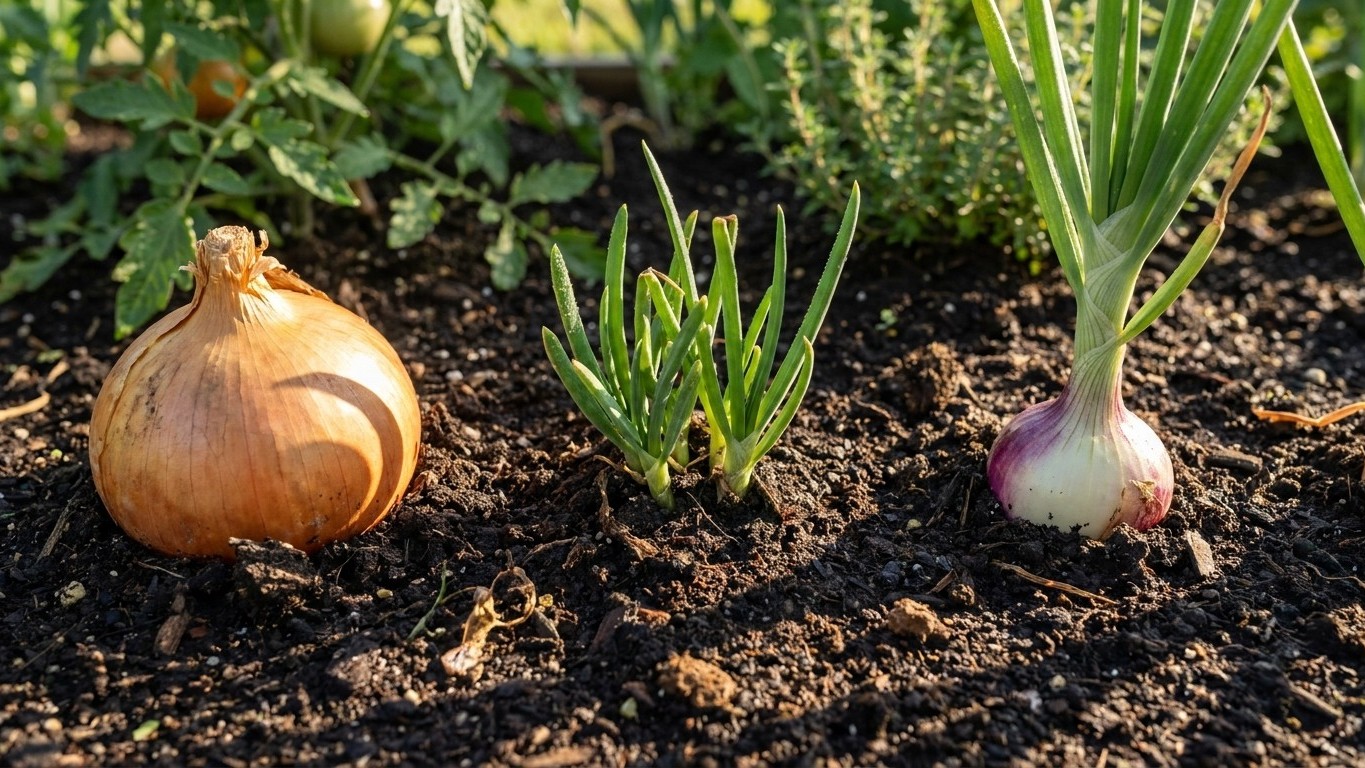

Lift onions in Rhode Island once most of the tops have flopped over and gone yellow, usually from late July into August. Pull them on a dry day and cure them in a shaded, airy spot until the necks are tight and the skins feel papery. Only then do they go into storage. Pungent onions cured this way can last well into winter. Sweet onions are for eating in the first weeks after harvest.
Keeping them, and for how long
Storage life is mostly decided before the onion leaves the ground, and day length is what sets it up. An onion makes leaves until the days are long enough, then switches to making a bulb. NOAA’s National Centers for Environmental Information (NCEI) places the Providence station at 41.72 degrees north. At that latitude the longest day of the year brings 15 h 02 of daylight, by a standard sunset-hour-angle calculation at the June solstice (the geometric horizon, so real daylight runs about seven minutes longer). Rhode Island is small and the number shifts little across the state, but a gardener on Block Island or up near the Massachusetts line can check their own latitude to be sure.
Clemson Cooperative Extension’s Home & Garden Information Center says short-day onions start bulbing at about 12 hours of daylight. In Rhode Island that happens early in the season, so they make small bulbs. Long-day types wait for 14 to 16 hours, and 15 h 02 sits squarely in that window. That is why the long-day varieties are the ones that size up here and also the ones that keep. The best onion varieties for Rhode Island are mostly long-day types for this reason.
Why do sweet onions rot first?
The bite of an onion comes from volatile sulfur compounds, and those same compounds help protect the bulb in storage. A sweet onion carries fewer of them. University of Missouri Extension (guide G6355) puts it plainly: “As a rule, ‘sweet’ onions do not store as well as the more pungent types.” Short-day onions tend to run sweeter and long-day onions tend to keep longer. A southern garden gives onions to eat soon, and a northern one gives onions that can feed you into March.
| Onion type | Sulfur compounds | Best use | Storage |
|---|---|---|---|
| Sweet, usually short-day | Fewer | Raw, in the first weeks after harvest | Poor |
| Pungent, usually long-day | More | Cooking, winter supply | Good |
What temperature and humidity do cured onions need?
Clemson Extension states it this way: “Ideal conditions are between 45 °F and 55 °F, and 50 to 60 percent humidity.” In practice that means 45 °F to 55 °F with 50 to 60 percent humidity. Onions want it dry, which is the opposite of carrots and other roots. A single cellar cannot hold both well, so decide which crop gets the good spot.
Treat any storage duration as a ceiling reached under those ideal conditions. A well-grown, well-cured, pungent onion can feed you into March, and a warm spell, a damp corner or a bruised bulb will shorten it. Check the stored crop every few weeks and eat the soft ones first.
Where in the house that actually is
Few homes have a spot that matches those numbers exactly, so the goal is the closest room. A kitchen counter or any heated living space runs warmer than the range, and warm onions sprout early. A refrigerator runs colder than 45 °F, and its crisper drawer is humid, which is the wrong direction on both counts. An attached garage swings with the weather. In Rhode Island it can freeze in January and bake in August, and a frozen bulb turns to mush when it thaws.
The cool, dry interior spots come closest. Think of a closet on an outside wall of an unheated room, a spare bedroom with the heat turned down, or a basement corner away from the furnace and the water heater. Many Rhode Island basements run damp, especially near the coast in summer. A basement that tops 60 percent humidity is a better place for carrots than for onions, unless a dehumidifier brings it down.
The only way to know is to measure. Put a thermometer with a humidity reading in the spot you plan to use and watch it for a week before the onions go in, because skipping that step means finding out in January that half the crop has sprouted or gone soft. Read it morning and evening, and again after a rainy day. If the reading sits between 45 °F and 55 °F and 50 to 60 percent humidity, store there. If it runs warm, pick another room. If it runs damp, add air movement or a dehumidifier.
Once you have a spot, store onions in mesh bags, open crates or slatted baskets so air moves around every bulb. Keep them in a shallow layer and out of plastic bags, which trap moisture. Keep them away from the potato bin as well, since potatoes give off moisture and prefer a different setup.
How do you lift and cure onions in Rhode Island?
When are onion tops ready to lift?
Watch the plants, not the calendar. Late in the season the necks soften and the tops fall over on their own, and once most of the patch has toppled and begun to yellow, the bulbs have finished sizing up. Stop watering about the time the first tops lean so the outer skins can dry. Then choose a dry day, loosen the soil with a garden fork and lift the bulbs by hand. Shoving a shovel through the row nicks bulbs, and a nicked onion will not keep.
How do you cure onions step by step?
Curing dries the neck and the outer skins so the bulb is sealed against rot. Bulbs go into storage only once the necks are tight and the skins papery, never straight from the ground. Leave the tops on while they dry.
- Spread the onions in a single layer on screens, racks or slatted crates, off the ground.
- Choose a shaded spot with good airflow, such as a covered porch, an open shed or a garage with the door up.
- Bring them under cover during rain, and keep them out of direct afternoon sun, which can scald the bulbs.
- When the neck is tight and the skins are papery, trim the tops to a short stub, brush off loose soil and move the bulbs to storage.
While you handle them, sort as you go. Bulbs with thick necks, soft spots, bruises or damage from insects go in a bowl for the kitchen, not into storage. Onion maggot and thrips damage opens the door to rot, so it helps to know what eats onion in Rhode Island, and when. For a wider look at the whole season, start with onions in Rhode Island.
Common questions
Can I store sweet onions through the winter?
Not reliably. University of Missouri Extension notes that sweet onions do not store as well as the more pungent types, because they carry fewer of the sulfur compounds that protect the bulb. Eat them within the first weeks, or slice and freeze them for cooking.
Can I keep cured onions in the refrigerator?
A refrigerator is colder than the 45 °F to 55 °F range Clemson Extension recommends, and its humidity runs higher than the 50 to 60 percent onions prefer. It is fine for a cut onion or a bulb you plan to use soon. For a whole winter crop, a cool, dry, airy room does better.
How long will cured onions last?
Under ideal conditions, a pungent onion grown in a northern garden can feed a household into March. That is the best case. Warm rooms, damp air, bruised bulbs and necks that were never fully dried all cut it short, so check the crop every few weeks and use the soft ones first.
Can onions share a cellar with carrots?
Poorly. Carrots and other roots want humid air, and onions want 50 to 60 percent humidity. A single space cannot do both well. If you have only one cellar, give the onions a shelf at the driest, coolest end and keep the roots in damp sand or a separate crate at the other.