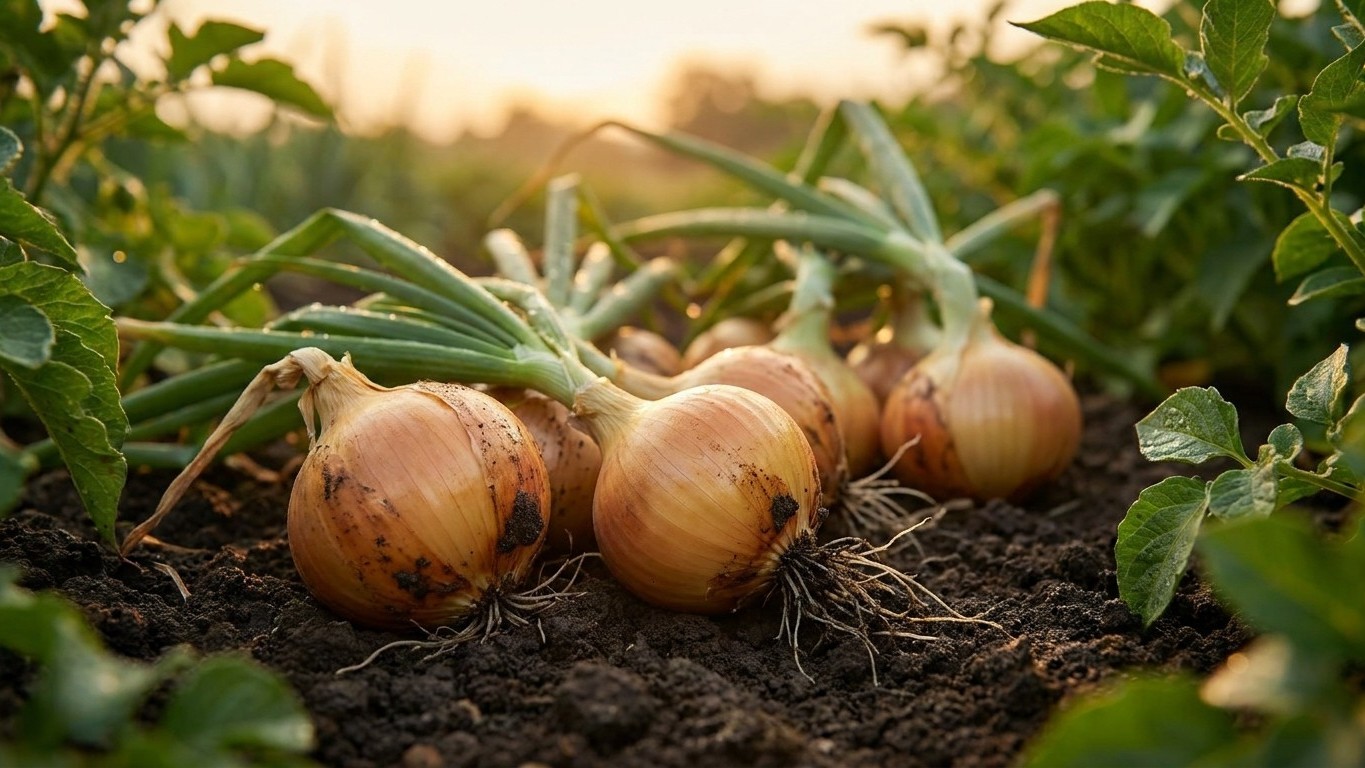

Lift onions once most of the tops have fallen over and turned yellow, which in the Southeast usually means late spring. Pull them on a dry day. Cure them in shade, with air moving, until the necks are tight and the skins feel papery. Only then do they go into storage. Sweet onions will not last long however well you cure them, so eat those first and keep the pungent bulbs for the pantry.
How do you know when onions are ready to lift and cure?
The plant decides, and day length tells it when. Bulbing starts when the days pass a threshold, regardless of how warm the weather is. Clemson Cooperative Extension puts that threshold at about 12 hours for short-day varieties. The reference city sits at 32.90 degrees north and gets 14 h 10 of daylight on the longest day, so short-day onions start swelling early in spring and finish before the worst heat arrives. Long-day varieties wait for 14 to 16 hours, and the longest day here only just reaches the bottom of that range. They are a poor fit for the coast (the best onion varieties for South Carolina are the short-day types). The far north of the state gets more summer daylight than the coast, so a gardener in the Upstate should check their own latitude before leaning on the Charleston numbers.
When are onions ready to lift?
Watch the tops, not the calendar. When the leaves lose their stiffness and bend over at the neck, the bulb has stopped growing. Stop watering as soon as the first tops fall. Wet soil at this stage keeps the neck soft and invites rot. Once most of the tops are down and yellowing, loosen the soil beside the row with a garden fork and lift the bulbs by hand. Pulling on the tops tears them and bruises the neck, and a bruised neck is where rot gets in.
Pick a dry stretch. Late spring in the humid South can turn rainy with little warning, and onions that sit wet on the ground after lifting start to spoil. Check the forecast before you lift the whole bed. Set aside any bulb that shows pest damage, since tunneled or chewed bulbs rot first (what eats onions in South Carolina, and when covers what to look for). Those go in the kitchen this week.
How do you cure onions?
Curing dries the outer skins and seals the neck so the bulb does not take in moisture or rot from the top down. Lay the bulbs in a single layer on a screen, a wire rack or slatted crates, off the ground, in a shaded spot with moving air. A covered porch or an open-sided shed works. Keep them out of direct sun. Strong afternoon sun can scald the bulbs and leave soft, bleached patches. Leave the tops on while they dry.
A bulb is cured when the neck is thin, tight and dry, with no give when you squeeze it, and the outer skin rustles like paper. Humid weather slows this, so give it longer in a damp spell and run a fan if the air is still. Then trim the roots and cut the tops down to a short neck, and brush off loose soil. Do not wash the bulbs. A thick, green, stubborn neck that never dried means the bulb did not finish properly, and it goes to the kitchen first along with any bruised ones.
Keeping them, and for how long
Clemson Cooperative Extension’s Home & Garden Information Center gives the target in one line: “Ideal conditions are between 45 °F and 55 °F, and 50 to 60 percent humidity.” (Clemson HGIC factsheet on onions, leeks, shallots and garlic). The number to write on a sticky note is 45 °F to 55 °F with 50 to 60 percent humidity. Cool, dry and airy is the whole recipe.
Dry is the part gardeners get wrong. Carrots, beets and other root crops want cold and damp, and onions want the opposite. A single cellar cannot hold both well, so if you grow both, give the onions a separate spot. Damp air softens the skins and lets rot move from bulb to bulb. Curing comes first. Bulbs go into storage only once the necks are tight and the skins papery, never straight from the ground.
How long they last depends on the variety, and any length you hear is a ceiling that needs the ideal conditions above, not a promise. University of Missouri Extension states the rule plainly: “As a rule, ‘sweet’ onions do not store as well as the more pungent types.” The reason is chemical. An onion’s bite comes from volatile sulfur compounds, and those same compounds help protect the bulb in storage. A sweet variety has fewer of them, which makes it better raw and worse at surviving the winter. Pungent onions keep better in storage than sweet ones. Sweet onions do not keep as well as the more pungent types, even when stored well.
Day length lines up with this. Short-day types run sweeter and long-day types keep longer. A southern garden therefore gives you onions to eat soon, while a northern garden grows onions that can feed you into March. Do not plan on a sweet onion that stores, because it will not oblige.
Store the bulbs in mesh bags, open crates or baskets, never in a sealed plastic tub, and never stacked deep. Look through them every few weeks. One soft bulb can spoil its neighbors, so pull out any that feel soft at the neck or smell sour. Use sprouting bulbs first.
Where in the house that actually is
A domestic refrigerator runs colder than onions like, and its air is damp. Cold and humid air work against the bulb, so keep the store dry. Keep a cut half in the fridge for a few days if you must, but not the whole crop. A heated room is the opposite problem, since it sits well above the 45 °F to 55 °F range and wakes the bulbs up. They sprout and shrivel. A garage or shed is cooler on paper, but it swings with the weather. A closed garage in a South Carolina summer gets hot, and in a cold snap it can drop low enough to hurt the bulbs.
The honest answer for most houses here is the coolest interior spot you have. Think of a closet on the shaded side of the house, a pantry against an inside wall, or a cool back room with the vents closed. Basements are rare near the coast, and in places that have one it is often damp, which is the wrong condition. Late spring and summer are the hard months. Indoor temperatures sit above the target range from the time you harvest until fall, so expect to eat the sweeter bulbs quickly and to keep the pungent ones in the coolest, driest place you can find until cooler weather arrives.
Do not guess at a spot. Put a thermometer with a humidity readout where the onions will sit and read it for several days, mornings and evenings, before you load them in. Skipping that check is how a whole season’s crop ends up soft by midsummer in a closet that looked cool. If the reading drifts above 55 °F or the humidity climbs past 60 percent, move the onions or run a small fan for air movement. Check the readout again after a rainy week.
Common questions
Can I store sweet onions through the winter?
Not reliably. Sweet onions have fewer of the sulfur compounds that protect a bulb in storage, so they soften sooner than pungent types. Eat them first, and store the pungent bulbs for later in the season.
Can I keep cured onions in the refrigerator?
A refrigerator runs colder than the 45 °F to 55 °F range and holds more moisture than onions like, so it is a poor place for a whole crop. Use it only for a cut onion, wrapped, and for a short time.
Should I cut the tops off before curing?
Leave them on while the bulbs dry. The neck seals as the tops dry down. Once the necks are tight and the skins are papery, trim the tops to a short neck and clip the roots.
What if the tops never fall over?
Stop watering and let the bed dry. If the tops stay green and the bulbs have swelled, you can still lift them. A bulb with a thick, green neck keeps poorly, so use those first. Growing a variety suited to the length of day in your area (see onions in South Carolina) avoids most of this.