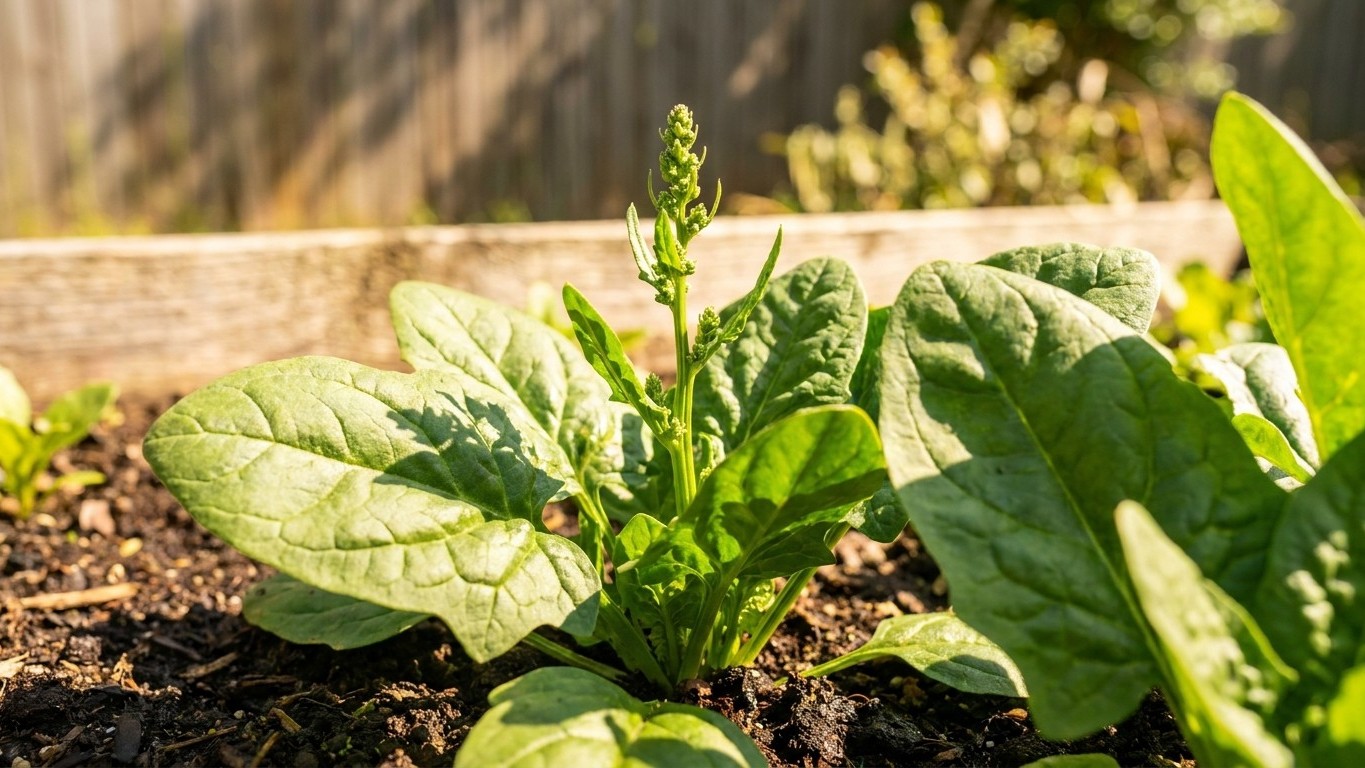

Spinach tells you when it is ready: a full rosette of broad leaves, cut before a stalk starts climbing from the center. The calendar only frames that signal. Frost dates mark the good spring and fall stretches, and heat closes the spring one. What happens after the knife matters just as much, because spinach is a short-keeping crop that gives about two weeks at best, and only in serious cold. Sowing and variety basics are in Growing Spinach in Kansas.
When spinach is ready in Kansas
Cut spinach once the plant has a full rosette of broad, dark outer leaves and the center is still a tight tuft, before any stalk starts to rise. For spring sowings around the Wichita reference station, check your own county for the last spring frost, and for fall sowings watch for the first fall frost. Treat those as a range that slides with your own weather.
The frost dates behind that range come from NOAA NCEI climate normals for the Wichita airport station. The last spring freeze falls between April 4 and April 18, and the first fall freeze between October 23 and November 2. Suburban and rural gardens usually freeze later in spring and earlier in fall than an airport does, often by one to two weeks, and more at elevation. Your county extension office can tell you how far your ground sits from the airport.
How do you tell spinach is ready to cut?
Look at the center of the plant. A young rosette has flat, rounded leaves, and the middle stays low and crowded. When the center leaves turn narrow and pointed and the plant begins to stretch upward, it is heading for a flower stalk, and the harvest window is nearly shut.
Before that point you have two options. Take outer leaves only and leave the center to keep producing, or cut the whole plant just above the crown. Outer-leaf picking spreads the harvest over more days. A whole-plant cut makes sense when the weather is turning and you would rather bank the crop than gamble on another pick.
Why does spring spinach run out so fast in a hot climate?
Utah State University Extension says spinach grows best where temperatures do not exceed 75°F. That figure is both a growth ceiling and the point where leaves start turning bitter. Wichita averages 57.6 days a year at 90°F or higher, so once the heat arrives, the plant stops being pleasant to eat long before it dies.
Day length adds a second push. The longest day at the reference city runs 14 hours and 36 minutes of daylight, and long days trigger flowering in spinach along with warmth. A cool June therefore does not buy extra weeks, because the days are already long. If you want the full mechanism and how to slow it, see Will Spinach Bolt Early in Kansas?
When can you cut a fall crop?
Count back from the first fall frost window and check your own county for the sowing date. That is also when the soil is still hot. Seed germination drops above 80°F soil, so the planting window opens when the soil cools, not when the air starts to feel like fall.
A cheap soil thermometer settles the question. Sow when the top inch of ground has dropped under that mark, and shade the row if a late heat wave returns. The extension publication names varieties to look for.
Keeping it, and for how long
The UC Davis Postharvest Technology Center, in its produce fact sheet on spinach, gives the optimum storage temperature as 0°C, which is 32°F, with an optimum relative humidity of 95-98%. It calls spinach highly perishable and says it will not maintain good quality for more than 2 weeks. That is a ceiling set under ideal conditions, not a plan for your refrigerator.
How long does spinach last after you cut it?
The same fact sheet says wilting, yellowing of leaves and decay are likely to increase following storage beyond 10 to 14 days. So the realistic picture is a window that begins to close in the second week even when the temperature is right. Treat the first days as the dependable stretch and anything after that as a bonus.
The clock starts at the cut. Spinach picked in the morning and chilled promptly has the full allowance to work with. A bag bought at a supermarket has already spent days in the distribution chain, so by the same logic it has fewer days left than a bunch from your row.
What happens when spinach is kept warmer than 32°F?
The fact sheet notes that decline comes faster at common distribution conditions of 5 to 10°C (41 to 50°F). That range is only a few degrees above the optimum, yet it is where most home refrigerators sit in practice. Spinach stored there yellows in days rather than weeks.
Humidity matters as much as temperature. A reading of 95-98% is close to saturated air. Leaves are thin and mostly water, and they lose it quickly into the dry air of a refrigerator, which shows up as limp, dull, slightly leathery spinach. Cold slows decay and moisture slows wilting, and you need both to get anywhere near the two-week ceiling.
Where in the house that actually is
A domestic refrigerator runs warmer than 32°F, and its door runs warmest of all. Every time you open it, the door shelves get a rush of room air, so they commonly land in the 41 to 50°F range where spinach yellows in days. Skip the butter-and-condiment shelves for greens.
The closest match to the optimum is the back of the bottom shelf, where cold air settles and the temperature swings least. If your fridge has a crisper drawer, a closed one on that low shelf works well. A small refrigerator thermometer costs a few dollars and tells you whether your spot is near 32°F or closer to 40. Put spinach on the back of the bottom shelf, not the door, because the door is warmer. One caution: leaves pressed against the back wall can freeze in a fridge that runs very cold, so leave a little air between them and the wall.
How do you get high humidity inside a home fridge?
Use a bag, a damp wrap, or water under the cut ends. A loosely closed plastic bag holds in the moisture the leaves give off, which raises the humidity around them without any equipment. Leave a gap for air so the bag does not turn slimy.
A paper towel, wrung out until it is only slightly damp, can line the bag or wrap the leaves. Soaking wet leaves rot faster, so shake off or spin dry any rinse water first. For whole bunches with stems, stand the cut ends in water and cover loosely. The stems drink, and the leaves stay in humid air.
Common questions
Can you cut spinach more than once?
Yes, as long as the crown stays alive and no flower stalk has started. Take the outer leaves and leave the center, and the plant keeps making new ones. Once warm weather and long days push it toward a stalk, the regrowth turns bitter and sparse, and it is time to cut the whole plant.
Why does spinach turn bitter in late spring?
Temperatures above 75°F push the plant past its comfort zone, and that figure is also where bitterness starts. Leaves picked from a plant under heat stress taste sharper than leaves from a cool April row. Early picking, before the heat, gives the mildest spinach.
Can you plant spinach in August for a fall crop?
You can try, but hot soil is the obstacle. Germination drops when soil stays above 80°F, so seed sown into a warm bed can sit there with poor results. Wait until the ground cools, or sow in a shaded spot, and use the 50 to 75 days Utah State University Extension gives to work backward from the harvest date you want.
Should you cut early if something is chewing the leaves?
Cutting what is clean is a reasonable move when damage is spreading, since the leaves you take are leaves the pests cannot. Which pests turn up, and when, is covered in What Eats Spinach in Kansas, and When. Wash thoroughly and dry before storing, so any hitchhikers and the extra moisture are both gone before the leaves go in the fridge.