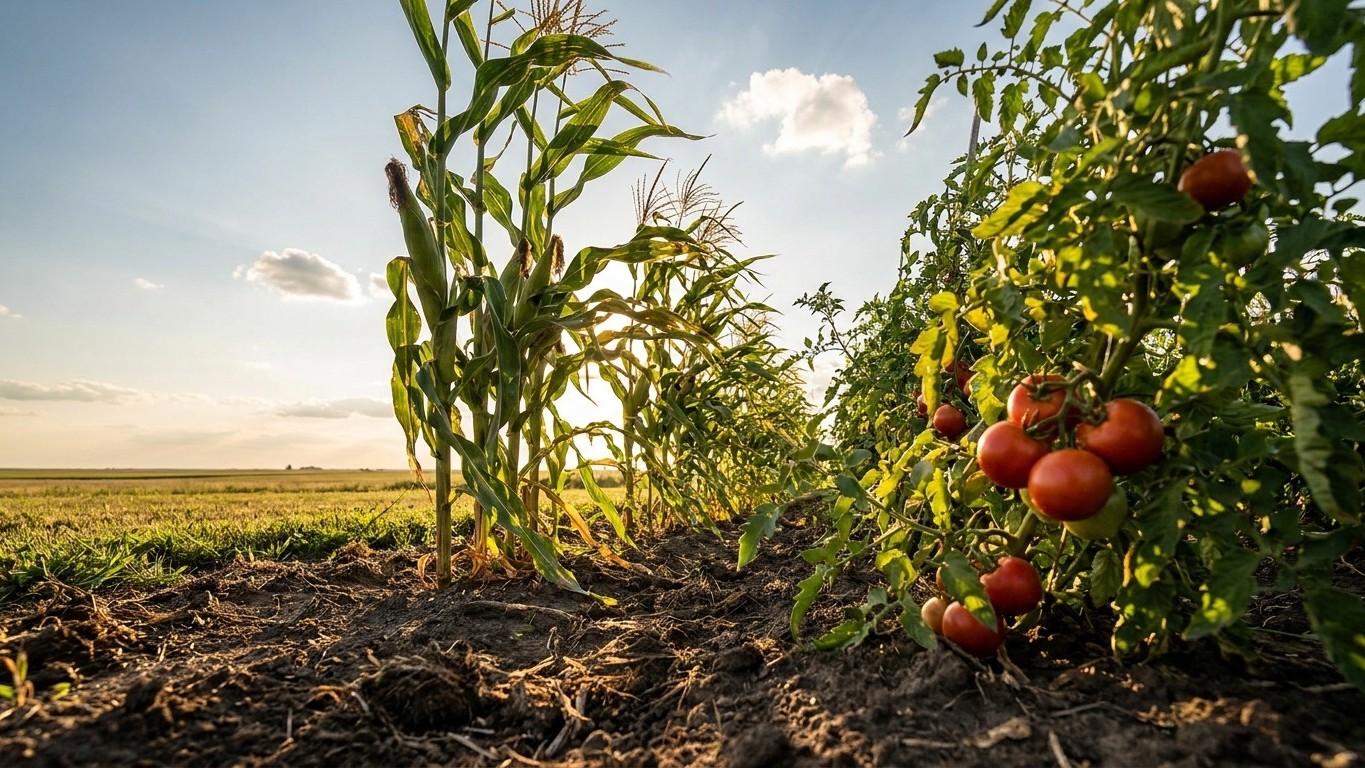

Vermont sweet corn comes ready from late July into early September, depending on when the garden was sown, and the plant itself tells you the right week. After picking, the clock runs fast. Clemson Extension says corn stored under optimal conditions lasts about five days at most, and it loses sweetness with each one. Here is how to read the ears and how to hold onto the sugar.
When sweet corn are ready in Vermont
Sweet corn is ready when three signs show up together: the silks at the ear tip are dry and brown, the husk is still moist and green, and a punctured kernel gives milky juice. In most Vermont gardens that lands from late July into early September, and the stretch after the first silks appear is the time to watch for the right week.
Two clocks run at once, and they answer different questions. Sixty to ninety days from planting, the range given by Utah State University Extension, tells you whether a variety fits your season at all. The count from silk emergence tells you which week to pick. Packet days to maturity count from sowing, so the silk count starts much later in the summer.
The planting date comes from the soil, not the calendar. Utah State says sweet corn needs soil above 60 F. Clemson Extension adds the depth that makes the reading usable: “Do not plant before the soil temperature at the 4-inch depth is at least 50 ºF. Wait to plant extra-sweet varieties until soil temperatures reach 65 °F.” Those two thresholds are not interchangeable. A supersweet seed sown at 50 F rots instead of sprouting, which is why a gardener can succeed one year and fail the next after changing variety.
Soil at 60 F arrives well after the last frost. NOAA’s NCEI climate normals for Burlington put the last 32 F freeze between April 30 and May 10 (the 30 to 70 percent probability band), and the ground takes more time to catch up. Push a thermometer 4 inches down in the morning before you sow. Our guide to when to sow sweet corn in Vermont covers that part in detail.
The other end of the season matters just as much. The same normals give a first fall freeze between October 3 and October 13. Burlington sits on Lake Champlain, the mildest corner of the state, so the Green Mountains and the Northeast Kingdom run substantially shorter. A variety that needs 90 days, sown in early June, may not finish on a hillside farm. Pick the shorter-season type there, and see Growing Sweet Corn in Vermont for the full season plan.
Can a neighbor’s corn change how sweet yours is?
Yes, if the types are mismatched. Utah State Extension warns that sweetness is lost when su, se and sh2 types tassel at the same time. It gives no separation distance, so build the plan on timing. Grow one type, or stagger plantings so one finishes tasseling before the next begins. Plant in blocks of three or more rows rather than one long row, because a block pollinates better. Ripe ears also draw raccoons and birds, and what eats corn in Vermont, and when explains who shows up.
Keeping them, and for how long
Picked corn starts losing sweetness immediately. Clemson Cooperative Extension states it plainly: “Sweet corn loses sugar from the kernel rapidly at high temperatures… Sweet corn can be stored under optimal conditions for about five days, but will lose sweetness with each day of storage.” That sentence is the reason for the old advice to run from the garden to the pot.
Read it as a ceiling. About five days is the most you can expect under optimal conditions, and it is not a promise. An ear left on a warm counter or in a hot car will fall short of it. The mechanism is simple: sugar leaves the kernel, and heat speeds that up. Cold slows it down.
How fast does each type of sweet corn lose sugar?
The genetics of the kernel set the pace. The standard su type loses sugar fastest. The se type holds it longer, and sh2 holds it longest. That is the practical reason to choose a type. If you pick a big armful and cook over several days, an sh2 or se type will taste better on day three than an su type will. If you eat the corn within an hour of picking, any of the three works.
The source gives no storage humidity, so rely on simple habits. Leave the husks on until cooking, since they protect the kernels, and don’t pile warm ears in a closed bag or a sunny basket. Pick in the cool of early morning or evening, because corn that has soaked up afternoon sun starts its sugar loss from a warmer place. Heat matters in Vermont too. Burlington averages 5.4 days a year at 90 F or more, and a harvest that falls on one of those days needs to move into the cold quickly.
Plan the harvest around the fridge, not the other way around. Pick what you can eat or process over the next couple of days, and pick again when the next ears pass the three-sign test. Staggered sowings help here, because they spread the ripening across weeks. A single planting ripens almost all at once, and a dozen dozen ears on one afternoon is more corn than the five-day ceiling lets you use.
Where in the house that actually is
Match the corn to a place in the house by how cold it stays and how steady that temperature is. The refrigerator comes closest. Sugar loss is a heat problem, so the cold direction is the right one, and a fridge holds a steady temperature day and night. A heated room is the worst option. A kitchen counter, especially near the stove, a sunny window or a dishwasher that has just run, is the warm place where the sugar goes fastest. A garage looks cool but swings with the weather: a September afternoon can bake it, and a clear night can chill it. It also gets hot on any of those 90 F days.
An unheated basement or cellar may be the second choice. Check it first, because it only beats the kitchen if a thermometer shows it cooler and steadier. Never assume.
How do you check the temperature with a thermometer?
An inexpensive appliance thermometer settles the question. Put a thermometer in the fridge before the first ear comes in, leave it for a few hours, and read it. Test the crisper drawer, a middle shelf and the door separately. The door shelf usually runs warmest, and the back of a shelf can run coldest. Put the corn in the coldest steady spot that does not freeze other food.
Corn is bulky, so you may have to clear space. Husks on, a dozen ears can fill a drawer. If space is the problem, shuck and cook the extras the same day and chill the cooked kernels, rather than leaving whole ears out where they warm up. Doing that gives you sweet corn you can eat later without keeping fresh ears past the five-day ceiling.
The same check works for a garage or basement. Read it at midday and again before bed for a few days in late summer, and you will see how much the space swings. A swing of several degrees is the signal that the place won’t hold corn well. Do it before harvest, because once the ears are in the house the sugar is already leaving.
Common questions
These are the quick answers that come up around the end of July.
How do I know when sweet corn is ripe?
Look for three signs together. The silks at the tip are dry and brown, the husk is still moist and green, and a punctured kernel gives milky juice. Any one alone can mislead you. Watch the first silks to know which week to start checking.
Can I plant sweet corn right after the last frost?
Usually not. Soil at 60 F comes well after the last frost, which falls between April 30 and May 10 at Burlington and later in the hills. Clemson Extension says to wait for 50 F at the 4-inch depth for ordinary sweet corn and 65 °F for extra-sweet types. Let the soil thermometer decide.
Will farm-stand corn keep for a week?
Not at full sweetness. Clemson Extension says about five days under optimal conditions, and sweetness fades with each day. Ask how recently the ears were picked, keep them cold, and expect an sh2 type to hold its sugar longest and an su type to lose it fastest.
Does corn in the next garden affect my crop?
It can if the types tassel at the same time. Utah State Extension warns that su, se and sh2 types lose sweetness in that case, so grow one type or stagger the plantings. Plant in blocks of three or more rows to pollinate well.
Your county extension office can tell you which short-season types do best at your elevation, which is worth a call before ordering seed for a hillside garden.