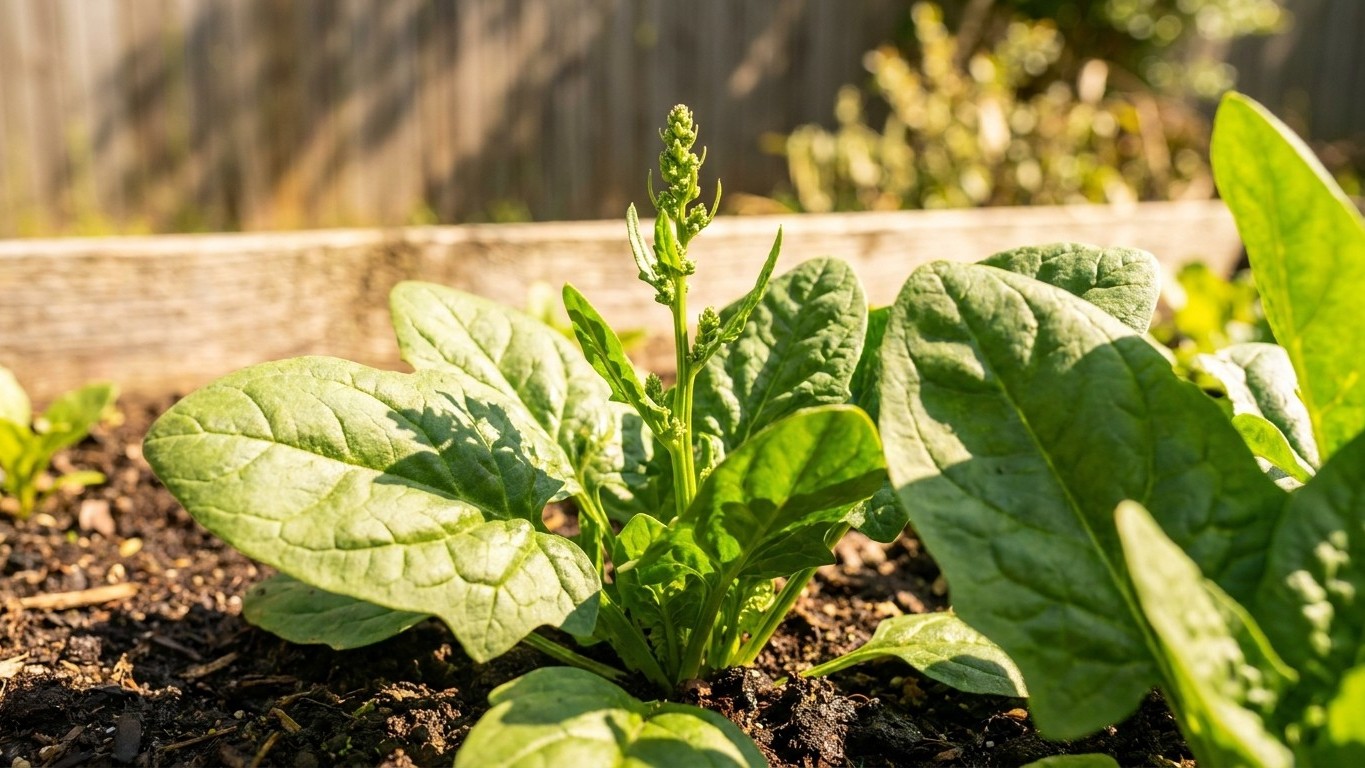

Cut spinach once the outer leaves are big enough to eat and the center of the plant is still a low, flat rosette. In West Virginia that happens in spring before the weather climbs past 75°F, and again in fall before hard cold. After cutting, spinach is a short-lived crop. UC Davis puts the ceiling at two weeks, and only at 32°F. A home fridge runs warmer, so plan on less. What follows covers the cutting windows, the storage numbers and the shelf that comes closest to them. For the full growing calendar, start with Growing Spinach in West Virginia.
When spinach is ready in West Virginia
The plant tells you before the calendar does. Start cutting when the outer leaves are about the length of your hand and the center is still a tight, low cluster. The date shifts with your elevation, your slope and the year, but that signal stays the same everywhere in the state.
What does spinach look like when it is ready to cut?
A few signs separate a good cutting from a late one:
- Outer leaves are broad, smooth and deep green, roughly a hand’s length.
- The center stays low and leafy, with no tall, thickening stem rising from it.
- New leaves are still rounded or lightly savoyed, not narrow and pointed.
- Leaves snap crisply and taste sweet, without a sharp edge.
Cut the outer leaves and leave the center, and the plant keeps producing for a while. Cut the whole plant at the base when you see the center starting to stretch. That stretch is the first step toward bolting, and once it begins the plant will not go back. The Will Spinach Bolt Early in West Virginia? page covers how to catch it early.
What are the spring and fall cutting windows?
The Charleston station, in the Kanawha River valley, gives the clearest reference for the state. NOAA NCEI 1991-2020 climate normals put the last spring freeze between April 9 and April 23, and the first fall freeze between October 18 and November 1. Spring spinach is sown as soon as the soil can be worked, so the first cutting comes in the weeks around and after that April window. Higher ground freezes noticeably earlier in fall than the valley does, so count back from your own first frost rather than Charleston’s.
Fall is the trickier season. Utah State University Extension advises planting a fall crop before the heat of summer returns. The obstacle at the start of that window is warm soil. Germination drops once soil climbs above 80°F, and a West Virginia late summer can keep it there. The sowing window opens when the soil falls back below that line, whatever the calendar says. Seed packets print their own days count, and for a direct-sown crop that count starts at sowing.
Why does summer end the harvest?
Spinach grows best where temperatures stay at or below 75°F, and that same number is where leaves turn bitter. Charleston averages 16.0 days a year at 90°F or higher, which is the heat the crop has to dodge. Heat is only half of it. On the longest day of the year the reference city gets 14 h 41 of daylight, and long days alone push spinach toward flowering. A cool summer, or a shady hollow, does not buy extra weeks. Plan on being done by the time the days are long and the afternoons are warm.
Keeping it, and for how long
What temperature and humidity does spinach keep best in?
The UC Davis Postharvest Technology Center lists the optimum for spinach at 0°C, which is 32°F, with relative humidity of 95 to 98%. That is cold enough to slow the leaf’s breathing almost to a crawl and humid enough that the leaf cannot dry out. A refrigerator set for milk and leftovers rarely hits both numbers. The cold is close on the right shelf, and the humidity needs help from you.
How long does cut spinach really last?
UC Davis calls spinach highly perishable and says it will not maintain good quality for more than two weeks. That is a ceiling under ideal conditions, with the right temperature and a high-humidity environment. It is not a shelf life to count on. The same source says wilting, yellowing and decay become more likely once storage goes past 10 to 14 days. It also says the decline is faster at the 41 to 50°F that common distribution conditions run at, which is about where a fridge door sits.
| Condition | What UC Davis reports |
|---|---|
| Optimum temperature | 0°C (32°F) |
| Optimum relative humidity | 95 to 98% |
| Quality ceiling | No more than 2 weeks |
| Decline begins | Beyond 10 to 14 days: wilting, yellowing, decay |
| Warmer handling (41 to 50°F) | Decline is faster |
Two weeks at 32°F is the best case. At warmer fridge temperatures, count on a shorter run. Spinach cut on a warm afternoon starts losing quality before it ever reaches the kitchen, which is one more reason to cut early in the morning while the leaves are cool and full of water. Garden spinach starts out fresher than anything off a truck, so you have a head start, but the clock runs the same.
Leaves that have gone limp but are not slimy or yellow can still be cooked. Slimy, dark or sour-smelling leaves go to the compost.
Where in the house that actually is
A home refrigerator runs warmer than the 32°F optimum, and the door runs warmest of all, because every time it opens it swaps cold air for room air. The door is where the 41 to 50°F range lives. That makes it the wrong place for spinach, however convenient the shelf looks.
The closest you can get is the back of the bottom shelf, or a crisper drawer set to its high-humidity position. Cold air settles low, and the back of a shelf sits farthest from the door’s warmth. Keep the spinach away from the vents of a frost-free fridge if you can, since air blowing straight from the cooling coil can freeze the leaf edges.
High humidity at home means keeping the leaves from drying while keeping them from sitting in puddles. A few approaches work:
- A loosely closed plastic bag holds the moisture the leaves give off.
- A damp paper towel or cloth wrapped around the leaves adds a little more.
- Stems of whole bunches stand in an inch or two of water, like cut flowers, with a bag loosely over the top.
Dry the leaves if they are wet from the garden hose, and keep the bag from sealing so tight that droplets collect and speed decay. Put the spinach on the back of the bottom shelf in a loosely closed bag with a damp wrap, because a bag on the door can turn yellow within days.
Check the bag every couple of days and pull out any leaf that has gone slick, since one decaying leaf spreads quickly through the rest. If you grew more than you can eat before it yellows, blanch and freeze the surplus or cook it down. Both beat watching a full bag turn to green slime on day twelve.
Common questions
Can I still cut spinach after it bolts?
You can, but the leaves turn bitter and small as the stalk takes over. Cut the whole plant, taste a leaf first, and use what is still sweet. Once the stalk is tall, the plant will not revert to leaf production.
How long does fresh-cut spinach last in the fridge?
UC Davis says spinach will not hold good quality beyond two weeks, and that is at 32°F and 95 to 98% humidity. In a home fridge the realistic window is shorter, and quality starts to slip after 10 to 14 days even in good conditions. Use it first among your greens.
Is the refrigerator door a good spot for spinach?
No. The door holds the warmest air in the fridge, and spinach declines faster at 41 to 50°F. Use the back of the bottom shelf or a humid crisper drawer.
Why does my spinach taste bitter?
Warmth is the usual cause. Spinach grows best at or below 75°F, and that number is also where bitterness shows up. Long days can add to it by pushing the plant toward flowering. Cut earlier in the season, and cut in the morning while the plants are still cool.