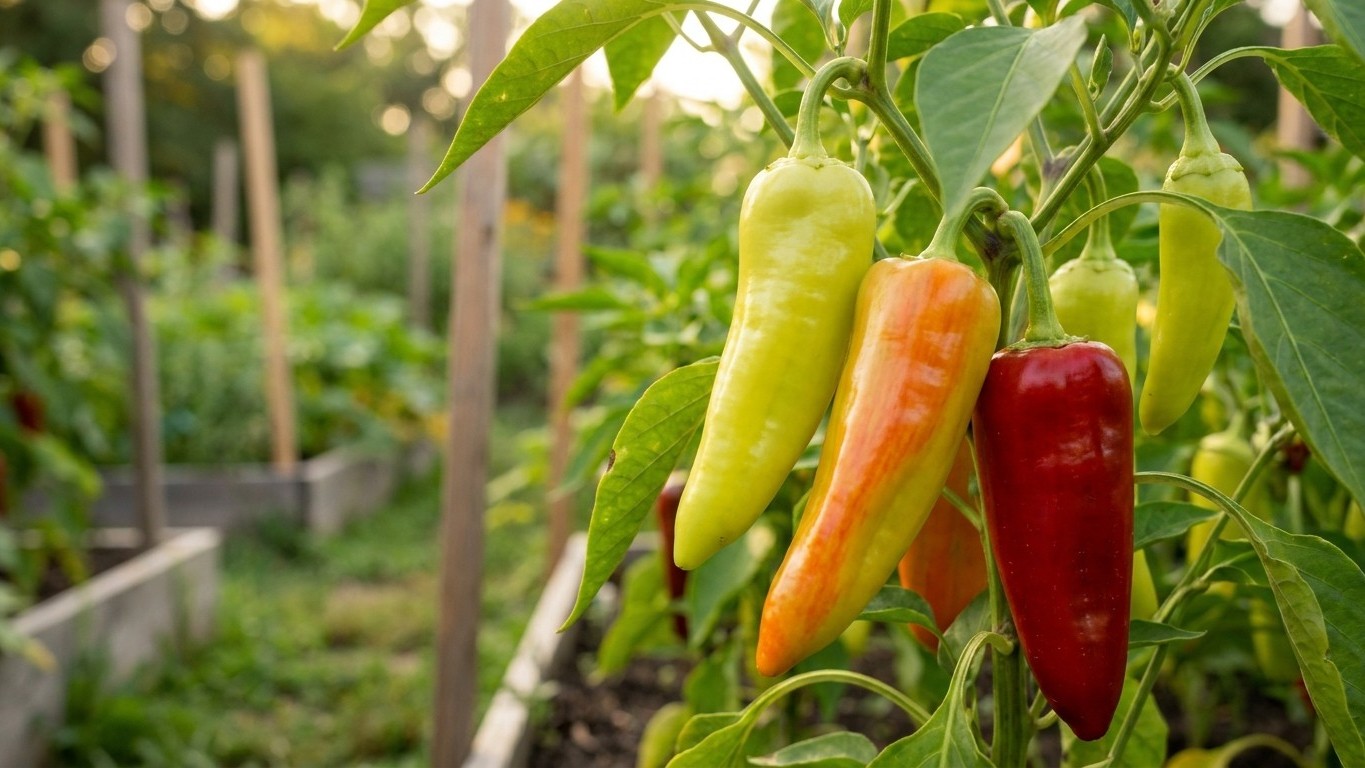

Pick peppers when they reach full size and feel firm and glossy. Clemson Cooperative Extension puts that at about 70 to 85 days after transplanting. In Newfoundland and Labrador that means late summer, and the fruit has to be in before frost. After that, keep it out of the refrigerator. A domestic fridge runs colder than peppers tolerate, and the cold leaves them pitted and soft. A cool room does the job far better.
Keeping them, and for how long
Why does the fridge damage peppers?
Peppers come from warm country, and their skin and flesh are injured by cold well above freezing. Below about 45 °F (roughly 7 °C) the fruit develops chilling injury: small sunken pits on the skin, soft patches, and a faster slide into rot. A domestic refrigerator sits below that line, so the crisper drawer, where nearly everyone puts them, is the wrong place. The damage often shows up after the pepper comes back to room temperature, which is why people blame the pepper instead of the fridge.
Clemson Cooperative Extension gives the target. The best storage conditions for peppers are 45 to 50 °F, with 80 to 90 percent relative humidity, for two to three weeks. That range is warmer than a fridge (the top end is 10 °C) and far more humid than a heated living room.
Treat the two to three weeks as a ceiling reached under ideal conditions. A pepper that was nicked at harvest, picked fully ripe, or kept a few degrees too warm will go sooner. Dry air pulls moisture out of the skin and the fruit wrinkles even when the temperature is right. Check the batch every few days and use any pepper that has started to soften.
When are peppers ready to pick in Newfoundland and Labrador?
The clock starts at transplanting. Clemson counts about 70 to 85 days from transplant to harvest. Transplants need 8 to 10 weeks indoors first, and Utah State University Extension says to move them out when the soil reaches 60 F (about 16 °C), after frost has passed. At the St. John’s A reference station, Environment and Climate Change Canada gives May 30 as the mean last spring frost. That is the midpoint of a window. In one year out of two the last frost falls later, and northern and upland districts run weeks behind the station.
Say a plant goes out in the first half of June. The 70 to 85 day count then points to ripe fruit from roughly mid-August into September. A cold, slow summer pushes that later, and a cool snap can stall fruit already on the plant.
Day counts on seed packets can mislead here. The 35 to 45 days a pepper needs to size up run from flowering, not from sowing or transplanting. A blossom that opens late in the season may never become a harvestable fruit before frost arrives.
Heat is not what ends the season at the reference station. St. John’s A averages 0 days a year reaching 32 °C, and only 0.16 days a year above 30 °C. The warm end of the fruit-set problem simply does not occur there. The cool end does matter. Utah State University Extension says fruit set fails when nights drop below 55 F (about 13 °C) or days climb above 90 F. Nobody can read your nights from a map, so keep a min/max thermometer in the garden through July and August. If blossoms keep dropping, the full breakdown is in Why Peppers Fail to Set Fruit in Newfoundland and Labrador.
For the cut itself, use pruners and leave a short stub of stem on each fruit. Pulling by hand tears branches. A pepper at full size, firm and glossy, is ready, and picking regularly keeps the plant producing. When frost is in the forecast, take everything that has reached usable size, because a frosted pepper deteriorates quickly. Look each fruit over before storing it. Chewed spots and punctures rot first, and What Eats Pepper in Newfoundland and Labrador, and When explains who is responsible and when they show up. For the bigger picture of the season, start with Growing Peppers in Newfoundland and Labrador.
Where in the house that actually is
Almost no spot in a house sits at 45 to 50 °F with 80 to 90 percent humidity by accident, but a few come close. The fridge is too cold. A heated kitchen or living room is too warm and too dry, so peppers there shrivel within days. A garage looks tempting, but it follows the weather. On a mild September afternoon it may be fine, and on a clear October night it can drop low enough to chill or freeze the fruit.
The best candidate in most houses is a cool, unheated but frost-proof space. A basement corner away from the furnace, a cold cellar, an unheated spare room or a porch that stays above freezing all qualify. Basements in damp coastal areas may already sit near the humidity range, which helps. A north-facing room with the heat turned down or the vent closed can work too.
Do not trust your hand to judge it. Leave a thermometer in the spot for two full days before you commit the harvest to it. A min/max model is ideal because it records the overnight low you would otherwise miss. A cheap hygrometer will tell you whether the air is anywhere near 80 percent. If the spot reads under 45 °F at night, the peppers will pit. If it holds well above 50 °F, plan on a shorter keeping time.
Once you have a spot, set the peppers in a single layer, or in a loosely closed or perforated bag with a dry paper towel. The bag slows moisture loss without sealing in condensation, and sealed, wet fruit molds. Go through them every few days and pull out any soft ones so the rest stay sound. Anything you plan to eat within a few days can stay on the counter.
Common questions
Can I put peppers in the fridge for a day or two?
You can, but the safer habit is to avoid it. Chilling injury builds with time below about 45 °F, and the pits and softness often appear only after the fruit warms up. Whole peppers belong in a cool room. Once a pepper is cut, the fridge is fine for the pieces, because you are no longer trying to store the fruit for weeks.
Should I pick peppers green or wait for color?
Either works. A pepper at full size, firm and glossy, can be picked green and eaten. Waiting for red, yellow or orange gives sweeter fruit but takes longer on the plant, and in a short season that wait carries a frost risk. If frost is in the forecast, pick everything of usable size, and fruit that has already started to color will often keep coloring indoors at room temperature.
How do I know the last frost is really over?
You can’t know it from a date. The mean last spring frost at St. John’s A is May 30, and in one year out of two it falls later. Treat that as the middle of a window. Transplants should also wait until the soil reaches 60 F, which is the Utah State University Extension guideline. If you are inland or north of the St. John’s area, expect to wait weeks longer, and ask your local extension or agriculture office what has been normal near you.
How long will peppers keep once they are picked?
Under the best conditions, 45 to 50 °F with 80 to 90 percent relative humidity, Clemson Cooperative Extension says two to three weeks. That is the most you can expect, not a promise. In a warm kitchen, plan on a much shorter time, and in a refrigerator expect pitting and soft spots.