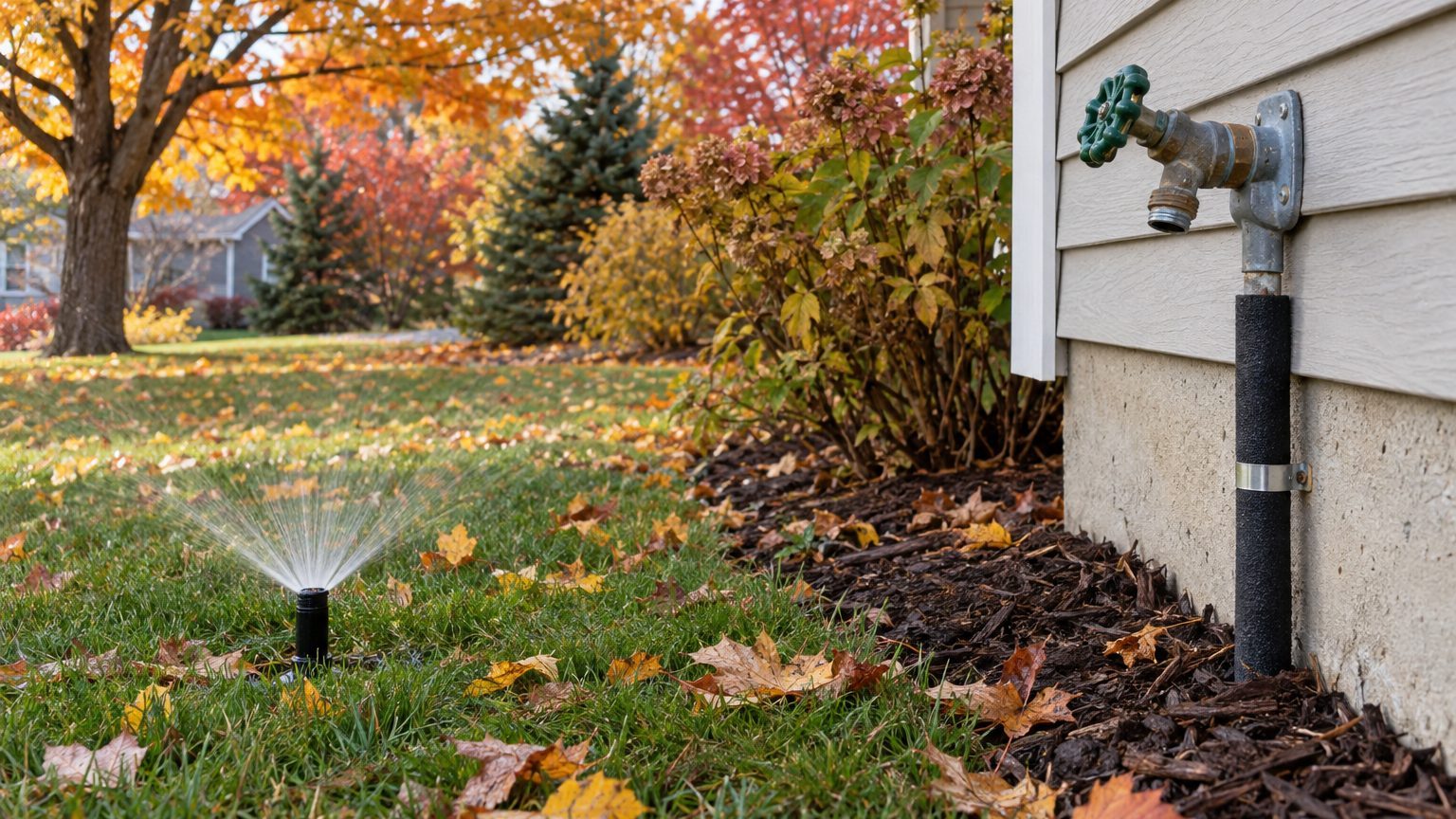

Winterize Virginia sprinklers and outdoor faucets before the first hard freeze. On the coast that means finishing ahead of mid-November, and in the mountains it means starting weeks sooner. The job is short: shut off the supply, get the water out of the lines and valves, and pull the hoses. Skip it and you won’t see the damage until the first warm spring day, when you turn the system on and a geyser shows you where the crack is.
When to do it in Virginia
Plan to winterize in the weeks before the first fall frost, which at Virginia Beach falls between November 10 and November 24 (NOAA NCEI 1991-2020 Climate Normals, the 30-70% probability band for a 32°F freeze at the NAS Oceana station). Do it before the first hard freeze, not after the first light one. On the coast, finish before the November 10 to November 24 stretch begins. The calendar is late October as this goes to print, so for Tidewater owners the window is open and the deadline is a couple of weeks off.
A light frost on a clear night burns off by midmorning and does little to buried pipe. The freeze that splits things is the night that stays below freezing for hours, with ice given time to build inside fittings. Forecasters flag that kind of night only a few days ahead. That is not much warning if you have several irrigation zones to drain and a compressor to track down, so work to the frost date and not to the forecast.
Virginia Beach is the mild end of the state, and that matters for how you read these dates. NOAA’s mean daily minimum for the coldest month there is 31.6°F, so the typical coldest night sits right at freezing, with plenty of nights above it and plenty below. Across the whole state the USDA Plant Hardiness Zone Map (2023, built on 1991-2020 normals and on the average annual extreme minimum) runs from 5a to 8b. A homeowner in the mountains lives in a very different winter from one at the beach.
Is a full blowout necessary on the Virginia coast?
Not always. Freezes on the coast are real, since 31.6°F sits just under 32°F, but they tend to be short, and a short freeze gives ice less time to wreck buried pipe. If the system has automatic drain valves and the lines slope to them, a coastal owner can often skip the compressor and rely on drains plus protection of the exposed parts. A hard freeze can still arrive in any given year, so the protection part is not optional.
What is worth doing every year, coast or not: turn the irrigation controller to off or rain mode, close the water supply to the system, drain the aboveground backflow assembly and the pipe feeding it, and disconnect every hose. The aboveground parts break first, because they are the only parts of the system open to the air. A full blowout remains the safest choice for any system with low spots where water pools.
When should you winterize in the Blue Ridge and southwest Virginia?
Earlier, by weeks. The Blue Ridge and southwest Virginia see their first fall frost well ahead of the Virginia Beach range, so every task here moves up with it. Places between the coast and the mountains fall between the two. Your county extension office can tell you the typical first frost date for your town, and the Virginia guides cover other seasonal jobs around the state. If you are in the mountains and haven’t started, this is the week to do it.
Sprinkler lines: drain or blow out
Water expands as it turns to ice, and pipe doesn’t stretch to match. Ice forms a plug in a line, the water trapped between the plug and a closed valve has nowhere to go, and the pressure splits the pipe or cracks the fitting. The same thing happens inside valve bodies and in the backflow preventer, which usually sits above ground and takes the first hit. The damage hides until spring. The pipe may weep for months before anyone notices.
What is the difference between a manual drain, an automatic drain and a blowout?
Three methods are in common use, and they leave different amounts of water behind:
- Manual drain: after you shut off the supply, you open drain valves at the low points of the system and let gravity do the work. It works only where the lines slope toward those valves, and heads and dips in the pipe still hold water.
- Automatic drain: the valves open on their own when line pressure drops and the water runs out. They save a step, but grit can keep one from sealing or opening, and pockets of water still remain between the drains.
- Compressed-air blowout: a compressor connected at the blowout port pushes the remaining water out through the heads, one zone at a time. It is the most thorough of the three.
Which method does Virginia’s climate call for?
Virginia’s early cold arrives in fits and starts before winter settles in. A system that drains well rides out the first dips, but only a blowout clears the low spots where water sits, and those spots are where freezes do their damage. On the coast, where freezes are short, drains plus protection of the exposed parts may be enough. Inland and in the mountains, where hard freezes last longer, a blowout is the safer choice. Blow out the lines in the days before the frost window opens, and earlier than that in the mountains.
If you do the blowout yourself, work one zone at a time with the water supply closed. Keep the regulator within the pressure limits for your pipe and heads (the manufacturer’s label tells you), wear eye protection, and never stand over the backflow assembly while air is moving. Run each zone only until the heads spit mist and then air, because air with no water to cool the heads can overheat and damage them. Then set the controller to off so it doesn’t run through the winter.
When is a professional the sensible choice?
Hire one when the system has no blowout port, when you don’t know how many zones you have or where the valves are, or when a previous winter left you with a burst line. The same goes for an old system you haven’t touched and for any job that needs a larger compressor than you can safely handle. A pro also knows how to service the backflow assembly, which is the part most homeowners are least sure about. Book early, because the frost window pulls every irrigation company in the area into the same two weeks.
Outdoor faucets and hoses
Start with the hoses. Unscrew every one from every spigot, including the one behind the shrub and the one on the side of the garage. Drain each hose and coil it for storage. Take off splitters and timers too, since water sits inside them and keeps the tap from draining.
Then go indoors and find the shutoff valve that feeds each outside tap. It is usually in a basement, crawl space or utility room, close to the wall the tap is on. Close that valve, go back outside and open the tap to let the pipe drain. Leave the outside tap open all winter, which gives any water left in the line room to expand. All of this is valve turning. If you can’t find the interior valve, if it won’t close, or if the outside tap keeps dripping after you shut it, call a plumber. Cutting, replacing or insulating pipe is the plumber’s work as well. For a longer walk-through by tap type, see Winterizing Outdoor Faucets Before the First Freeze.
Why does a frost-free faucet still fail with a hose attached?
A frost-free tap has a long stem, so the valve seat sits inside the warm side of the wall and not out in the cold. When you close it, the water left in the barrel is supposed to run out through the spout, because the barrel is angled slightly downward. A hose changes that. Even a hose with the nozzle closed holds water in the barrel, and that water freezes in the section of pipe reaching through the wall. The pipe splits, and the break is often inside the wall, where you won’t see it until spring.
That also explains why a frost-free tap can fail without any hose. If it was installed level or tilted upward, the barrel never drains fully. A tap that drips steadily inside the wall after the first cold snap should get a plumber’s eye. More on how these taps work and how to tell whether yours is installed right is in Frost-Free Outdoor Taps. Pull every hose before the November 10 to November 24 frost range on the coast, and earlier in the mountains, frost-free tap or not.
What goes wrong here
Three failures show up most often in Virginia, and each one traces back to timing or to something forgotten.
What happens when an early cold snap comes before you drain?
The NOAA range of November 10 to November 24 is an average. At the early end, the chance of a 32°F freeze has only just started to climb, and some years the cold shows up earlier than the range, especially inland. If it catches a system still full of water, the signs in spring are a wet patch around one head, a riser that sprays when the zone starts, or a backflow assembly that leaks from a cracked body. The fix is to treat the first forecast freeze as a deadline you have already missed, and to finish the work ahead of the range and not inside it.
How does a forgotten hose show up in spring?
Quietly at first. The tap sprays from behind the handle when you open it, or a stain spreads on the basement ceiling below the wall it sits in. A hose on a reel in the garage or a timer left on a side spigot does it just as well as a hose in the middle of the yard. Walk the whole property once, front, back and sides, and look at every tap. A forgotten hose is the cheapest of the three failures to prevent. Once the pipe has split, it is a plumber’s repair, and Frozen Pipes explains what to do if you find ice instead of a leak.
Why does the valve box flood, and what does it do to the valves?
Irrigation valves sit in a box set into the ground, and a box with a loose lid or a clogged base fills with rain and runoff. Water standing around the valves in a freeze can crack a valve body, and in spring you see a zone that won’t shut off or a valve that weeps. Check each valve box in the weeks before the first frost range, lift the lid, clear the soil and debris, and look for standing water. If a box fills after every storm, ask an irrigation pro to look at the drainage around it.
Before shutting the system down for the season, give the lawn its last watering, and see Winterizing a Lawn for the rest of that fall routine. In spring, wait until the freezing nights have passed where you live, then open the supply slowly. A fast surge into empty lines is hard on fittings, and a slow fill lets any weak spot show itself before it fails.
Common questions
When is the first fall frost in Virginia?
At Virginia Beach, NOAA’s 1991-2020 Climate Normals put the first fall frost between November 10 and November 24, based on the 30-70% probability band for a 32°F freeze at the NAS Oceana station. That is the mild end of the state. The Blue Ridge and southwest Virginia see their first frost weeks earlier, so winterize sooner there.
Can I winterize my sprinkler system myself?
You can handle the shutoff, the controller, the hoses and any manual drain valves. A blowout is within reach if you have the right compressor, a regulator, a blowout port and eye protection, and you work one zone at a time. A professional makes sense when you have no blowout port, don’t know the layout of the system, or have had a burst line before.
Should I leave the outdoor faucet open or closed for winter?
Close the interior shutoff valve and then leave the outside tap open. That lets the line drain and leaves room for any remaining water to expand. A closed outside tap with the interior valve still open keeps water in the pipe, and that water can freeze.
Do I need to winterize if winters on the Virginia coast are mild?
Yes, though the job is lighter. The mean daily minimum of the coldest month at Virginia Beach is 31.6°F, so nights at or below freezing happen every winter. Disconnect the hoses, turn off the irrigation supply and protect the aboveground parts. Whether you also blow out the lines depends on how well the system drains.