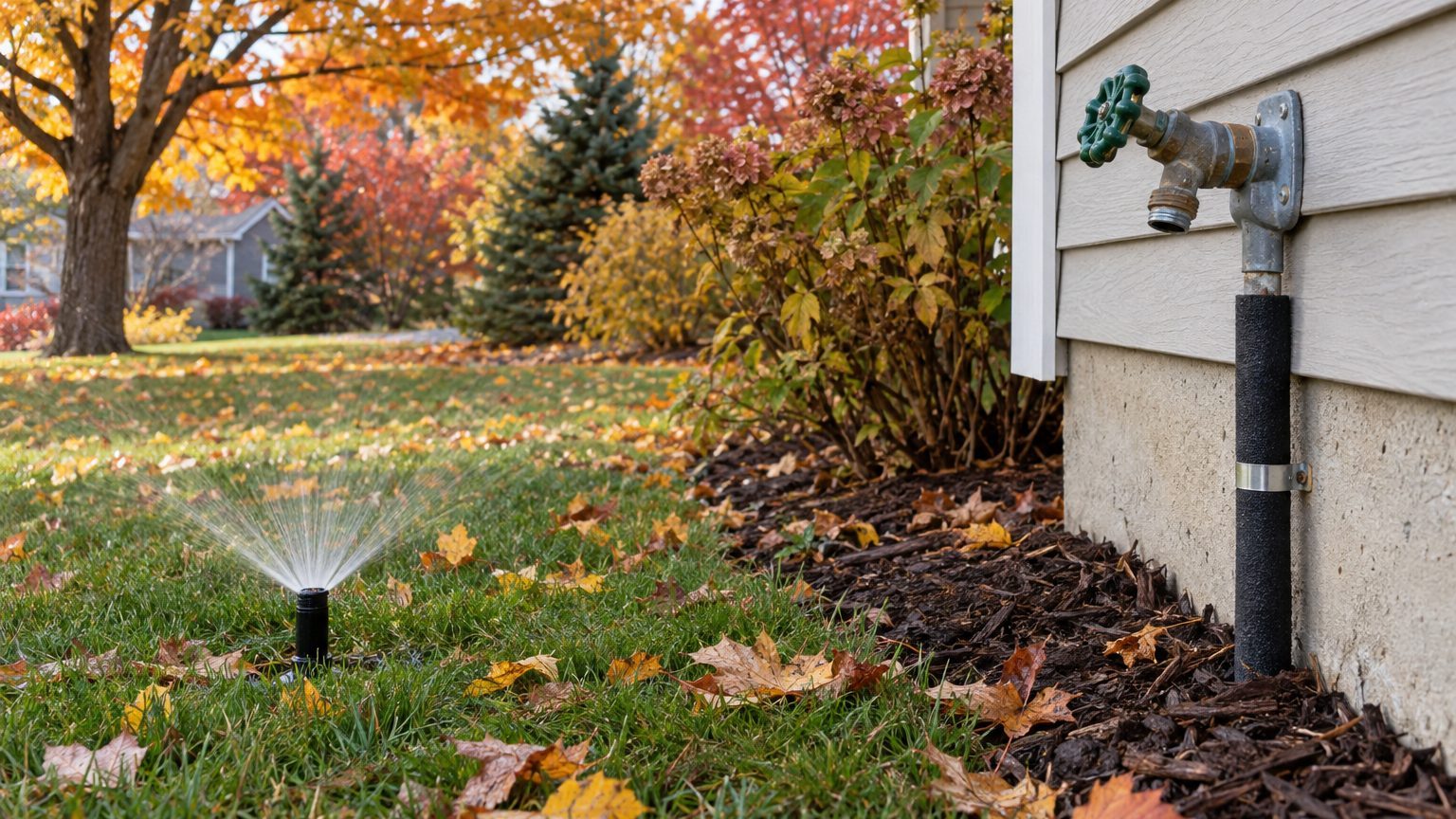

In West Virginia, shut down the sprinkler system and outdoor spigots before the first hard freeze. At Charleston, NOAA’s 1991-2020 normals put that first fall frost between October 18 and November 1. Ridgetop and mountain yards freeze earlier, so their deadline comes sooner. The job fits in an afternoon: drain or blow out the irrigation lines, close the interior valve feeding each outdoor tap, and leave nothing attached to a hose bib.
When to do it in West Virginia
Finish winterizing before the first fall frost, which at Charleston falls between October 18 and November 1, and follow the rule of before the first hard freeze, not after the first light one. A light frost may only brown the tomato vines, but a hard freeze that holds overnight is what pushes cold into exposed pipe, valves and backflow assemblies. Waiting for the first freeze to prove you right is the expensive way to learn the date.
Why the first frost sets the clock
The figure behind that window comes from the NOAA NCEI 1991-2020 Climate Normals for the Charleston station, which list the dates when the chance of a 32°F night climbs through the 30 to 70 percent band (NOAA NCEI normals data). At the early end of that range, a freezing night is still the less likely outcome. By the later end it is the likelier one, and somewhere in the middle it is close to a coin flip. A coin flip is a poor bet when the loss is a cracked valve body.
Winter then confirms the danger. The mean daily minimum of Charleston’s coldest month is 26.1°F, according to the same NOAA NCEI Climate Normals. That is an average of the overnight lows, so plenty of nights run colder than 26.1°F. A winter that routinely sits below 32°F is not one where you can skip the job or settle for a quick spigot check. Full drainage of irrigation lines is the right call here.
Adjusting for elevation and a warm fall
Charleston sits in a river valley, and higher ground across the state freezes noticeably earlier in fall. The USDA Plant Hardiness Zone Map (2023 edition, built on average annual extreme minimum temperatures) places West Virginia in zones 5a to 7a, so conditions differ a lot from one county to the next. Treat Charleston as a reference point, not a promise. If your property is on a ridge, in the northern part of the state, or in the highlands, move every fall task ahead of the Charleston window.
A warm, dry October is the most tempting time to put it off. Fall in this part of the country often delivers a string of mild afternoons, followed by a single clear, calm night that drops well below freezing. Plan the work for the weeks before October 18 to November 1, and earlier still if you live above the valley floor, so that a weather forecast never becomes your deadline. If you are already doing fall chores, Winterizing a Lawn covers the turf side of the same seasonal shift, and the West Virginia guides collect other timing questions for the state.
Sprinkler lines: drain or blow out
Water expands as it turns to ice, and nothing in an irrigation system is built to give way gracefully. Buried polyethylene and PVC pipe can split along its length. Fittings crack at the joints, valve bodies fracture, and the above-ground backflow assembly is usually the first casualty because it has no soil around it for insulation. You will not see any of this in December. The system looks fine until spring, when it is turned on and starts spraying where it should not.
The three methods compared
Irrigation systems are shut down one of three ways, and which one suits you depends on how the system was installed.
| Method | How it works | Main weakness |
|---|---|---|
| Manual drain | Close the supply, then open drain valves at the low points of the lines and let gravity empty them | Only works if the lines slope to the drains; water in dips stays put |
| Automatic drain | Valves open on their own when line pressure falls, releasing water at low points | Debris can hold a valve shut, and pockets of water can remain |
| Compressed-air blowout | An air compressor pushes water out of each zone through the heads | Wrong pressure or poor technique can damage heads and pipe |
Manual and automatic drains are fine when the system was laid out with a slope toward them, and plenty of older residential systems were not. Any sag in a lateral line becomes a small pond, and a pond in a pipe is exactly what a hard freeze needs. Compressed air does not care about slope. It clears the line zone by zone and shows you immediately when a head has stopped producing water, which is a free diagnosis of what is clogged.
What this climate calls for
With first frost arriving between October 18 and November 1 at Charleston and a 26.1°F average minimum in the coldest month, blow out the lines before the first hard freeze, and do not rely on automatic drain valves alone. Treat the drain valves as backup rather than the whole plan. In colder parts of the state, do the blowout earlier than the Charleston window suggests.
If you do it yourself, the sequence matters more than the equipment. Shut off the water supply to the system first. Relieve pressure, then connect the compressor at the blowout port. Wear safety glasses, and keep your face and hands away from the heads, because they can eject debris under air pressure. Work one zone at a time and stop when only a fine mist comes out, since running air too long through a dry head can overheat the parts. Follow the pressure limit printed by your pipe and head manufacturer. Set the controller to rain mode or off so the system doesn’t try to run on its own.
A professional is the sensible choice in a few situations: a large system with many zones, a compressor too small to clear the lines, a buried layout you can’t map, or a backflow assembly you aren’t sure how to drain. The same goes for any system that cracked in a previous winter, because it probably has a low spot or a failed fitting that needs finding. Book the visit before the early end of your local frost window, not after a freeze warning has appeared on the forecast.
Outdoor faucets and hoses
Faucets are the simple part of winterizing, and also the part where one forgotten step does the most damage. A standard hose bib has a short run of pipe running through the wall, and whatever water sits in it when the temperature drops will freeze and split the pipe inside the wall. The fix involves nothing but hands and valves.
- Disconnect every hose, splitter, timer and sprayer, and store them indoors.
- Find the interior shutoff valve for each outdoor tap, often in a basement, crawl space or utility room, and close it.
- Open the outdoor tap and let it drain.
- Leave the outdoor tap open for the winter so any leftover water has somewhere to go.
That is the full list. If you cannot find the interior valve, if it will not turn, or if the outdoor tap keeps dripping after you close it, stop there and call a plumber. Anything beyond turning valves, such as cutting, soldering or replacing the faucet, is plumber’s work, and a botched repair in a wall is worse than the leak it was meant to fix. The longer walkthrough is in Winterizing Outdoor Faucets Before the First Freeze.
Why a frost-free faucet still fails
A frost-free faucet puts its shutoff seat well inside the heated part of the house, at the end of a long stem. The body slopes downward so that, after the valve closes, the water remaining in the barrel runs out through the spout. That design works only if the water can leave. Attach a hose and the water cannot drain, so it sits in the barrel just outside the heated space and freezes. In effect, the hose turns a frost-free faucet into an ordinary one. Even a hose with a nozzle closed at the far end holds water against the spout. For more on how these fixtures work, see Frost-Free Outdoor Taps.
Foam insulating covers are sold for hose bibs, but they slow heat loss and do nothing about trapped water. Use one if you like, though only after the hose is off and the tap has drained. Take every hose off the spigots before October 18 to November 1 at Charleston, and sooner at higher elevations, so the habit is done before the weather forces it.
What goes wrong here
The most common failure is timing. A cold snap in the middle of October, before anyone has gotten around to draining, catches the whole neighborhood at once. Higher elevations hit freezing sooner than Charleston does, so a homeowner who relies on valley dates can be a few weeks late. The result appears in spring: a wet patch around the backflow assembly, a sprinkler zone that pops up weakly or not at all, a head that sprays sideways from a hairline crack, or water bubbling up in the lawn where a buried line gave out.
The forgotten hose is the quieter one. It is usually the hose behind the shrubs or the one on the back spigot nobody uses in summer. If it stays connected through a hard freeze, the trapped water can split the pipe inside the wall, and nothing shows until the tap is turned on in spring. Then comes the spray inside the wall, a stained ceiling below, or a damp sill. If you suspect a pipe has already frozen or burst, the steps in Frozen Pipes cover what to do next. Walking the perimeter on a fixed fall date, tap by tap, catches almost all of these.
Valve boxes, the green lids set into the lawn, flood quietly. They collect runoff and snowmelt, and standing water around the valves can freeze and crack them, especially if the system was drained poorly. Check that each lid is in place, that the box is not sitting full of water, and that nothing is buried under mulch or soil. When you turn the water back on in spring, open the supply slowly and watch every tap, valve box and zone before walking away. A small leak found in the first ten minutes costs a repair visit, while one found a week later can cost a flooded box and a spring lawn that turns to mud.
Common questions
Can I wait until November to winterize?
In Charleston, the first fall frost window runs from October 18 to November 1 (NOAA NCEI 1991-2020 Climate Normals), so waiting until November puts you at or past the late end of it. A hard freeze can come ahead of the average date, and mountain locations freeze earlier than the valley. The safer plan is to finish ahead of the window and use any warm October days for the job rather than treating them as a reason to delay.
Do I still need a blowout if my system has automatic drain valves?
A blowout is the safer plan in West Virginia. Automatic drain valves open as pressure falls, but debris can keep one from opening, and any sag in a line leaves a pocket that the valve never reaches. The coldest month averages a 26.1°F overnight low at Charleston, according to NOAA’s 1991-2020 normals, which is plenty cold for a small pocket to freeze solid. If you want to trust the drain valves, have a pro confirm that every zone clears.
Is a frost-free faucet enough on its own?
Only if no hose is attached. The faucet drains through its sloped body once the valve closes, but a connected hose blocks that drainage and leaves water in the barrel, which can freeze and split the pipe inside the wall. Remove all hoses and timers before the first hard freeze, and close the interior shutoff if you can reach it.
What if a freeze is forecast and I haven’t started?
Work in this order: shut off the water supply to the sprinkler system, open the manual drain valves if you have them, disconnect every hose, close the interior shutoff to each outdoor tap, and open the tap to drain. Then book a blowout for the first available day, because gravity drains alone may leave water in low spots. A foam cover over a tap with a hose still attached, though, only hides the problem and does not protect the pipe.