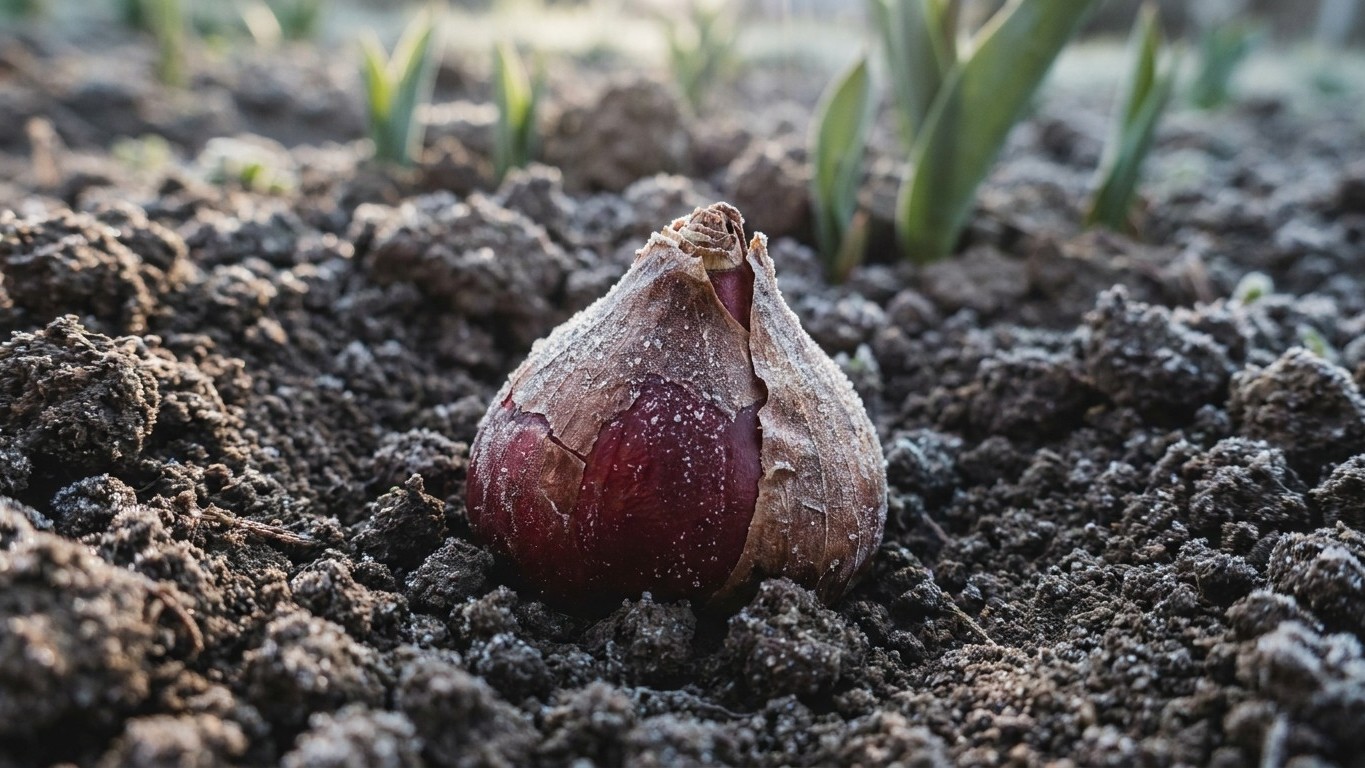

Garlic in Quebec is bothered by a short list of pests: fly larvae that tunnel into the base of the plant, tiny sap-feeders on the leaves, microscopic worms that live in soil and inside cloves, and rodents that dig up fresh cloves. Garlic goes in during autumn and comes out the following summer, so it meets some of these pests in fall, some in spring, and some just before harvest.
Which pests attack garlic in Quebec
The body that tracks crop pests in the province is the Quebec agriculture ministry, MAPAQ, and its regional offices are where you ask what is active near you. Of everything a provincial pest list can hold, only a handful of groups feed on a garlic bed. Four are worth knowing by their habits:
- Fly larvae (maggots) from the onion family’s usual flies, which eat the base of the plant and the bulb.
- Thrips and mites, which feed on leaf sap and, in the case of mites, on cloves in storage.
- Stem and bulb nematodes, roundworms too small to see that live in soil and inside planted cloves.
- Rodents such as mice and voles, which dig up and chew cloves and young shoots.
Garlic is the one crop in most gardens that sits in the ground from autumn planting until the following summer, so every pest on that list has a long window to find it.
Which pests on provincial lists can you ignore in a garlic bed?
Plenty of insects on forestry and orchard watch lists have no reason to touch garlic. Wood-boring beetles live under bark, and fruit-tree insects feed on foliage and fruit of trees. A gardener who reads a list of regulated pests and sees a tree borer next to a vegetable can set it aside, because neither its larvae nor its adults feed on bulbs or leaves of an allium.
How do the four groups differ?
Maggots and nematodes work below ground, so you often notice them only after the plant has already suffered. Thrips and mites work on the surface and leave visible marks. Rodents are the odd one out: they are a problem of the cold months, not of the growing season.
When each one shows up, and what it does first
The calendar here is set by the first fall frost, not by a month. At the Montréal/St-Hubert A station, Environment and Climate Change Canada’s Canadian Climate Normals for 1981-2010 put the first fall frost on average on October 5. That is a midpoint. In one year out of two the first frost comes earlier, and in the other it comes later, so it is never a safe date. The station sits in the south, and northern or upland districts run weeks behind it. The planting calendar for Quebec counts back from that frost window.
What appears first after planting and through winter?
Rodents come first. In the weeks after the cloves go in, the first sign is a small hole or a loose clove sitting on the surface. Nematodes are already present if the planted cloves carried them, but the cloves show nothing until growth starts. Through winter, the thing to watch for is shoots pushed up by repeated freezing and thawing, which looks like pest damage but is not.
What appears in spring and early summer?
When growth resumes after the thaw, nematode damage appears as short, swollen, twisted shoots, often in patches. Fly larvae follow as the weather warms and the plant is growing quickly. The first symptom is a plant that yellows from the tip and flops, then pulls out of the soil with almost no resistance. The base is soft and often holds small pale larvae.
In the weeks before the bulbs are lifted the following summer, thrips and mites take over. The first thing you see is pale or silvery streaks along the leaves, sometimes with curled, distorted growth. Mites in particular travel with the bulbs into storage, so a clove that looks fine at lifting can shrivel on the shelf.
Telling the damage apart from everything else
Yellow leaves have a dozen causes, and an insect is rarely the first one to check. Cold, saturated soil, a nutrient shortage, a fungal rot, and a dry spell all look much like larval feeding from a distance. The table sorts the common symptoms by what separates one cause from another.
| What you see | Possible cause | What settles it |
|---|---|---|
| Tips yellow in spring, plant still firm | Cold or waterlogged soil, nutrient shortage, or early disease | Check the base and roots: firm and white roots point away from larvae. Wet soil that stays soggy points to drainage. |
| Plant flops and pulls out easily | Larval feeding, or a bulb rot | Look for larvae in the soft base. Rot shows fuzzy growth or discoloration without larvae. |
| Silvery or pale streaks on leaves | Sap-feeders, or wind and hail scuffing | Scuffing is torn and uneven, sap-feeding is fine and in lines. A hand lens helps. |
| Stunted, swollen, twisted shoots in patches | Soil-borne worms, or herbicide drift | Patches that grow year to year and a sliced clove with soft, discolored tissue call for a lab check through extension. |
| Shoots missing or lying on the surface | Rodents, or frost heave | Chewed stubs and holes mean rodents. Intact shoots pushed up with bare roots mean heave. |
The best test is the cheapest: pull one affected plant before treating anything, keeping the roots intact, and look at the base and roots. Compare it with a healthy plant a few feet away. A soil-moisture check helps too. Push a finger down to the first knuckle in the bed. Dry soil at that depth in a dry spell can explain yellow tips on its own.
Take a sample and a photo to MAPAQ for confirmation, particularly if you suspect nematodes, which can only be identified under a microscope.
What actually works here, and what is a waste of time
On a season with a hard winter and a short window after the first frost, a barrier laid at the right moment beats a treatment sprayed late. Floating row cover goes on before the adult flies start laying eggs, which means when spring shoots first emerge, and it has to be sealed along every edge with soil or boards. A gap defeats it. The cover can come off once the leaves are tall and the weather is hot, then the bed needs a check for thrips.
Rotation does more than anything else against soil-borne pests. Keep garlic, onions, leeks and shallots out of a bed once they have had trouble there, and give the bed a break from the whole family. Nematodes in particular can stay in soil for years, so a one-year break is rarely enough. Clean planting stock matters just as much. Buy seed garlic from a grower in a similar climate, such as the ones in garlic varieties that suit Quebec winters. Stock from a milder region, for example one suited to Rhode Island winters, may be well adapted there and still carry pests or struggle here. Discard any clove that is soft, shriveled, or discolored before it goes in the ground.
Two habits protect the next crop. Bag and discard infested plants rather than composting them, because larvae and worms survive in a home pile. Cure bulbs fully after lifting and store them cool and dry, since mites do their damage on damp, warm shelves.
What does not work?
Spraying on a calendar without knowing the pest wastes money, because each group above is controlled by something different and some live where sprays never reach. Planting grocery-store garlic is a gamble with unknown origin and unknown pests. Companion plants and homemade garlic or pepper sprays are folklore: none stops a fly from laying eggs at the base of a plant. Late action hurts most of all. A larva already inside the bulb is out of reach by the time a leaf yellows. For what is legal and registered in the province, ask MAPAQ. A regional office knows what applies to your garden.
Where to check this for your own county
The best source for your area is MAPAQ, the Quebec agriculture ministry, through the regional office that serves your county or municipality. Staff there see local pest reports week by week and can tell you whether larvae, mites or worms are active near you this year.
Presence varies widely inside the province. A pest that is common in the St. Lawrence lowlands may be absent from an upland garden, and the frost date moves by weeks between the south and the north, which shifts every date in the calendar above. A province-wide record says what exists somewhere in Quebec, not what is in your bed.
For the full growing picture, from site choice to harvest, see growing garlic in Quebec. The next step is a short list in hand before you call the regional office: your municipality, the date you planted, what the symptom looked like first, and a photo of one pulled plant.
Common questions
Can I plant garlic from the grocery store?
It is a poor bet. Store garlic may come from far away, it is often treated to stop sprouting, and nothing tells you whether it carries mites or nematodes. Seed garlic from a grower in a similar climate costs more but starts the bed clean.
Is it safe to compost garlic plants that had pests?
No. Larvae and nematodes can survive in a home compost pile and return to the garden with the finished compost. Bag the plants and put them out with household waste, or ask your municipality what it accepts.
Can I replant garlic in the same bed next year?
If the bed had no problems, rotation is still the safer habit. If it had worms or larvae, give the whole onion family a long break in that spot, longer than a single season, and grow something unrelated there.
When should I put row cover on garlic?
Set it when the spring shoots first come up, before adult flies start laying eggs, and seal every edge. Go by what the plant is doing in your own yard rather than a date.