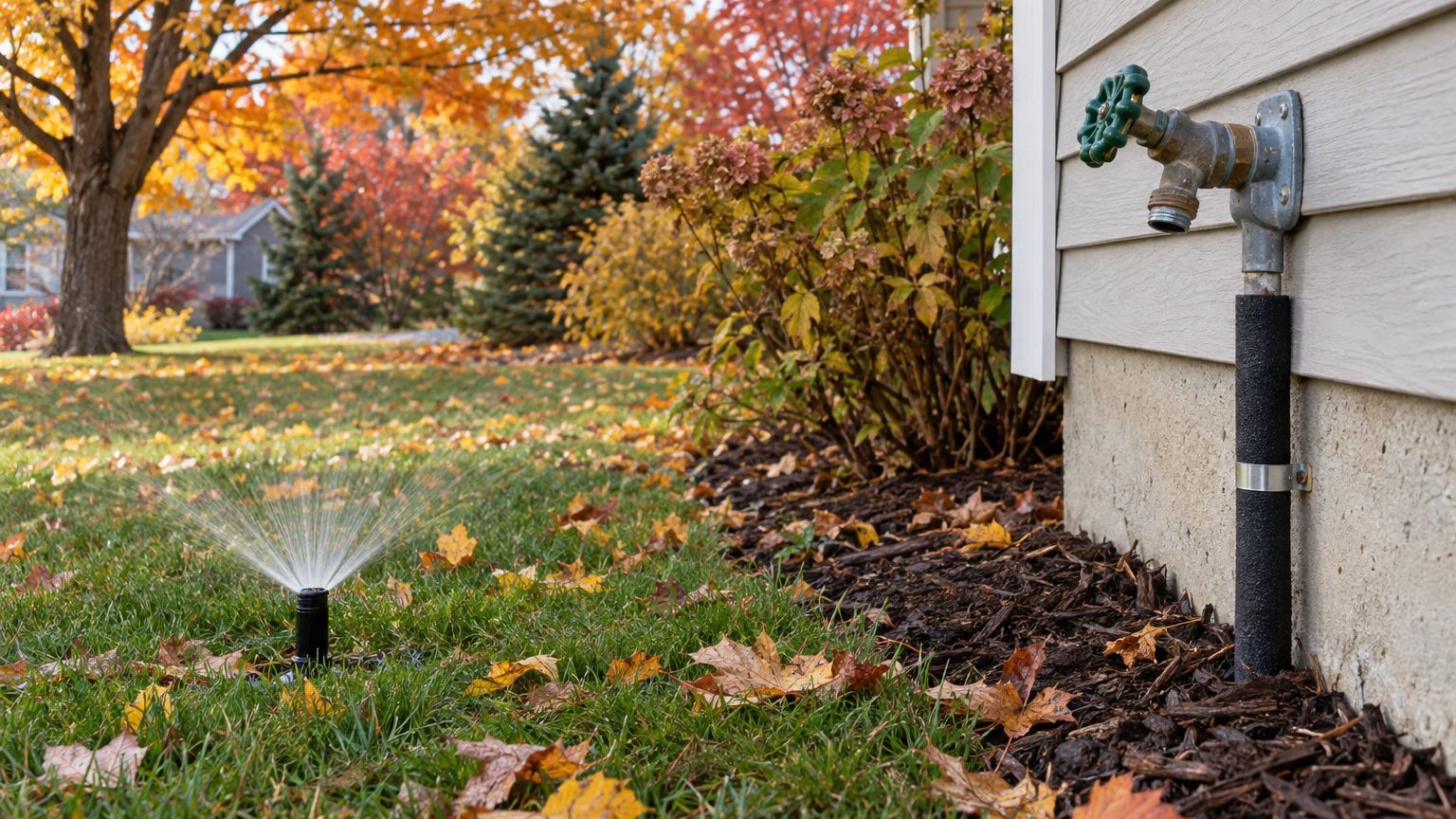

Most Georgia yards need less than the northern winterizing ritual. In Atlanta, the coldest month still averages nightly lows above freezing. For many homes the job is a short fall checklist: unhook hoses, close the water to outdoor taps, drain the exposed parts of the irrigation system, and watch the overnight forecast. A full compressed-air blowout makes more sense farther north and in the mountains, where freezes arrive weeks sooner.
When to do it in Georgia
For metro Atlanta, finish before the first fall freeze, which NOAA’s NCEI 1991-2020 Climate Normals for the Atlanta station place between November 13 and December 1 (the 30 to 70 percent probability band for a 32°F freeze). The rule is to act before the first hard freeze, not after the first light one, so work through the last week of October and into early November, and be done before the November 13 to December 1 window opens.
The same NOAA normals put the mean daily minimum of Atlanta’s coldest month at 35.6°F. That average sits above freezing, and it is the reason a full blowout is often unnecessary for a house in the metro area. Individual nights still swing around an average, and a clear, calm night behind a cold front can drop below 32°F. What is worth doing every year is simple: take the hoses off, close the indoor shutoffs to outdoor taps, switch the irrigation controller off, and wrap or drain any backflow preventer that sits above ground.
How much earlier does it freeze in north Georgia and on the coast?
The Atlanta airport station sits in an urban heat island, so its readings run warmer than open ground nearby. North Georgia and the mountains freeze several weeks earlier in fall, and the work moves earlier with them. In those counties, watch the forecast closely, and anyone reading this now should do the job this week. The coastal plain runs milder. Freezes there tend to come later and bite less, though a cold snap can still catch a bare faucet.
Hardiness zones help a little here. The USDA Plant Hardiness Zone Map 2023, built on the average annual extreme minimum temperature, shows Georgia running from 6a to 9b. A house in a 6a pocket of the mountains lives in a different winter than one in a 9b spot near the coast. The county extension office can tell you what a typical first freeze looks like for your address.
What should you watch in the forecast?
Read the overnight low, not the daytime high. A forecast of 70°F at three in the afternoon tells you little about a 31°F dawn. When the lows start sliding toward the mid-30s, the work should already be finished. For other fall chores that follow the same calendar, the Georgia guides cover timing across the state.
Sprinkler lines: drain or blow out
Why does frozen water split sprinkler pipes?
Ice takes up more room than the water it came from. Inside a closed pipe or valve body, that extra volume has nowhere to go. Plastic pipe splits along its length, fittings crack, and valve diaphragms and backflow devices can be damaged. The damage stays hidden all winter and shows up in spring, when the system is pressurized and water sprays out of the break.
Sprinkler heads, risers and the short stubs of pipe at each valve all hold water too. The parts above ground are the most exposed because soil does not insulate them. That means the backflow preventer, the pipe feeding it and any valve assembly that is not buried. These are the parts to protect first in a mild climate.
Manual drain, automatic drain or blowout: which fits Georgia?
Three methods get water out of an irrigation system. They differ in how much of the water they remove and how much skill they need.
| Method | How it works | Best fit in Georgia |
|---|---|---|
| Manual drain | You shut off the supply to the system, then open drain valves at the low points and let gravity empty the lines | Metro Atlanta and other milder areas, where systems have drain valves |
| Automatic drain | Valves at low points open on their own when water pressure falls after shutoff | Systems that already have them; check that debris has not left one stuck |
| Compressed-air blowout | A compressor pushes air through the lines, zone by zone, to force water out of pipes and heads | North Georgia, the mountains, and systems with no drain valves or with pipe that dips and holds water |
With a coldest-month minimum of 35.6°F at the Atlanta station, a manual drain is the sensible default in the metro area. Shut off the supply, drain the backflow preventer and the low points between late October and early November, and keep the blowout for north Georgia or for systems that cannot drain on their own. In the mountains, where the first freeze comes weeks ahead of Atlanta, a blowout is cheap insurance and the work belongs in October.
When is a professional the sensible choice?
A blowout looks easy and is not. Too much air pressure, or air run too long through one zone, can damage heads, valves and pipe. A technician knows the safe pressure for your system and the order to work the zones. Hire one if your system has no drain valves, if you do not know where the low points are, if the house sits in the mountains, or if you found a leak last spring. Book the visit early enough that the work lands before the November 13 to December 1 frost window, or well ahead of it in colder counties.
Outdoor faucets and hoses
Hoses can cause freeze damage to faucets. A hose left attached holds water against the faucet, and that water has nowhere to go when it freezes. The fix needs nothing beyond your hands. Anything past turning valves, such as cutting pipe, soldering, or swapping a faucet, is a plumber’s job. A longer walk-through is in Winterizing Outdoor Faucets Before the First Freeze.
How do you drain an outdoor faucet?
Start outside, finish inside, and work in this order:
- Unscrew every hose, splitter, sprayer and timer from each outdoor tap.
- Drain the hoses, coil them, and store them in a garage or shed.
- Find the interior shutoff valve for each outdoor faucet, often in a basement, crawlspace or garage near the wall the faucet passes through, and close it.
- Go back outside, open the tap, and let the water run out.
- Leave the outside tap open for the winter so any trapped water has room to expand.
Disconnect every hose between late October and early November, even in a mild stretch. If a house has no interior shutoff, or the valve will not close fully and keeps dripping, leave it for a plumber. Forcing an old valve can start a leak inside the wall.
Why does a frost-free faucet fail with a hose attached?
A frost-free faucet has a long stem that puts the shutoff seat inside the warm part of the wall. The barrel slopes slightly downward, so water drains out the spout whenever the faucet is closed. That design only works if the water can leave. With a hose threaded on, the spout is plugged, the barrel stays full, and the water sits in the section outside the wall, where it can freeze and split the pipe. You often cannot see the damage until spring, when the tap is turned on and water sprays inside the wall.
A frost-free tap is protected only when the hose comes off, so remove it even from this type. Details on how these taps work, and how to tell whether yours slopes properly, are in Frost-Free Outdoor Taps.
What goes wrong here
What happens when a cold snap arrives before you have drained?
Georgia winters are mild enough that many people put off the work. November 13 is the early end of a probability band, so some years bring the first 32°F night sooner. When it catches a full system, the backflow preventer or the pipe feeding it is the usual casualty. In spring you see a leak at the device when the system is switched on, a zone that will not build pressure, or a wet patch that keeps spreading. Watch overnight lows from late October through the first weeks of December, and if a cold night is forecast before you have drained, shut off the supply and open the drain at the backflow preventer that afternoon.
What does a forgotten hose do to a faucet?
The hose, or a splitter left on the end of it, traps water against the tap. In spring the faucet may drip steadily from the spout, or it may look fine outside while water sprays inside the wall when turned on. Look for a damp spot on the interior wall, a stain on the ceiling below, or moisture in the crawlspace. If you find any of these, close the interior shutoff and call a plumber. For what to do if a pipe has already frozen, see Frozen Pipes.
Why does a sprinkler valve box flood in winter?
Buried valve boxes catch rain and runoff. A box that fills with water around the valves can freeze and crack a valve body or damage the wiring. In spring the signs are a zone that will not shut off, one that never turns on, or a water bill that jumps with no visible leak. Keep the lid in place, clear mud and debris from the bottom so the box drains, and shut the supply before cold weather so the valves are not holding pressurized water. While you are shutting down irrigation for the season, the lawn needs a plan too, and Winterizing a Lawn covers it.
Common questions
Do I need to blow out my sprinkler system in Atlanta?
Often not. With the coldest-month mean minimum at 35.6°F at the Atlanta station, most metro systems do well with the supply shut off, the backflow preventer drained or wrapped, and the low points opened. A blowout is worth it for systems with no drain valves and for homes in north Georgia and the mountains.
Can I leave a hose connected if the forecast stays above freezing?
You can, but a surprise cold night can freeze the water trapped between the hose and the faucet. A hose is easy to remove and reconnect, and removing it before the November 13 to December 1 window costs almost nothing.
What if the first freeze has already hit?
Drain the system now and open the outside taps once the forecast warms. If a pipe or faucet may have frozen, leave the water off to that line until it thaws, then turn it on slowly and check for leaks. A suspected break in a wall is a plumber’s call.
Do frost-free faucets need winterizing in Georgia?
They need the hose removed, which is the single step that lets them drain. Closing the interior shutoff, where there is one, adds another layer of protection in colder parts of the state.
Related guides
- When to Winterize Sprinklers and Outdoor Faucets in Alabama
- When to Winterize Sprinklers and Outdoor Faucets in Hawaii
- First and Last Frost Dates in Georgia
- When Does the Heating Season Start in Georgia
Sources : fieldreport.caes.uga.edu | rainbird.com