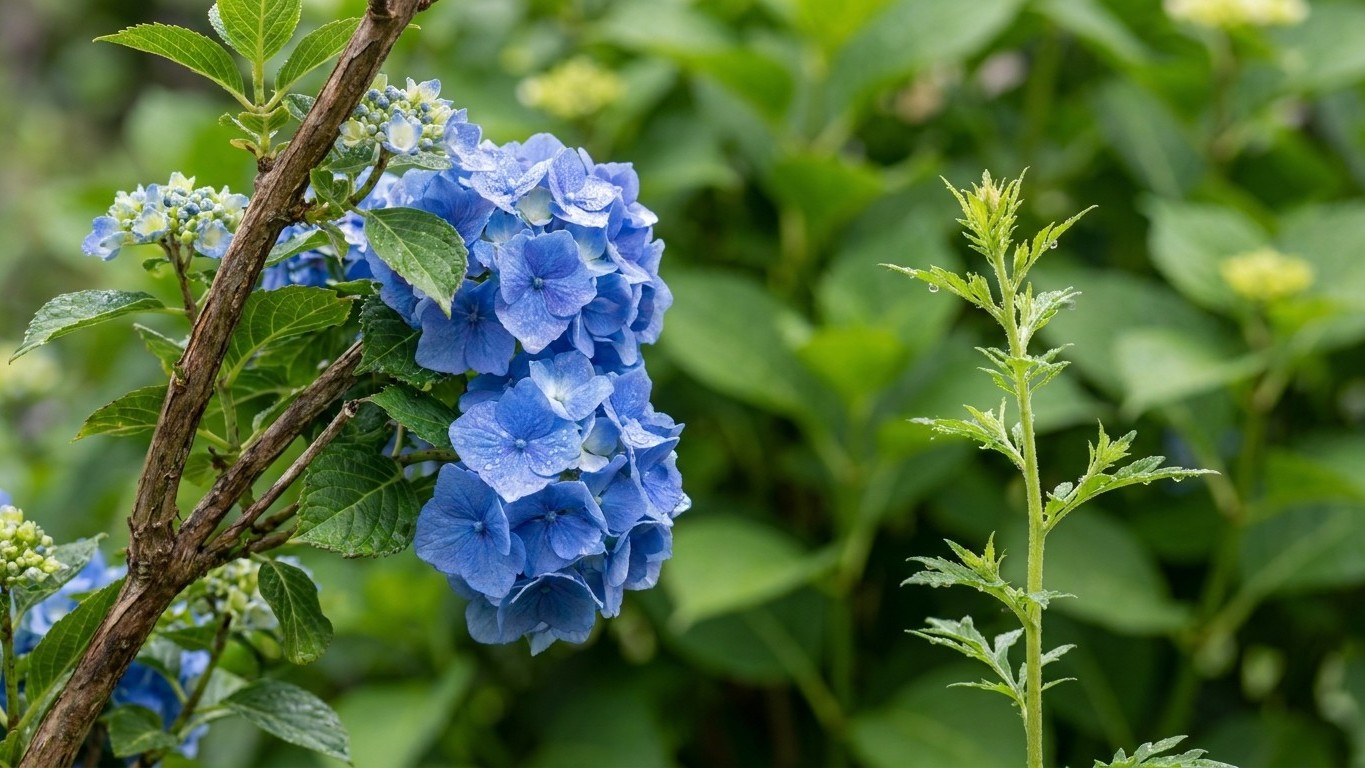

Hydrangeas come out pink in much of Minnesota because the soil, especially in the south and west, runs neutral to alkaline. In that soil, aluminum (the mineral that makes bigleaf blooms blue) stays locked away from the roots. Acidify the soil around a bigleaf hydrangea, give the plant aluminum it can absorb, and new flowers shift toward blue. White hydrangeas and the hardy panicle and smooth types will not follow.
What this comes down to in Minnesota

In the Twin Cities, the average last spring frost falls around April 30 and the average first fall frost around October 10, though frost can arrive a week or more on either side of those dates. Flower color on a bigleaf hydrangea is settled during the growing season between those two dates, and the neutral to alkaline soils across much of the state tilt the result toward pink unless you intervene.
What decides whether a hydrangea blooms pink or blue?
The pigment is the same in both colors. What changes is whether aluminum reaches the flowers. Nearly every soil contains aluminum, but it dissolves into a form roots can absorb only when the soil is acidic. In neutral or alkaline ground it stays bound to soil particles, the plant takes up little, and the blooms turn pink. Where soil is strongly acidic, the plant absorbs plenty and the blooms turn blue. Purple or mixed pink-and-blue heads mean the plant is getting some aluminum but not enough.
A second lever sits inside the plant. Phosphorus ties up aluminum, so a fertilizer high in phosphorus pushes flowers pink even in decent soil. The color you see is a readout of aluminum availability, and soil pH is what controls that availability. Blooms that have already opened will not change. Only flowers that form after the soil shifts will.
Which Minnesota hydrangeas can change color at all?
Only some of them. The shrubs most Minnesota gardeners grow, the panicle and smooth types, ignore soil chemistry entirely.
| Type | Place in Minnesota gardens | Color responds to soil? |
|---|---|---|
| Bigleaf (Hydrangea macrophylla) | Marginal in cold winters; needs protection or a reblooming cultivar | Yes |
| Mountain (Hydrangea serrata) | Marginal, similar to bigleaf | Yes |
| Panicle (Hydrangea paniculata) | Reliable across nearly the whole state | No |
| Smooth (Hydrangea arborescens) | Reliable across nearly the whole state | No |
| Oakleaf (Hydrangea quercifolia) | Marginal in the north | No |
A pink panicle in October is not a soil effect. Panicle blooms open white or cream and blush pink as they age and the nights cool. Some smooth hydrangeas are bred to be pink from the start. If your pink shrub is one of these, no amount of aluminum sulfate will make it blue. The general care for all of these shrubs is covered in the guide to growing hydrangeas in Minnesota.
Working it out for your own garden
The method starts with the soil. A pink bigleaf might be sitting in alkaline ground, or it might be a cultivar that stays pink under many conditions, and only a test shows which one you have.
How do you test soil before trying to change hydrangea color?
Take a sample from the root zone, a few inches down and a foot or so out from the base of the shrub, and measure the pH with a kit or a lab test through your county extension office. A reading near neutral or higher explains pink flowers. A reading well into the acidic range means blue is possible without help, and if the flowers are still pink, the cause is probably a phosphorus-heavy fertilizer or a cultivar that resists blue. Test again each spring, because a bed that was acidic one year can drift back.
How long does it take to turn a hydrangea blue?
Take a bigleaf in a Twin Cities bed with neutral soil. The ground thaws, shoots leaf out, and the last spring frost (on average around April 30) passes. Once the new leaves have opened, that is the moment to apply aluminum sulfate, dissolved in water and poured around the root zone at the rate on the label. Repeat on the label’s schedule through early summer. Stop well before autumn, long before the average first fall frost, around October 10. Blooms may come out purple or mixed the first summer, with a cleaner blue possible in the second. Garden sulfur lowers pH more slowly but holds longer, and many gardeners use it as the base layer with aluminum sulfate as the quick push.
Now take a bed along a concrete foundation, or one fed by hard well water. Concrete leaches lime into the soil, and alkaline water raises pH with every watering. A spring drench there fades within weeks, and the shrub drifts back to pink. The fix is a container. Fill a large pot with acidic potting mix, plant the bigleaf, and feed it a low-phosphorus fertilizer. Because you control the mix, the color holds. The pot can also move into an unheated garage for winter, which suits a shrub whose buds are vulnerable (see Protecting Hydrangeas Through a Minnesota Winter).
What changes across the state
The Twin Cities sit in the mild south of Minnesota. Northern Minnesota runs weeks tighter at both ends of the frost window, so spring comes later and fall frost arrives earlier. The USDA Plant Hardiness Zone Map, which is built on a single variable (the average annual extreme minimum temperature), spans zones 3a to 5a across the state. That spread matters more for bigleaf hydrangeas than any soil treatment. In the colder parts of the range, winter often kills the flower buds, and a pink or blue shrub that never blooms is a color question with no answer.
The soil changes from region to region too. Across the south and west, glacial deposits rich in limestone and prairie soils tend to run neutral to alkaline, which is why pink is the default there. In the southeast, limestone bedrock close to the surface makes well water hard. In parts of the north-central and northeastern forests, sandy and peaty soils under conifers are naturally acidic, and a bigleaf there can turn blue without any help (if it survives the winter). Close to Lake Superior, cool summers and slow springs shorten the season further.
These regional patterns are broad. A single yard can differ from its neighbor’s through lawn lime, foundation concrete, old fill, or irrigation habits. The soil test from your own bed is a better guide than any regional map.
The mistakes this state punishes

The first is acting on a warm spell. Minnesota can deliver a stretch of mild weather in late March or early April, and then freeze again. Aluminum sulfate poured onto cold ground before the roots are active mostly washes away with snowmelt and rain. Wait until the soil has thawed, shoots are leafing out, and the last spring frost has passed. Then the roots are drinking and the product has somewhere to go.
The second is overdosing. More aluminum sulfate does not make bluer flowers. Too much burns roots and can stress the plant. Follow the label rate and spread applications over the season. A third mistake is feeding with a high-phosphorus fertilizer, often a lawn or bloom-booster product, which binds aluminum and sends flowers back to pink. Switch to a low-phosphorus formula. Wood ash and lime spread near the bed do the same thing by raising pH.
Trying to turn a panicle or smooth hydrangea blue is a waste of money, because those shrubs have no color response. Check the species before buying acidifier.
Pruning in spring also removes the buds. Bigleaf hydrangeas bloom mostly on old wood, so cutting stems back in April takes away the flowers you were trying to color (see When to Prune Hydrangeas in Minnesota). Winter dieback does the same job. A cold winter without protection kills the buds, and the shrub leafs out green with no flowers at all.
Checking this against your county
The frost dates here come from the Twin Cities, and a state-wide figure is a starting point. Your county’s soil, water, and last frost can differ by weeks and by a full pH point or more. Your county office at University of Minnesota Extension can advise on soil testing, local frost timing, and which bigleaf cultivars have done well near you. For care that applies to every hydrangea, from siting to watering, return to the guide on growing hydrangeas in Minnesota.
Common questions
Can I turn a white hydrangea pink or blue?
No. White hydrangeas lack the pigment that responds to aluminum, so soil changes do nothing. Panicle types may blush pink as the blooms age, but that happens on its own schedule.
Will coffee grounds or vinegar turn hydrangeas blue?
Coffee grounds change soil pH only a little and unpredictably. Vinegar acidifies briefly and can stress roots if used heavily. Aluminum sulfate or garden sulfur, applied as directed, is more dependable.
Why did my blue hydrangea turn pink or purple?
Usually the soil pH drifted up. Hard tap or well water, concrete near the bed, lime on the lawn, or a phosphorus-rich fertilizer can all do it. A fresh soil test will show which one applies.
Is a pink hydrangea less healthy than a blue one?
No. Pink and blue plants are equally healthy. The difference is whether aluminum reaches the flowers, and either color is a normal result of soil chemistry.