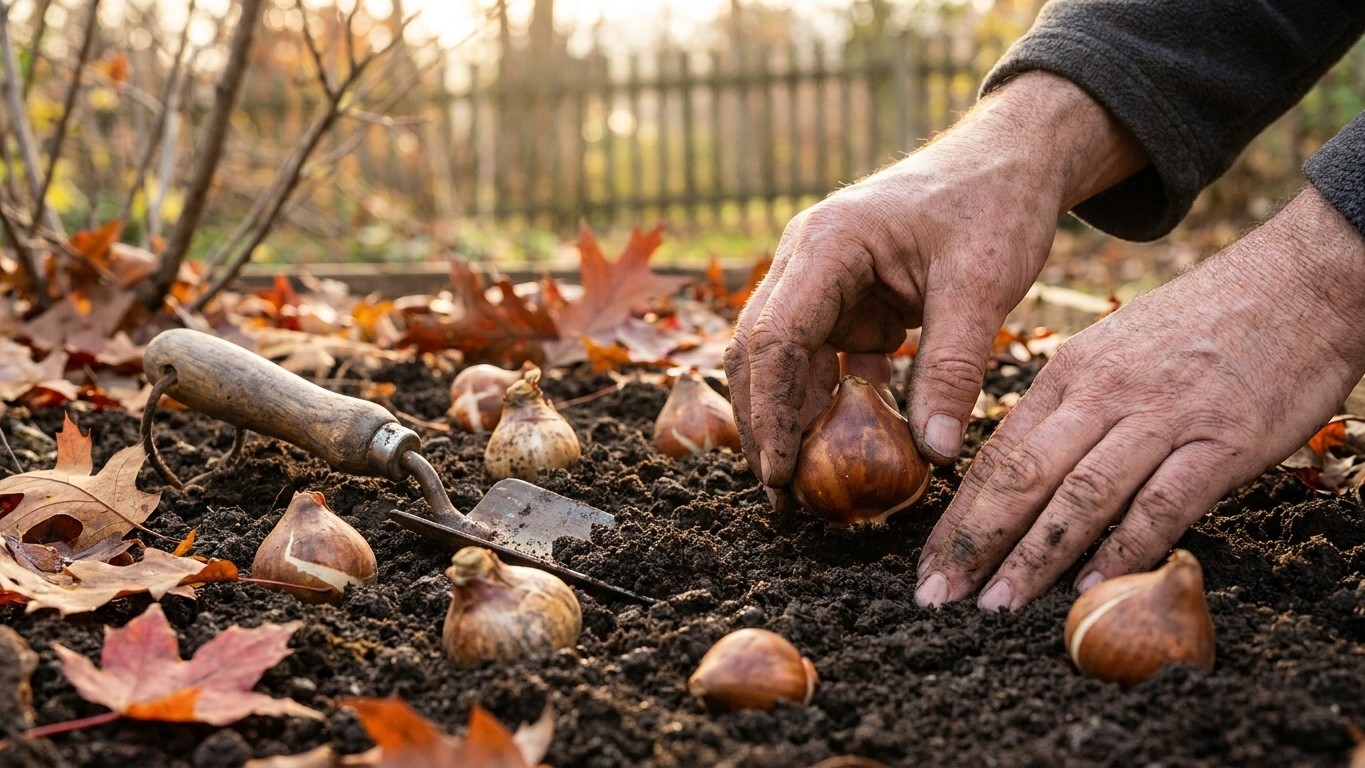

Alabama gardeners can plant nearly every fall-shipped bulb in the catalog, but only some of them will flower here more than once. The dividing line isn’t hardiness zone or soil type. It’s whether the bulb gets enough sustained cold to trigger a bloom before the ground warms up again. Gardeners with limited yard space or poor drainage can sidestep some of these issues entirely by Growing Spring Bulbs in Containers in Alabama, where soil temperature and moisture are easier to control.
When to plant bulbs in Alabama

The target window across most of Alabama runs from mid-October through early December. That’s not an arbitrary date pulled from a seed catalog. It’s built backward from the average first fall frost at the Huntsville reference station, which lands somewhere between November 2 and November 16, according to NOAA’s 1991-2020 climate normals. The old rule of thumb, plant roughly six weeks before the ground freezes hard, doesn’t translate literally here since Alabama soil almost never freezes solid the way it does in Minnesota or Vermont. What extension agents watch instead is soil temperature dropping consistently below 60°F, which tends to happen in the weeks bracketing that frost date.
Miss the window on the early side and you’ll see the problem within a month. Bulbs planted into warm September soil often push up green shoots before winter, spending stored energy on top growth that a hard freeze then kills outright. The bulb survives, usually, but it’s weaker going into spring and the flower is smaller or absent.
Miss it on the late side and the failure is quieter but just as real. A bulb needs several weeks of root growth in cool, moist soil before the ground gets cold enough to slow it down. Plant in late December or January and the roots haven’t had time to anchor and feed the bulb. What comes up in March is often a stunted stalk or nothing at all, and the bulb has spent its one shot at establishing without much to show for it.
One more thing worth saying plainly: that November frost date is an average of thirty years of data, not a promise. Roughly half of all years will see the first frost arrive earlier than November 2, and half will see it later than November 16. Treat the window as a target, not a deadline, and lean toward planting a week or two early rather than scrambling in late December because a warm spell fooled you into waiting.
Whether your winter is cold enough
Here’s the number that decides everything else on this page: most spring-flowering bulbs need somewhere between twelve and fourteen weeks with soil temperatures below about 45°F to complete the internal process that produces a flower. Skip that chilling period, or cut it short, and the bulb doesn’t die. It just leafs out and skips the flower, or sends up a bloom stem too short and weak to notice. Gardeners in warmer pockets of the state who can’t rely on natural chilling often turn to Forcing Spring Bulbs Indoors in Alabama as a workaround. This is the single figure to keep in mind before ordering any bulb from a catalog, whether you garden in Alabama or anywhere else. Without it, you have no way to judge whether a given variety is worth the money.
Alabama’s winter, measured at the coldest point, gives a mean daily low in the coldest month of 33.1°F at the Huntsville reference station. That’s a useful number because it tells you the state doesn’t get brutally cold. It also tells you the margin for a full twelve-to-fourteen-week chill isn’t generous everywhere. North Alabama, sitting in USDA zone 7a, usually strings together enough consistently cool weeks to satisfy bulbs with a modest chill requirement. The southern edge of the state, reaching into zone 9a along the Gulf Coast, runs milder and shorter on sustained cold, and that’s exactly where the classic Alabama bulb disappointment shows up: tulips and hyacinths that bloom beautifully the first spring, on chilling done back at the nursery, and then fade to leaves-only by year two or three.
The workaround for those higher-chill bulbs is pre-chilling: twelve weeks in the refrigerator’s crisper drawer, sealed away from apples, pears, and other ripening fruit. Ripening fruit gives off ethylene gas, and ethylene damages the flower bud inside a chilling bulb even at low concentrations. Skip that precaution and you can chill a batch of tulip bulbs for the full twelve weeks and still get blind, flowerless stems in spring. It’s an extra step, and it costs refrigerator space for three months, but it’s the only way to get a tulip or hyacinth to bloom well in the warmer half of this state.
Cold required vs. cold delivered, by bulb
| Bulb | Weeks of cold needed (below 45°F) | What Alabama typically delivers | Verdict |
|---|---|---|---|
| Tulips | 12-14 weeks | Met in north Alabama some years; short in south Alabama | Pre-chill 12 weeks, or plant as a one-season annual |
| Hyacinths | 12-14 weeks | Same shortfall as tulips, especially south of Birmingham | Pre-chill or treat as annual |
| Daffodils | 10-12 weeks | Met across nearly the entire state | Reliable, returns for years |
| Crocus | 8-10 weeks | Met statewide, including the Gulf Coast | Reliable |
| Grape hyacinth (Muscari) | 8-10 weeks | Met statewide | Reliable, naturalizes readily |
A gardener in Huntsville or Fort Payne can plant most of this list without a refrigerator ever entering the picture. A gardener on Mobile Bay, working in the mildest slice of zone 9a, is really choosing between pre-chilling the high-demand bulbs or building a spring display around the ones that don’t ask for it.
Which bulbs suit Alabama
Set aside chill requirements for a moment and look at plain hardiness. Alabama’s USDA range of 7a to 9a covers a wide swath of bulbs that are bred and sold for exactly this kind of climate. The following names are safe bets across most of the state, chilling issues aside:
- Daffodils / Narcissus (zones 4-8, with many cultivars performing well into 9)
- Crocus (zones 3-8)
- Grape hyacinth / Muscari (zones 4-8)
- Snowflake / Leucojum (zones 4-9)
- Spanish bluebell / Hyacinthoides hispanica (zones 4-9)
Now the bulbs that tend to let a gardener down here, and the specific way they do it. Tulips are the repeat offender: gorgeous the first spring on stored nursery chilling, then increasingly leafy and flowerless each year after as Alabama’s winters fail to fully reset the bud. Hyacinths follow the same pattern for the same reason. Ranunculus and anemone, while sold as fall bulbs in some catalogs, often rot outright in Alabama’s wetter winters if drainage isn’t sharp, since they evolved for a drier dormancy than the Southeast typically offers.
None of this is an absolute line. A hardiness range is a guideline built on averages, and a tulip bed tucked against a south-facing brick wall in Huntsville, with better drainage and a bit more reflected warmth, will often outperform the same bulbs planted in an open, low-lying yard nearby. Microclimate moves the needle more than the map does.
What digs them up here
Squirrels and voles are selective, and the selection comes down to chemistry rather than appetite. Daffodils and other bulbs in that family contain lycorine, a compound that makes them bitter and mildly toxic, so wildlife generally leaves them alone once planted. Tulips and crocus contain no such defense and are treated as a snack by both squirrels working from above and voles tunneling from below.
- Bulbs squirrels and voles target: tulips, crocus
- Bulbs they leave alone: daffodils, grape hyacinth, snowflake
For the bulbs on the target list, the one method that consistently works is physical: lay galvanized wire mesh flat over the planting bed, pinned at the edges, and leave it in place until the ground freezes. Squirrels can’t dig through it, and it costs a few dollars and an hour of work per bed. Repellent sprays and granules get sold heavily every fall, but they wash off with the first rain and need reapplying constantly to do anything at all. If you’re planting tulips in a yard with an active squirrel population, the mesh isn’t optional.
Where to check for your own county
Every figure above, the frost dates, the 33.1°F coldest-month minimum, the 7a-9a zone range, comes from statewide reference data anchored to a specific station. Alabama runs roughly 330 miles from the Tennessee line to the Gulf, and a planting calendar built around the state’s midpoint can be off by two or three weeks at either edge. A gardener in the Tennessee Valley plants earlier and deals with a harder, longer winter than one on Mobile Bay, where frost some years barely shows up at all.
The Alabama Cooperative Extension System, the state’s land-grant extension service, publishes county-level guidance that accounts for exactly that spread. Their county offices track local frost records and can tell you whether your particular soil and elevation push your bulb-planting window earlier or later than the statewide average used here. For anyone gardening near a zone boundary, or trying to decide whether pre-chilling tulips is worth the refrigerator space this year, that county-level call is the one to make before the bulbs go in the ground.