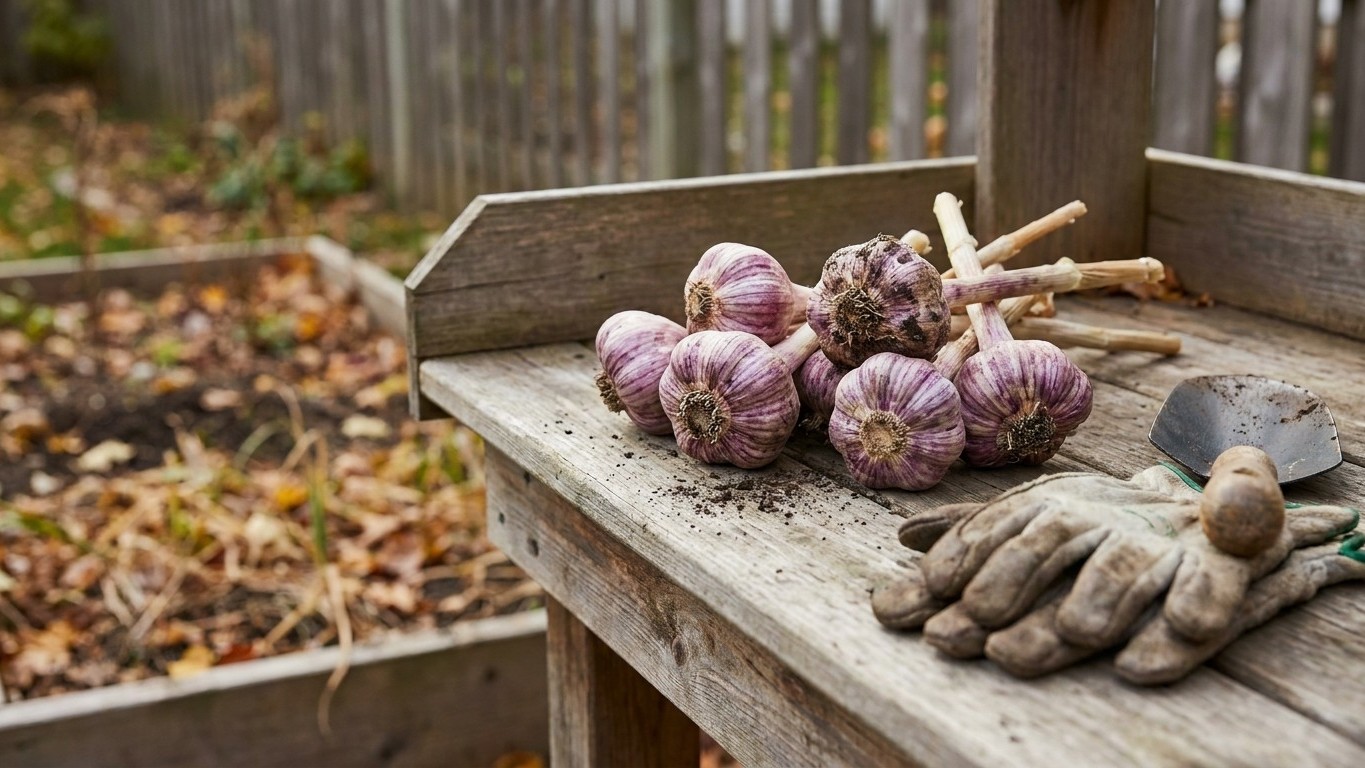

Garlic set out in Alabama in the fall, close to that first frost window, comes out of the ground the following summer, usually once the lower leaves have browned and dried back. From there it needs a few weeks of curing in a warm, shaded, airy spot before it goes into storage, and given Alabama’s humidity, how you cure it matters almost as much as when you dig it.
When garlic is ready to lift in Alabama
Garlic planted in the fall spends the winter building roots, then puts its real growth into the bulb once soil warms in spring. In Alabama, that means the plant is rarely fully dormant the way it would be in a colder state. Roots keep working through mild winter stretches, and top growth can restart earlier than gardeners moving from northern states expect. That head start doesn’t change the harvest signal, though: the plant tells you when it’s ready, not the calendar.
The standard cue, used by garlic growers everywhere, is leaf die-back. Once the lower third to half of the leaves have turned yellow or brown while the upper leaves are still green, the bulb has typically stopped sizing up and started forming its papery wrapper. Pull one test bulb and split it open. Cloves that are plump, distinct, and wrapped in intact skin mean the rest of the bed is ready. Wait too long past that point and the wrapper starts to split, which shortens how long the bulb keeps in storage.
Alabama’s north-south stretch matters here. A garden near Huntsville and one near Mobile aren’t running on the same clock, since spring warms earlier and winter chill is shorter in the southern part of the state. That’s one more reason the leaf signal beats a fixed date. If timing feels off for your county, the Alabama Cooperative Extension System is the resource to call for a local read.
Hardneck or softneck, and Why It Matters for timing
Which type you planted shapes how the harvest window behaves in a mild-winter state like Alabama.
| Type | Chill needs | Fit for Alabama |
|---|---|---|
| Hardneck | Higher chilling requirement | Can underperform in the state’s milder winters |
| Softneck | Lower chilling requirement | Generally better suited to Alabama’s winter conditions |
Softneck types tend to size up more reliably where winters don’t deliver sustained cold, which is most of Alabama outside its coolest pockets.
Curing it, and where to hang it here
Curing is what turns a freshly dug bulb, still full of moisture, into something that will actually keep. Leave the plant whole, roots, stalk, leaves, all attached. Don’t wash the bulbs. Brush off loose soil by hand and move them straight out of the sun.
The goal is airflow without direct sun or rain, and in Alabama that’s the tricky part. A hot, humid August afternoon on an exposed porch can do more harm than good, since trapped moisture invites mold before the outer skins have had a chance to dry down. A covered porch with a cross breeze, an open-sided garage, or a barn bay all work better than a closed shed, where heat and humidity just build up with nowhere to go.
Bundle a handful of plants together with twine and hang them upside down, or lay bulbs in a single layer on a screen or slatted rack so air moves underneath as well as over the top. Spacing matters more in Alabama’s humidity than it does in a drier climate. Crowded bulbs trap moisture between them, and that’s exactly where rot starts.
Curing continues until the outer wrapper turns papery and the neck, if there is one, tightens and dries. Check bulbs periodically rather than on a fixed schedule, since a stretch of humid weather can slow the process noticeably. Once the skins rustle and the roots are brittle, trim the roots close to the base and cut the tops down, leaving an inch or so of stalk if you’re not braiding softneck varieties. At that point the bulb is ready to move into storage, and any bulb that still feels soft or damp inside the neck needs more time on the rack, not a spot in the pantry.
Storing it through a Alabama winter
Alabama’s mild winters cut both ways for stored garlic. You won’t lose bulbs to hard freezes indoors, but you also don’t get the cold, steady conditions that keep garlic dormant for months without effort. Warmth is the main enemy of a stored bulb, since it wakes the clove up and pushes it toward sprouting well before spring.
Cool, dry, and dark beats everything else. A closet on an exterior wall, an unheated but insulated pantry, or a garage that doesn’t swing into summer-like heat all work better than a kitchen cabinet near an oven or a spot close to a water heater. Skip the refrigerator for whole bulbs. Fridge humidity and cold in that specific range are known to trigger early sprouting rather than prevent it.
Mesh bags, loosely woven baskets, or old pantyhose strung with bulbs let air keep circulating, which matters even after curing is done. Alabama’s humidity doesn’t disappear once summer ends, and sealed containers or plastic bags trap whatever moisture is left in the bulb, setting up mold in storage the same way it does on the curing rack. Check stored bulbs every few weeks. Pull anything that’s gone soft, sprouted, or started to smell off before it spreads to its neighbors.
Softneck varieties, cured well, commonly outlast hardneck types in storage, which lines up with softneck being the more reliable performer in Alabama’s winters to begin with. Save your best, firmest bulbs for fall replanting rather than eating your way through them first. Those are the ones carrying the traits that worked in your specific spot.
What goes wrong here
Most garlic failures in Alabama trace back to moisture. That shows up two ways: through documented pests in the field, and through cure or storage mistakes after the bulbs are dug.
The Alabama Cooperative Extension System documents these pests affecting garden crops in the state:
- Aphids
- Corn earworm (tomato fruitworm)
- Cowpea curculio
- Imported cabbageworm
- Leaffooted bug
- Mexican bean beetle
- Spider mites
- Spotted cucumber beetle
- Squash vine borer
- Stink bugs
Beyond the field, the two most common losses happen after harvest. Curing in a closed, humid space, or hanging bulbs where direct sun hits them through a window, either invites mold or scalds the outer wrapper, both of which shorten how long the bulb lasts. In storage, the mistake is almost always a spot that’s too warm or too damp, whether that’s a cabinet near a heat source or a sealed bag that traps moisture the bulb is still releasing weeks after curing looked finished.
None of this is unique to Alabama, but the state’s combination of humid summers and mild winters makes both failure points show up faster and more often than they would in a drier or colder climate. A grower who treats curing and storage as seriously as planting date tends to lose far fewer bulbs to rot than one who assumes the harvest is the finish line.
Common questions
Can I harvest garlic early in Alabama if the weather turns wet?
Pulling bulbs before the lower leaves have browned usually means smaller cloves and thinner skins, which cure poorly and don’t store as long. If wet weather threatens rot in the ground, digging a few days early and curing carefully indoors is usually the safer trade-off, but it’s a compromise, not the ideal timing.
Does Alabama’s climate suit hardneck garlic at all?
It can work in cooler pockets of the state, but hardneck types generally need more sustained winter chill than most of Alabama delivers. Softneck types are the more consistent performer statewide.
How long does properly cured garlic keep in Alabama’s climate?
That depends heavily on storage conditions rather than the state itself. Bulbs kept cool, dry, and dark last considerably longer than those exposed to warmth or humidity, which is why storage location matters as much as the curing process itself.
What should I do if stored garlic starts sprouting?
Use it first, since sprouting bulbs are still edible but decline in quality quickly. Sprouting is usually a sign the storage spot is too warm, so it’s worth moving the remaining bulbs to a cooler location before more of them follow.