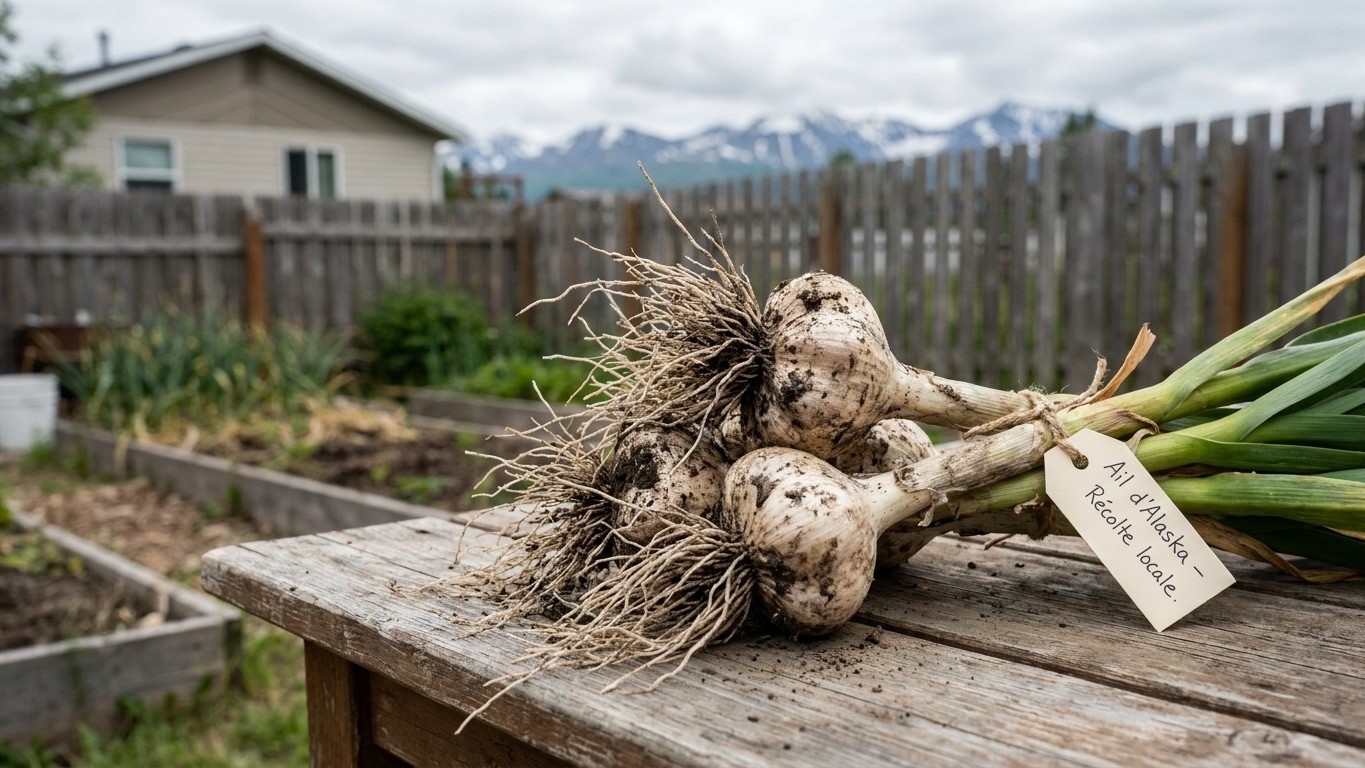

Garlic catalogs love to make each variety sound like it wants its own calendar — Inchelium Red here, German White there, Chesnok Red somewhere else again. In Alaska that distinction mostly dissolves. Every one of them, softneck or hardneck, gets counted back from nearly the same first-frost date and lands in the ground within the same early-September stretch. The real difference shows up later, underground, in how each bulb takes the cold once winter actually arrives.
The short answer for Alaska

For gardens near Anchorage, garlic goes into the ground in early September, the catalog target shared by every variety on this list. NOAA’s 1991-2020 Climate Normals put the first fall freeze at that station between September 22 and October 1, so an early-September planting gives cloves three to four weeks of root growth before the soil begins to stiffen.
That freeze window is a midpoint, not a promise. In roughly half the years on record the first freeze lands after October 1, and in the other half it arrives before September 22. Treat the range as the point where risk starts climbing, not the day frost is guaranteed to hit.
Every variety here, from the softnecks Early Red Italian, Inchelium Red, Italian Late and Lorz Italian through hardnecks like German White and Chesnok Red, carries the same early-September catalog window because each is counted back from a similar first-frost date. What differs between them isn’t when you plant, it’s how the bulb handles the winter once it’s in the ground. Hardneck types generally shrug off harsher cold better than softnecks do, which is why a hardneck-leaning planting list, with a softneck or two kept for kitchen storage, tends to be the safer bet outside the mildest coastal gardens.
Working it out for your own garden
The early-September target isn’t a fixed calendar date so much as a calculation you can redo for your own soil. Start with the first-fall-freeze figure for a station near you, the Anchorage range is September 22 to October 1, and count backward far enough that a clove can grow real roots before the ground stiffens, but not so far that a warm spell pushes green shoots up before winter arrives.
Steps to calculate your own window
- Find the first fall freeze date for a weather station close to your actual garden, not a statewide average.
- Count back three to four weeks from that date to land on your own planting window.
- Move the window earlier if your site sits at higher elevation or well away from any large body of water.
- Move it later, toward the far end of the window, if your garden sits on a coast or beside a large lake that holds heat into fall.
Elevation, a nearby lake, and the coast are the three things most likely to shift that date by two weeks either way from the Anchorage figure. Higher ground cools faster and loses its frost-free days earlier in the season. A large lake or the ocean does the opposite, holding stored summer heat into September and pushing the first freeze later than a station a few miles inland at the same latitude. Neither effect is something NOAA’s Anchorage data can tell you directly, so the adjustment has to come from watching your own site over a season or two.
Matching a variety to the calendar
Every named cultivar in Alaska’s garlic catalog shares the same early-September set-out, whatever type it is:
| Variety | Type | Catalog set-out window |
|---|---|---|
| Early Red Italian | Softneck | Early September |
| Inchelium Red | Softneck | Early September |
| Italian Late | Softneck | Early September |
| Lorz Italian | Softneck | Early September |
| Bavarian Purple | Hardneck | Early September |
| Blue Music | Hardneck | Early September |
| Chesnok Red | Hardneck | Early September |
| Duganski | Hardneck | Early September |
| Fall Festival | Hardneck | Early September |
| Georgian Crystal | Hardneck | Early September |
| Georgian Fire | Hardneck | Early September |
| German Red | Hardneck | Early September |
| German White | Hardneck | Early September |
| Ivan | Hardneck | Early September |
For the week-by-week version of this arithmetic, including how to shift the window for heavy clay or a known frost pocket, see When to Plant Garlic in Alaska: Counting Back From the First Frost.
What changes across Alaska
Interior Alaska, around Fairbanks, runs a shorter and more continental season than the Anchorage figures above describe. Winters go colder and the ground freezes earlier and deeper, so a clove timed to the coastal window may not get enough root time before the coldest part of the bed locks up. Gardeners there lean harder on hardneck types bred for real winter cold, and pile on thicker straw mulch than a Southcentral garden would ever need.
Coast, panhandle, and the far north
Southeast Alaska, the Juneau and Sitka panhandle, sits at the opposite extreme. The Pacific keeps winters milder and wetter, and the first fall freeze there typically lands later than the Anchorage range. That extra warmth and moisture cuts both ways for garlic, since UC ANR’s UC IPM guidelines for onion and garlic (Publication 3453) list white rot, caused by Sclerotium cepivorum, as active across a 50 to 75°F range, conditions a wet Southeast summer can sit inside longer than a drier Interior one does.
Southcentral coastal areas, the Kenai Peninsula and Kodiak, track close to the Anchorage numbers but carry more fog and less summer heat, which slows bulb sizing rather than shifting the planting date. Northern Alaska, above the Interior, has a growing season short enough that garlic needs a fully hardy, well-mulched hardneck and leaves no margin at all for a late planting.
The mistakes this climate punishes
Timing and mulch mistakes
The biggest mistake in a state with two extremes is treating one winter as normal. In a mild fall, it’s tempting to push planting toward the end of September because the ground still feels workable. But NOAA’s freeze window is a midpoint, and a clove set in after the average date can meet a sudden freeze with only a week or two of root growth behind it, not enough to survive a season of freeze-thaw heaving. Plant in the early-September window even when the calendar feels generous.
The opposite mistake shows up in colder years or at higher elevation: planting on the right date but too shallow, with no mulch layer to slow the freeze-thaw cycling that pushes half-rooted cloves right out of the ground. A straw mulch laid down immediately after planting, rather than after freeze-up, does more for winter survival here than the choice of variety does.
Assuming the cold protects against disease
Alaska’s winters invite a false sense of security about soil-borne disease, but that isn’t how these organisms work. UC ANR’s UC IPM guidelines for onion and garlic (Publication 3453) list the temperature range each pathogen needs to become active, and matching those ranges against the Anchorage growing season gives a mixed picture, not a clean bill of health.
| Disease | Published active range | Months matching the Anchorage growing season |
|---|---|---|
| White rot (Sclerotium cepivorum) | 50-75°F | 2 (June, July) |
| Fusarium basal rot (Fusarium oxysporum f. sp. cepae) | 59-90°F | 0 |
| Southern blight (Sclerotium rolfsii) | 86-95°F optimum | 0 |
| Pink root (Setophoma terrestris) | 75-85°F optimum | 0 |
Those figures are published soil temperatures, not the air readings behind the Anchorage count, and a monthly average hides plenty of days running warmer or cooler than that mean. A count of zero months doesn’t mean a disease can’t occur here, only that average conditions favor it less. Infected seed garlic carries these pathogens into a garden regardless of climate, which is the real reason to buy clean seed stock rather than replant a bulb that looked a little off last season. For the full walkthrough on soil prep and mulch timing, see Growing Garlic in Alaska.
Checking this against your county
The Anchorage figures above are a starting point, not a county-by-county forecast. The Cooperative Extension Service, part of the University of Alaska Fairbanks, keeps local contacts and publications for districts across the state, and its county-level guidance is the place to confirm a first-frost estimate for your own borough before locking in a planting date. Reach the extension service directory at uaf.edu/ces and search for the office nearest your garden. A five-minute call to a local agent beats guessing from a station two hundred miles away, especially if your garden sits at elevation or in a known frost pocket.
Common questions
Can I plant garlic in Alaska in spring instead of fall?
You can, but expect smaller bulbs. Garlic needs a stretch of cold to divide into separate cloves, and a spring-planted clove in a short Alaska season often just forms a single rounded bulb instead of a full head. Fall planting, timed to the early-September window described above, gives the crop both the cold exposure and the root time it needs before the summer push.
Will an early snow before I’ve planted ruin my garlic?
Not usually, if the snow is light and the ground underneath hasn’t fully frozen. Cloves can still be pushed into soil that’s cold but workable. Once the ground is frozen solid, though, forcing cloves in does more root damage than good, and you’re better off waiting until spring rather than pushing through a fall planting late.
Do I need to cover garlic beds with straw every winter?
In most of the state, yes. Mulch slows the freeze-thaw cycling that heaves half-rooted cloves out of the ground over winter, which matters more here than protecting against cold itself. Pull the mulch back or thin it in spring once new growth starts pushing through, so shoots aren’t smothered underneath it.
Which of these varieties stores the longest after harvest?
Softnecks generally outlast hardnecks in storage, which is why Early Red Italian, Inchelium Red, Italian Late and Lorz Italian are worth growing even in a hardneck-favoring climate. Keep a few softneck rows for the kitchen while relying on hardnecks like Duganski or German Red for the varieties bred to handle the harder cold.