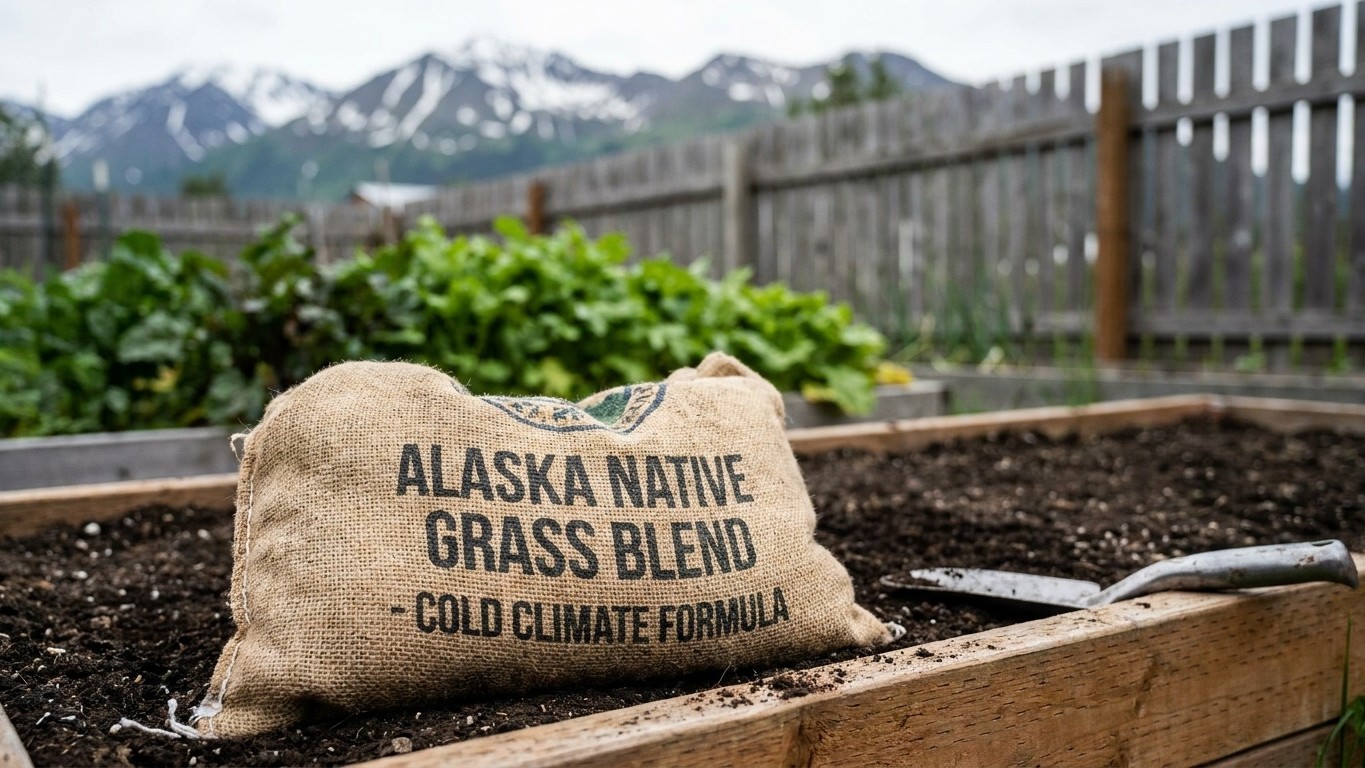

Fine fescues and perennial ryegrass are the safest grass seed picks for an Alaska lawn, because they root and knit together faster than Kentucky bluegrass inside the state’s short season. NOAA’s 1991-2020 climate normals put the first fall frost at Anchorage between September 22 and October 1, leaving roughly 143 frost-free days to get new seed established before winter. Get seed down as early in that window as the ground allows, and choose the species by what the lawn has to tolerate, not by price.
The short answer for Alaska
Fine fescue and perennial ryegrass are the two grasses that’ll actually take hold in your yard before winter comes back. They root fast enough to survive Alaska’s short growing season, and that’s what matters more than any bag price or brand name. The one thing to do right now: get seed in the ground as early as the soil can be worked, because in Anchorage you’ve only got about 143 frost-free days to work with before the ground shuts you out again.
Inside that zone, the realistic seed choices are Fine Fescues, Kentucky Bluegrass, Perennial Ryegrass, Rough Bluegrass and Tall Fescue, the five species Clemson’s HGIC 1214 and Penn State Extension both list as cool-season turf. All five go dormant and brown out under summer drought stress rather than dying, then green back up once rain or irrigation returns. That’s a different failure mode from a warm-season lawn, which would be killed outright by an Alaska winter rather than merely browning: Bermudagrass and zoysia, the usual warm-season picks, have no place on this list because their rhizomes cannot survive a freeze this deep.
There is no single best grass among the five, only a best fit for the lawn in front of you. Shade, foot traffic and how much fertilizer and water you’re willing to put in decide the winner more than any species being generically superior. A deeply shaded yard under spruce calls for a different pick than a sunny, kid-and-dog lawn, and the next section works through what each species costs in exchange for its strengths.
Working through the year

Ranking the five cool-season options
Fine fescues (a blend of red, chewings and hard fescue) come first for most home lawns here, because they tolerate the low light under birch and spruce and need less nitrogen than the others to stay green. Perennial ryegrass ranks second: it germinates faster than any other grass on this list, which matters when the window to establish new seed is measured in weeks rather than months. Kentucky bluegrass, the grass most people picture when they think of a lawn, spreads by rhizome into a dense, self-repairing sod, but it is slowest of the five to germinate and wants steadier moisture while it does. Tall fescue roots deepest of the group and handles a dry spell better than the rest, at the cost of a coarser blade and a clumping habit that will not fill in a bare patch on its own. Rough bluegrass sits last for most yards: it tolerates shade and wet, poorly drained soil better than any species here, but it thins out fast in full sun and will not take foot traffic.
| Species | Establishes | Strongest trait | What it costs you |
|---|---|---|---|
| Fine Fescues | Moderate | Shade and low-fertility tolerance | Thins under heavy foot traffic |
| Perennial Ryegrass | Fast | Quick germination for patching or new seed | Less winter-hardy than the others without snow cover |
| Kentucky Bluegrass | Slow | Dense, self-repairing sod | Needs steady moisture to establish |
| Tall Fescue | Moderate | Deepest roots, best drought tolerance | Coarse texture, clumps instead of spreading |
| Rough Bluegrass | Moderate | Shade and wet-soil tolerance | Thin in full sun, low wear tolerance |
Seeding within Alaska’s short window
Cool-season grass seed goes down either in spring once the soil has warmed enough to work, or in later summer with enough runway left before the season’s first hard freeze. At Anchorage, NOAA’s 1991-2020 normals put that freeze between September 22 and October 1, so a late-summer seeding has to go down well ahead of that range if the new grass is going to root deeply enough to survive winter. If you’re seeding a full new lawn rather than patching an existing one, it helps to work back from the basics laid out in Alaska Lawn Care before picking a species at all.
If tall fescue is your pick, Clemson’s HGIC 1219 Tall Fescue Maintenance Calendar sets out mowing height and nitrogen rates for that species, but those figures are built around South Carolina’s much longer growing season. Treat the calendar as a starting structure rather than a rate to copy directly, and check with the University of Alaska Fairbanks Cooperative Extension Service for guidance scaled to a season this short. For the week-by-week version of what to do once seed is in the ground, The Alaska Lawn Care Calendar, Month by Month lays out the same year in Alaska-specific terms.
What changes across Alaska
Every figure in this piece is measured at or near Anchorage, and NOAA’s own station data flags Anchorage as one of the mildest inhabited parts of the state. Move north or inland and the season most cool-season grasses need to establish and go dormant safely gets considerably shorter.
The Interior, around Fairbanks, loses weeks off both ends of the growing season compared with the coast, because continental winters there bring deeper, longer cold with less of the maritime buffering Anchorage gets from Cook Inlet. A late-summer seeding date that works on the coast can be too late once you’re several hundred miles inland.
Coastal Southeast Alaska, around Juneau, runs the other direction: the ocean keeps winters milder and summers cooler and wetter than Anchorage’s. That extra moisture favors the shade-and-wet-tolerant end of the list, rough bluegrass and fine fescue, over a species that wants a drier root zone like tall fescue.
Elevation matters even within a single metro area. Anchorage’s own Hillside neighborhoods, a few hundred feet above the bowl of the city, hold snow later into spring and can see frost return earlier in fall than the lower townsite, which shortens the safe seeding window without changing which species suit the soil and light. Snow cover itself is part of the difference: a reliable, early, deep snowpack insulates perennial ryegrass and Kentucky bluegrass crowns through cold spells that would otherwise thin them, while a thin or late snow year exposes the same lawn to harsher swings. That’s one more reason a seed choice that works on one side of the Chugach range can struggle on the other.
The mistakes this climate punishes
The four mistakes that show up here
- Seeding after the safe late-summer window, leaving roots too shallow before the first freeze
- Pushing a heavy nitrogen feeding right before that freeze window
- Scalping the lawn short on the last mow of the season
- Choosing a warm-season species expecting it to behave like the cool-season list
Each of these shows its cost the following spring, not right away, which is exactly why it’s easy to repeat the mistake a second year. Seed put down too close to NOAA’s September 22 to October 1 frost window at Anchorage germinates, then gets caught with too little root mass to survive the freeze. The lawn looks fine going into winter and comes back as bare, thin patches once the snow melts.
A heavy nitrogen application timed for that same late window pushes soft, leafy growth right when the plant should be hardening off. That soft tissue is more vulnerable to snow mold over winter, and the damage again only becomes visible in spring as matted, gray-pink patches where the turf was actively growing when the cold hit.
Cutting the last mow of the season too short strips leaf area the plant needs to store energy for winter and exposes the crown to drying wind once the ground freezes but before reliable snow cover arrives. The result is the same as the other two: a lawn that looked fine in October and comes back weak in May.
Planting Bermudagrass, zoysia or another warm-season species because a catalog lists it as low-maintenance is the costliest mistake of the four, because it does not recover at all. A cool-season lawn under drought stress browns and regreens once conditions improve. A warm-season lawn caught by an Alaska winter is simply dead, and the whole area has to be reseeded with one of the five cool-season species from scratch.
Checking this against your county
Every number on this page comes from a station at or near Anchorage, and the same figures will not fit Fairbanks, Juneau, Kodiak or the Mat-Su Valley exactly. The University of Alaska Fairbanks Cooperative Extension Service, at uaf.edu/ces, is the body to check for guidance built around your own borough rather than Anchorage’s climate normals.
Their district offices can also confirm which of the five species has actually performed well in local variety trials, something a national seed catalog cannot tell you. If your lawn sits at real elevation or well north of Anchorage, that local check matters more than anything ranked on this page.
Common questions
Can I sow grass seed right when the snow melts in spring?
Soil temperature decides that, not the calendar. Cool-season seed needs the soil to warm past its germination point first, and in Anchorage that often trails snowmelt by weeks. Sowing into cold, wet soil right after melt-off usually rots the seed before it ever germinates, so wait for the ground to dry and warm rather than going by the date snow disappeared.
What happens if I mix warm-season seed into my lawn for variety?
It will not survive an Alaska winter, and there is no partial credit for trying. Bermudagrass and zoysia, the common warm-season picks, are killed outright by the kind of hard freeze Anchorage sees every year, so any warm-season seed in a mix is money spent on a patch of dead grass by spring, not a hardier option.
Can I lay sod instead of seeding to get around the short season?
Sod skips the germination step since the grass is already established, which helps, but it still has to root into your native soil before the ground freezes. That puts it under the same deadline pressure as a late seeding, NOAA’s Anchorage frost window of September 22 to October 1, just with more of a head start going in. Availability of the five recommended species as sod varies by region, so check with local suppliers before assuming it’s an option.
Do I need to reseed my Alaska lawn every year like some Lower 48 lawns?
No, not with the species recommended here. Fine fescue, Kentucky bluegrass, perennial ryegrass, tall fescue and rough bluegrass are all perennials that persist for years once established. The exception is annual ryegrass, sold cheaply as a filler in some mixes, which is bred to die off after one season. Check the seed tag for “perennial” rather than “annual” ryegrass before you buy if you want the lawn to come back on its own.