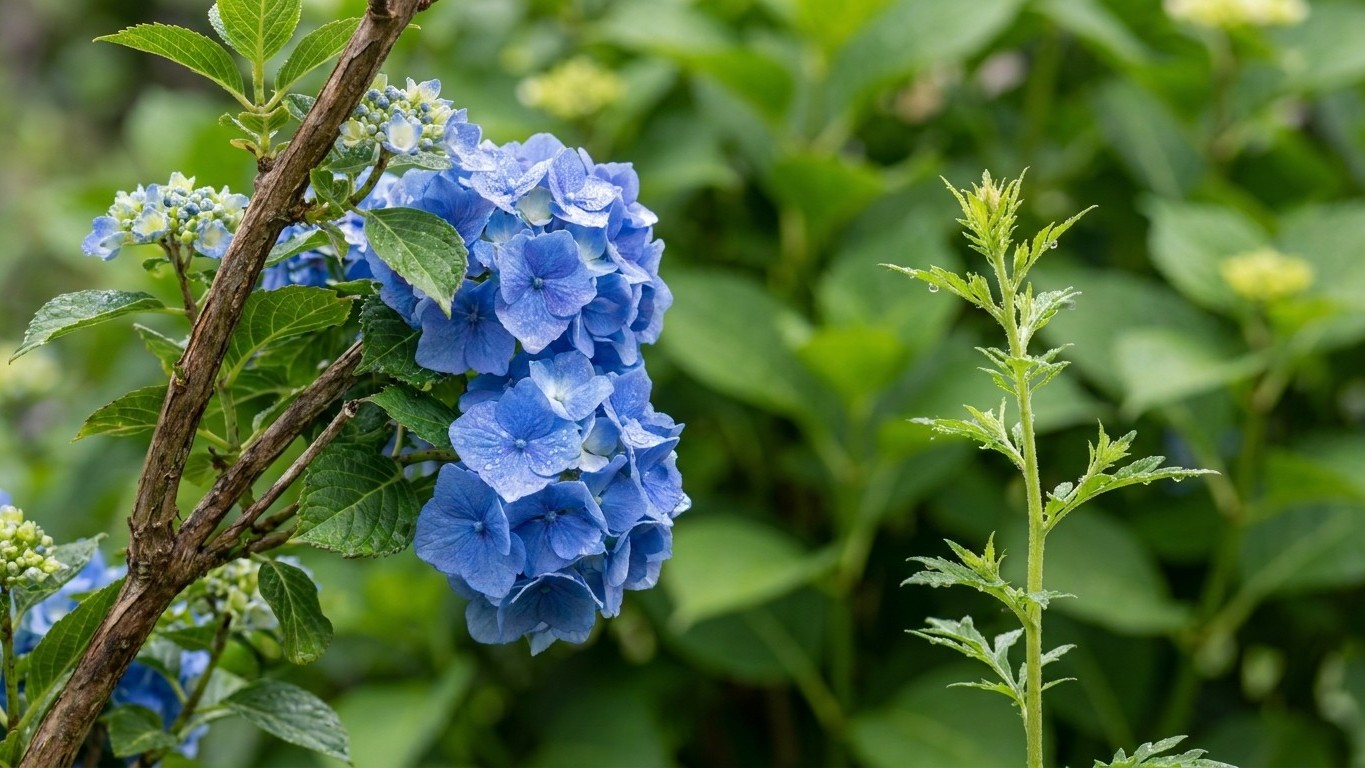

Hydrangeas in Alaska stay pink because most soils here sit at a neutral to alkaline pH, which locks up the aluminum that flowers need to turn blue. Getting blooms to shift color means lowering soil pH below roughly 5.5 and making sure aluminum is actually available to the roots, a project that takes patience given how short and cool the growing season is.
What this comes down to in Alaska
Near Anchorage, the frost-free window runs from a last spring frost between May 3 and May 12 to a first fall frost between September 22 and October 1, based on NOAA NCEI 1991-2020 climate normals for that station. That gives gardeners in the milder parts of the state something close to 143 frost-free days to work with, and that number matters more for hydrangea color than most people assume.
The chemistry behind pink versus blue blooms has nothing to do with the plant’s genetics and everything to do with what the roots can pull out of the soil. Hydrangea flowers contain a pigment called delphinidin. When aluminum ions are present and available, that pigment binds them and the blooms turn blue. When soil pH climbs above about 6.5, aluminum locks into a form the roots can’t absorb, and the same pigment reads pink instead. Alaska’s soils, particularly those built on glacial till and limestone-influenced parent material found across much of the south-central region, tend to sit on the neutral-to-alkaline side of that line already, which is the plain reason pink is the default color here rather than something a gardener chose.
Cold soil compounds the problem. Even where pH has been pushed low enough, root uptake of aluminum slows down when soil temperatures stay cool into June, which is common across the Anchorage bowl and even more pronounced inland. A gardener can do everything right on paper and still see a partial color shift simply because the roots aren’t warm enough yet to move the aluminum into the plant.
There’s also a species issue that sits underneath all of this. Only bigleaf hydrangea (Hydrangea macrophylla) and a few related mophead and lacecap types respond to soil pH at all. Panicle and smooth hydrangeas bloom white or cream and stay that color no matter what the soil chemistry looks like, so if a plant in an Alaska garden refuses to turn blue despite heavy amendment, checking the species tag is worth doing before blaming the soil.
Working it out for your own garden
Start with a soil test, not a guess. County extension offices and most garden centers can run a pH reading, and that single number tells you which direction you’re working: below 5.5 pushes toward blue, above 6.5 holds pink, and the range in between produces the muddy purples many gardeners see the first year they try to change color.
The arithmetic that matters here isn’t about planting dates, it’s about how much growing season you actually have to make a soil amendment take effect. If a gardener plants or treats a container-grown bigleaf hydrangea any time after the last frost window of May 3 to May 12, and the first fall frost arrives between September 22 and October 1, that leaves roughly 19 to 21 weeks of frost-free time. Aluminum sulfate, the amendment most commonly used to acidify soil and free up aluminum, typically needs several weeks per application to shift pH meaningfully, and it should be reapplied only after a retest rather than on a fixed schedule. In a 19-to-21-week window, that often allows for one solid application in late May or early June, a retest in July, and a second application if the reading still sits above 5.5, which is enough to start a color shift but rarely enough to finish it in a single season given how slowly cold soil moves chemical reactions along.
Work through a real case to see where the limit falls. A gardener transplants a container-grown bigleaf hydrangea in mid-May, right at the tail end of the frost window, and tests soil at pH 6.8. An aluminum sulfate application goes down in early June, followed by a retest in mid-July that reads pH 5.9, still too high for reliable blue. A second, lighter application follows, and by the time the first fall frost arrives in late September, the reading has dropped to roughly 5.6, right at the edge. Full, saturated blue blooms are unlikely to show until the following summer, once the lower pH has had a full season to settle in and root uptake has caught up.
Compare that to a gardener who skips the soil test entirely and dumps a heavy dose of aluminum sulfate on an established plant in one application. The pH can swing too far too fast, which stresses roots and can scorch foliage, especially in soil that’s still cool from a late spring. Slow and measured beats aggressive and rushed almost every time in this climate.
What changes across the state
Alaska’s hardiness zones span 1a to 8a under the USDA Plant Hardiness Zone Map, and that spread alone tells you the frost window quoted for Anchorage doesn’t travel far. Anchorage sits in one of the mildest inhabited parts of the state, and figures tied to it should be treated as a starting reference point, not a statewide constant.
Elevation is the first thing that moves the numbers. Gardens a few hundred feet higher than the Anchorage bowl see a shorter frost-free stretch and colder soil longer into spring, both of which slow the aluminum uptake a color change depends on. Coastal areas, including much of Southeast Alaska around Juneau and Sitka, tend to get heavier rainfall, and that extra moisture leaches soil over time in a way that nudges pH slightly lower than in the drier interior. That’s a small natural assist toward blue in wetter coastal gardens, though not a substitute for testing.
The Interior, centered on Fairbanks, runs a much shorter frost-free season and colder winters than the south-central coast, and its loess-based soils skew more alkaline, which works against blue blooms in two ways at once: less time for amendments to act, and a higher starting pH to overcome. North of the Interior, the growing season shrinks further still, to the point where outdoor bigleaf hydrangeas become a genuinely marginal proposition regardless of soil chemistry. The general rule holds across all of it: colder, higher, and drier pushes toward pink and toward a shorter amendment window; milder and wetter gives a color change slightly more room to work.
The mistakes this state punishes
The most common misstep is expecting a single season to deliver a full color change. Given the roughly 19-to-21-week frost-free window near Anchorage and even less in the Interior, one application of aluminum sulfate rarely finishes the job. Treat it as a two-season project and the disappointment mostly disappears.
Choosing the wrong species is the second trap. Planting a panicle or smooth hydrangea and expecting soil amendment to turn it blue wastes money and time, since those types don’t carry the pigment that responds to aluminum at all. Confirm the species before buying any acidifying product.
Overcorrecting is the third. A heavy, single application of aluminum sulfate in cold soil can drop pH too fast and damage roots rather than gently shifting bloom color, and that damage is harder to recover from in a short season with little time left to regrow before dormancy. Smaller doses spread across a retested schedule work with the climate instead of against it.
Last, treating soil pH as fixed once tested is a mistake gardeners repeat every year. Alaska’s mix of glacial and limestone-influenced soils tends to drift back toward alkaline over time, so a garden that read acidic last summer may need retesting rather than assuming last year’s amendment still holds.
Checking this against your county
Every figure here is anchored to Anchorage, and Alaska’s spread across USDA hardiness zones 1a to 8a means a garden in Fairbanks, Juneau, or a higher-elevation valley will see different soil temperatures and a different frost window than the one quoted above. Before committing to a color-change plan, run a local soil test and check current guidance through the University of Alaska Fairbanks Cooperative Extension Service, which can connect you with a county office and the state’s own hydrangea guidance for your specific area.
Common questions
Can any hydrangea in Alaska turn blue?
No. Only bigleaf hydrangea and closely related mophead or lacecap varieties respond to soil pH. Panicle and smooth hydrangeas bloom white or cream regardless of how acidic the soil becomes.
How long does it take to turn a pink hydrangea blue in Alaska?
Given the roughly 19-to-21-week frost-free window near Anchorage and slower aluminum uptake in cool soil, most gardeners see a partial shift the first season and a fuller color change the second season after repeated pH testing and adjustment.
Why do some Alaska hydrangeas stay purple instead of pink or blue?
Purple usually means the soil pH sits between roughly 5.5 and 6.5, the middle ground where aluminum is only partly available to the roots. Testing soil and adjusting further in one direction usually resolves it.
Does adding coffee grounds or vinegar work to acidify Alaska garden soil?
Those household methods produce inconsistent, temporary pH shifts and aren’t a reliable substitute for a tested application of aluminum sulfate or an equivalent product. A soil test before and after any amendment is the only way to know it actually worked.