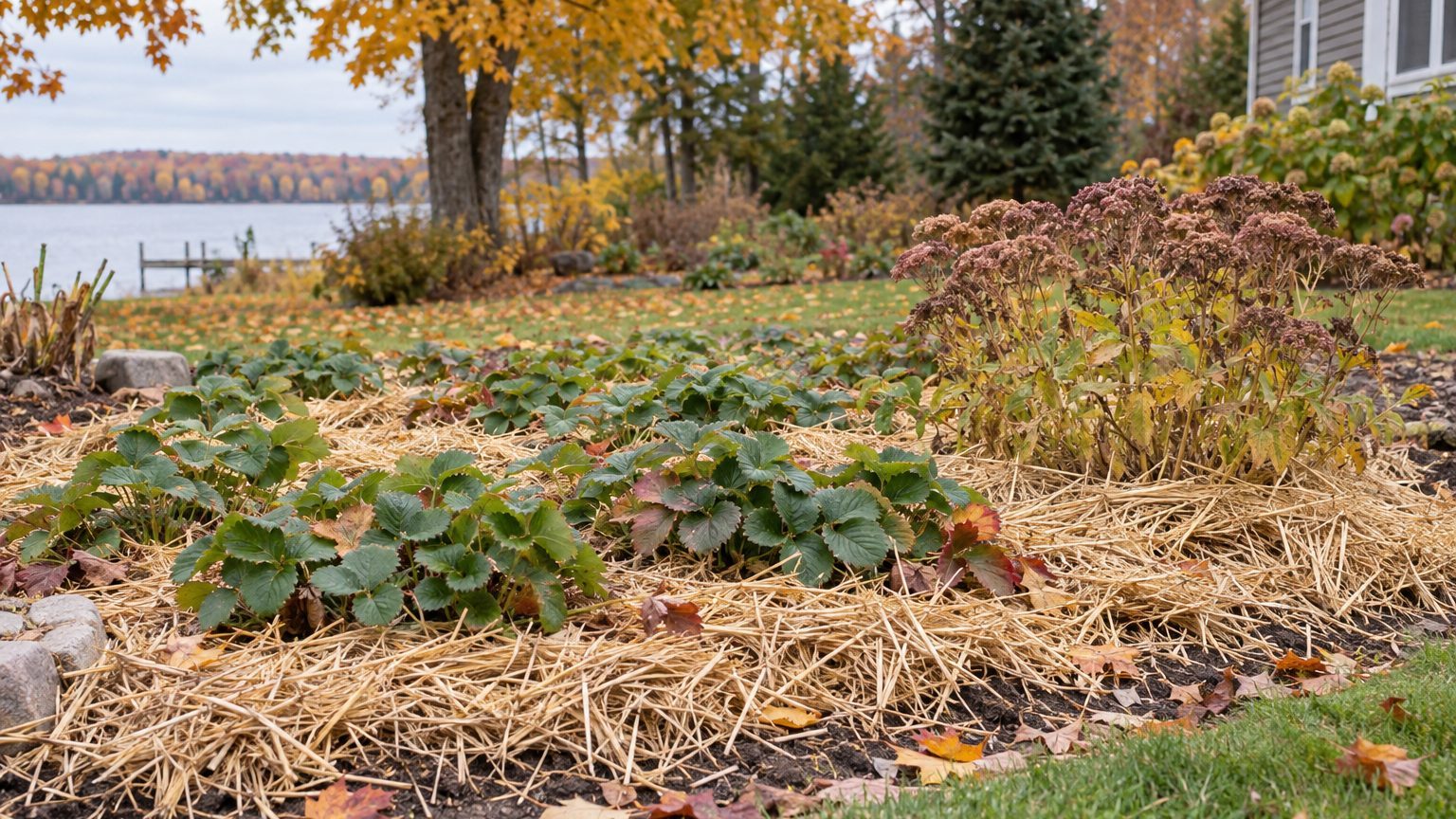

Wait for the ground to freeze, then mulch. In Anchorage, the first fall frost arrives between September 22 and October 1, according to NOAA’s 1991-2020 Climate Normals. That date is the cue to start watching the soil, not to start spreading straw. Winter mulch for strawberries and borderline perennials goes down after the soil begins to freeze, well after that window closes. Farther north, the freeze comes sooner, and so does the job.
When to put winter mulch down in Alaska
Wait for the freeze, not the frost
The rule runs against instinct. Winter mulch is not a blanket meant to keep plants warm. Its job is to keep frozen soil frozen, so a midwinter thaw doesn’t heave crowns out of the ground. Spread it while the soil still holds autumn’s warmth and you get the opposite result. So the line to write on your calendar is this: mulch after the ground begins to freeze, well after the September 22 to October 1 first-frost window has closed.
That window comes from the NOAA NCEI 1991-2020 Climate Normals for the Anchorage station, where the 30 to 70 percent probability band for a 32°F freeze runs from September 22 to October 1. The same data set counts about 143 frost-free days. Anchorage is one of the mildest inhabited corners of Alaska. The Interior and the north have far shorter seasons, and their first frost comes earlier. Fall jobs move earlier there, never later, so a gardener in those areas mulches sooner on the calendar and uncovers later in spring. Local frost patterns are laid out in First and Last Frost Dates in Alaska, and the wider Alaska guides cover how the rest of the fall checklist shifts with them.
Yes, the ground freezes here
In some parts of the country, a winter mulch conversation starts with “does the soil even freeze?” Not in Anchorage. NOAA’s 1991-2020 Climate Normals put the mean daily minimum of the coldest month at 11.0°F. That is an average of the nightly lows, not a record and not a monthly average of highs and lows together. It tells you the soil goes solid and stays that way for months, so heaving and cold exposure are real threats.
The USDA Plant Hardiness Zone Map (2023 edition, built on 1991-2020 normals) runs from 1a to 8a across Alaska. A range that wide is why no single zone number can guide a mulching date, and why Anchorage serves as the reference here. Other parts of the territory differ.
Snow is the best mulch there is. In a winter with steady cover, the snowpack does the insulating and mulch is a backup. It earns its keep when snow arrives late, blows off exposed beds, or gets stripped by a warm spell or rain.
Reading the soil instead of the calendar
Because the date drifts from year to year, let the ground make the call. Strawberry leaves have stopped growing and turned dull or reddish. Perennial foliage has collapsed. The top of the soil is stiff in the afternoon, not just at dawn, and a trowel meets resistance. Hard frosts have come night after night, not once. That is your signal.
Go early and the soil stays warm and damp under the cover. Crowns stay soft and active instead of going dormant, rot gets a head start, and mice and voles find a tidy, insulated shelter that nobody is disturbing. A week of patience costs nothing. A crown that rotted under warm straw costs a whole bed’s next berry crop.
Strawberries
Why the crowns need cover
A strawberry crown is a short, stubby stem sitting right at the soil surface. It holds the buds for next year’s leaves and flowers, and the feeder roots run shallow beneath it. That position is the problem. When soil freezes, thaws, and freezes again, it expands and contracts, and the shallow roots stretch and snap while the crown is pushed up onto the surface. By spring, plants can be sitting on top of the bed like they were set there by hand.
Bare cold is the second threat. With an 11.0°F mean nightly low in Anchorage’s coldest month (NOAA NCEI 1991-2020), real nights run colder than that, and a crown with no snow and no cover dries out in the wind. A layer of straw protects against both, but only if it goes on once the soil is already freezing. The full growing calendar, from planting to renovation, is in Growing Strawberries.
Clean straw, the right depth, and pulling it back
Use clean straw, meaning seed-free stalks from wheat or oats, not hay. Hay is full of seed and you will be weeding grass out of the patch by June. Straw is springy, traps air, and sheds water. Whole leaves mat into a soggy sheet, and grass clippings heat up and go slimy, so both make poor choices over crowns.
On depth, the only figure I can cite comes from NC State Extension. In its Extension Gardener Handbook, chapter 11, the guidance reads: “A 2-inch to 3-inch layer of mulch suppresses most annual weed seeds and makes it easy to hand-pull any that do germinate.” That sentence is about weeds, not strawberries, but it shows the general depth where mulch works without smothering. Treat 2 to 3 inches as the range to stay inside, measured after the straw settles. More is not better. Deep, wet straw holds moisture against the crown, which is how you trade heaving for rot. You can read the source at NC State Extension.
Spring is the part people forget. Apply the straw after the ground starts to freeze, and pull it off the crowns as soon as the snow is gone and pale new growth shows through. Rake it into the aisles rather than off the bed, so it is right there to throw back over open blossoms on a frost night. The colder your location, the later that uncovering happens, and the last-frost picture for your area should guide how long you keep it close.
Perennials and borderline plants
Most established, well-chosen perennials in Anchorage don’t need a heavy winter cover, because they were selected for the climate and snow does the rest. The plants that benefit are the ones at the edge of their comfort. A useful way to sort them:
| Plant group | Why mulch helps | How to apply it |
|---|---|---|
| Perennials in their first winter | Roots haven’t spread, so heaving can lift the whole plant | Ring of mulch after the soil starts to freeze |
| Shallow-rooted heavers such as heuchera and garden mums | Freeze-thaw cycles push them out of the soil | Ring of mulch, checked again in spring |
| Plants rated only marginally for your zone | Roots sit closer to their cold limit | Ring of mulch, plus a snow-catching cover if exposed |
| Perennial herbs such as thyme, sage, and lavender | Poor drainage plus cold is a bad mix | Light, airy cover; see the herb guide below |
| Established, proven hardy perennials | Snow usually covers them | Often nothing, or a light cover only in exposed spots |
Zone ratings deserve a caution here. The USDA system is built on one variable, the average annual extreme minimum temperature. That is the single coldest night of a typical year, which runs colder than the 11.0°F mean nightly low NOAA reports for Anchorage’s coldest month. A plant labeled for your zone has been vetted for that extreme, but a plant rated only marginally leaves no margin for a snowless cold snap. Tender herbs have their own playbook in Getting Perennial Herbs Through the Winter.
How you place the mulch matters as much as when. Put a ring around the crown after the ground starts to freeze, leaving a hand’s width of bare soil right at the stems. A pile against the crown holds moisture on the bark and buds, gives voles cover, and invites rot. Think doughnut, not volcano. The same NC State handbook, in its woody ornamentals chapter, advises: “Provide a 3-inch layer of mulch to reduce water loss and maintain uniform soil moisture and temperature around roots.” That line is written for trees, but it gives the same order of depth as the weed-suppression figure, and the ceiling of 3 inches applies to perennials too. Step-by-step placement is covered in Mulching Without Killing the Plant.
What goes wrong
Winter mulch fails in four predictable ways, and each one leaves a clue you can spot before the damage is done.
Mulching too early looks like soft, dark crowns in late fall or mushy, blackened growth at the base come spring. The soil under the cover never cooled, so plants stayed active and damp. The fix is to hold off until the ground has begun to freeze, weeks past the first frost, not days.
Matting and rot show up as a slick, sour-smelling layer, usually where wet leaves, grass clippings, or an overly thick blanket of straw settled in. Air can’t move, and the crown sits in a wet pocket. Choose fluffy material, stay within the 2-inch to 3-inch range, and fork through any clumps that pack down.
Voles are the quiet one. They tunnel under snow and mulch, where it is warm and protected, and chew crowns and the bark of young shrubs. Trails in the snow, runways in the mulch, and gnawed stems in spring point to them. Keep mulch off stems, apply it late so nothing moves in early, and wrap the trunks of young shrubs in hardware cloth.
Forgetting to uncover is the mistake that catches conscientious gardeners. Under straw, plants push out pale, yellow, leggy growth that scorches or rots in the first bright sun. Check mulched beds as the snow melts and pull the cover back once new growth shows. Keep the straw at the edge of the bed for frost nights, since the last frost often arrives after growth has already started.
Common questions
Can I mulch strawberries right after the first frost?
No. In Anchorage the first frost falls between September 22 and October 1, but soil is still warm then and plants are only beginning to harden. Mulch spread that early traps warmth and moisture against the crowns. Wait until the ground has started to freeze and the plants have gone dormant.
How deep should winter mulch be?
Stay within 2 to 3 inches. NC State Extension says a “2-inch to 3-inch layer of mulch suppresses most annual weed seeds,” and for trees it recommends “a 3-inch layer of mulch to reduce water loss and maintain uniform soil moisture and temperature around roots.” Going deeper doesn’t add protection. It adds rot and vole shelter.
Do I still need mulch if my garden gets steady snow cover?
Snow is an excellent insulator, and where it stays put all winter, mulch adds little. But snow can arrive late, blow off open beds, or melt in a thaw, and that is when heaving happens. Mulch is cheap insurance for exposed beds, new plantings, and plants at the edge of their zone.
Does the timing change in the Interior or the north?
Yes, and in a predictable direction. The figures here are for Anchorage. Colder places, including the Interior and the north, have far shorter frost-free seasons and earlier first frosts, so the freeze arrives sooner and mulching moves earlier on the calendar. Spring uncovering moves later. The signal stays the same: mulch after the ground starts to freeze, and uncover when new growth appears.