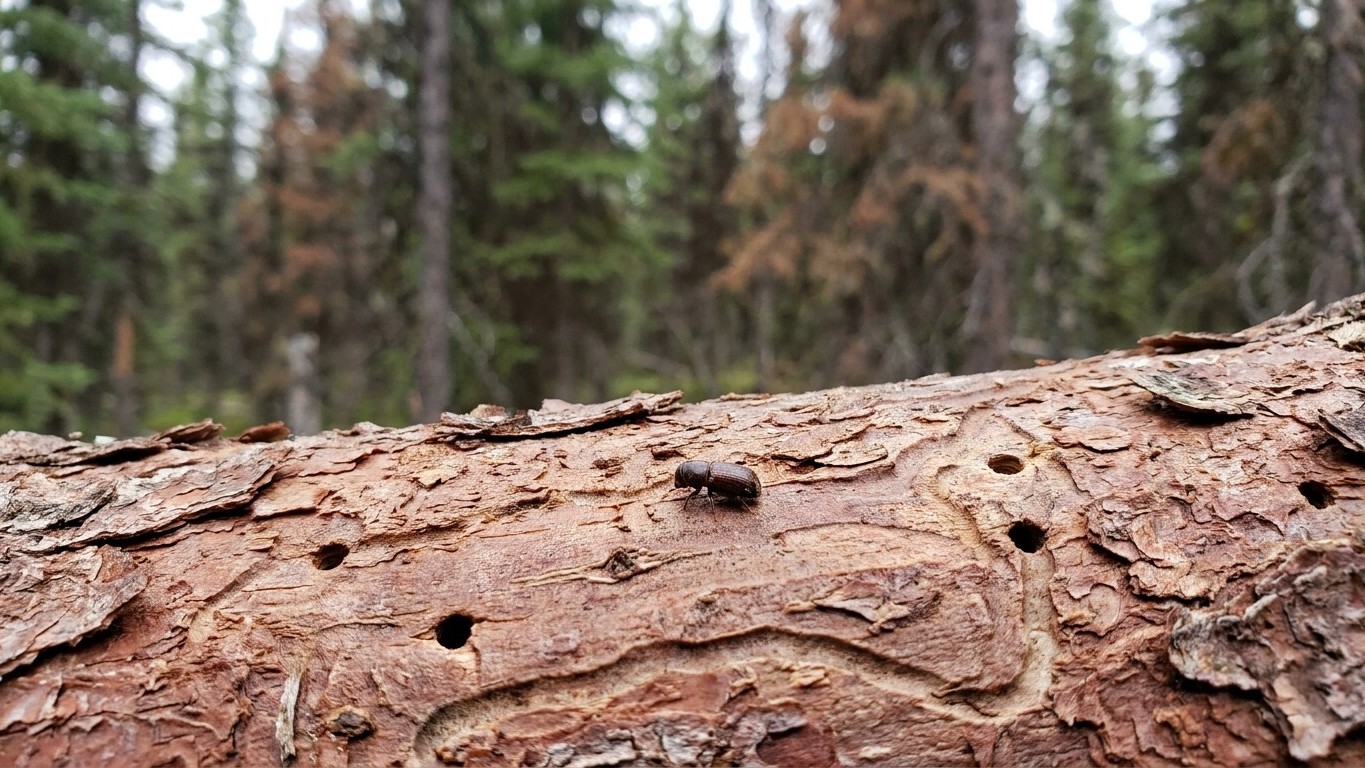

Spruce beetle activity in Alaska peaks in late May through July, when adult beetles emerge from dead and dying trees to fly and attack new hosts. The insect doesn’t disappear on its own schedule, either. What actually knocks back an outbreak is a mix of sustained deep-cold winters, natural predators, and active forest management, not a single silver bullet.
Alaska has lived through this cycle before. The Kenai Peninsula outbreak of the 1990s killed spruce across more than a million acres, and a second wave that ran roughly from 2016 through 2019 hit Southcentral Alaska even harder, affecting the Kenai Peninsula, the Matanuska-Susitna Valley, and parts of the Copper River area. Understanding when the beetle is active and what conditions actually suppress it helps homeowners and land managers make better decisions instead of just watching trees turn red and hoping for the best.
The Spruce Beetle’s Yearly Timeline in Alaska

Adult spruce beetles (Dendroctonus rufipennis) spend most of their lives out of sight, tunneling under bark. The visible part of their calendar is short. Flight and attack typically run from mid-May into July, with activity tapering as summer temperatures cool in late July and August. During that window, beetles bore into the bark of standing spruce, lay eggs in vertical galleries, and release pheromones that draw in more beetles, sometimes overwhelming a tree’s defenses within days.
Under normal conditions, spruce beetle takes two years to complete a generation, spending one winter as larvae and a second winter as pupae or young adults before emerging. But warmer summers have shortened that cycle. Research tracking outbreaks in Alaska found that unusually warm seasons can compress development into a single year, effectively doubling the reproductive rate and accelerating tree mortality across a stand. That’s a big part of why recent outbreaks have moved faster and covered more ground than the historical average.
Why Timing Matters for Detection
Trees attacked in early summer often don’t show obvious fading (the reddish-brown needle color people associate with dead spruce) until the following spring or even a full year later. That lag means a tree that looks green in August may already be doomed. Reddish boring dust collecting in bark crevices or at the base of the trunk, along with small pitch tubes, are the earlier warning signs worth checking for during the active flight period rather than waiting for needles to change color.
Where Alaska’s Outbreaks Have Concentrated
Spruce beetle isn’t evenly distributed across the state. Lutz spruce and white spruce stands on the Kenai Peninsula have been hit repeatedly, partly because mature, dense forests there provide exactly the kind of large-diameter host trees the beetle prefers. Sitka spruce along parts of the coast and white spruce stands through the Matanuska-Susitna Valley and Copper River basin have also seen significant mortality during the 2016 to 2019 event.
Drought stress plays a role in where outbreaks take hold. Trees weakened by dry soil conditions or root damage produce less defensive resin, making them easier targets for the first wave of attacking beetles. Once a population builds up in stressed trees, it can spread into healthier neighboring stands, which is how a localized problem turns into a landscape-scale die-off covering hundreds of thousands of acres.
What Actually Stops a Spruce Beetle Outbreak
No single factor ends an outbreak on its own. It’s a combination of climate, biology, and human intervention working together, and the balance shifts from year to year.
Extreme Cold Snaps
Sustained temperatures well below zero Fahrenheit, particularly in early winter before larvae have built up cold tolerance, remain one of the most effective natural checks on spruce beetle populations. A hard cold snap arriving in October or November, before insects have hardened against freezing, can kill a large share of a local population outright. The catch is that Alaska’s warming winters have made these lethal cold events less frequent and less severe than they were a few decades ago, which is part of why recent outbreaks have run longer and covered more territory than those in the mid-20th century.
Natural Predators and Competitors
Woodpeckers are surprisingly effective beetle control. During heavy outbreaks, woodpecker activity on infested trunks can strip away enough bark to expose larvae to weather and predation, and heavily “flecked” bark is a visible sign that birds have been working an infested tree. Parasitic wasps and predatory beetles that target spruce beetle larvae also help suppress populations, though their impact is usually gradual rather than a fast fix during an active outbreak.
Forest Management and Sanitation
Removing recently killed and freshly attacked trees, known as sanitation harvesting, cuts down the number of beetles that can emerge and disperse the following season. The Alaska Division of Forestry and land managers with the USDA Forest Service have used this approach on the Kenai Peninsula and in Southcentral forests, prioritizing removal of trees still holding live beetle broods rather than older gray, long-dead snags that have already released their beetles. Thinning dense, even-aged spruce stands before an outbreak starts also reduces the concentration of host trees, making it harder for beetle populations to build to outbreak levels in the first place.
Pheromone-based tools add another layer. Anti-aggregation pheromones, sold under names like MCH, mimic a chemical signal that tells incoming beetles a tree is already fully occupied, steering them away from valuable individual trees such as those near a home or in a high-value stand. It’s a targeted tool for protecting specific trees rather than a landscape-wide fix, and it works best when applied before beetles have already colonized the target tree.
What Homeowners and Landowners Can Actually Do
For anyone with spruce trees on their property in an affected region, the practical options fall into a few categories:
- Remove and properly dispose of recently killed or heavily attacked trees before the next flight period, ideally by debarking, chipping, or burning the wood rather than leaving it stacked nearby.
- Avoid storing cut spruce logs or fresh slash near living trees during spring and early summer, since untreated wood can serve as a beetle breeding ground.
- Reduce stand density around high-value trees through thinning, giving remaining spruce more water and nutrients to maintain resin production.
- Consider pheromone treatments on individual high-value trees before the May-to-July flight window, applied by a licensed applicator or according to product label directions.
- Monitor for early signs, boring dust, pitch tubes, and woodpecker flecking, rather than waiting for obvious needle discoloration.
Timing removal work matters almost as much as doing it. Cutting and dealing with infested wood in fall or winter, after beetles have already emerged and before the next spring’s flight, avoids accidentally creating a pile of breeding material during the vulnerable season.
A Cycle Shaped by Climate, Not Just Insects
The bigger pattern behind Alaska’s spruce beetle history is climatic rather than purely entomological. Research from the USDA Forest Service and university partners studying Alaska’s forest health has linked warmer summers and milder winters directly to faster beetle life cycles and reduced winterkill, and that connection helps explain why outbreak intensity has shifted over the past three decades compared to historical records. Alaska’s Division of Forestry and Fire Protection tracks aerial detection surveys each year to map new mortality and guide where sanitation and thinning work gets prioritized.
None of this means outbreaks are permanent or unstoppable. Alaska’s spruce forests recovered after the 1990s Kenai event, regenerating with a mix of spruce, birch, and other species over the following two decades. What determines how fast a given stand bounces back has less to do with the beetle itself and more to do with whether a hard freeze arrives at the right moment, whether predator populations catch up, and whether management crews get to the freshly infested trees before that next May flight begins.