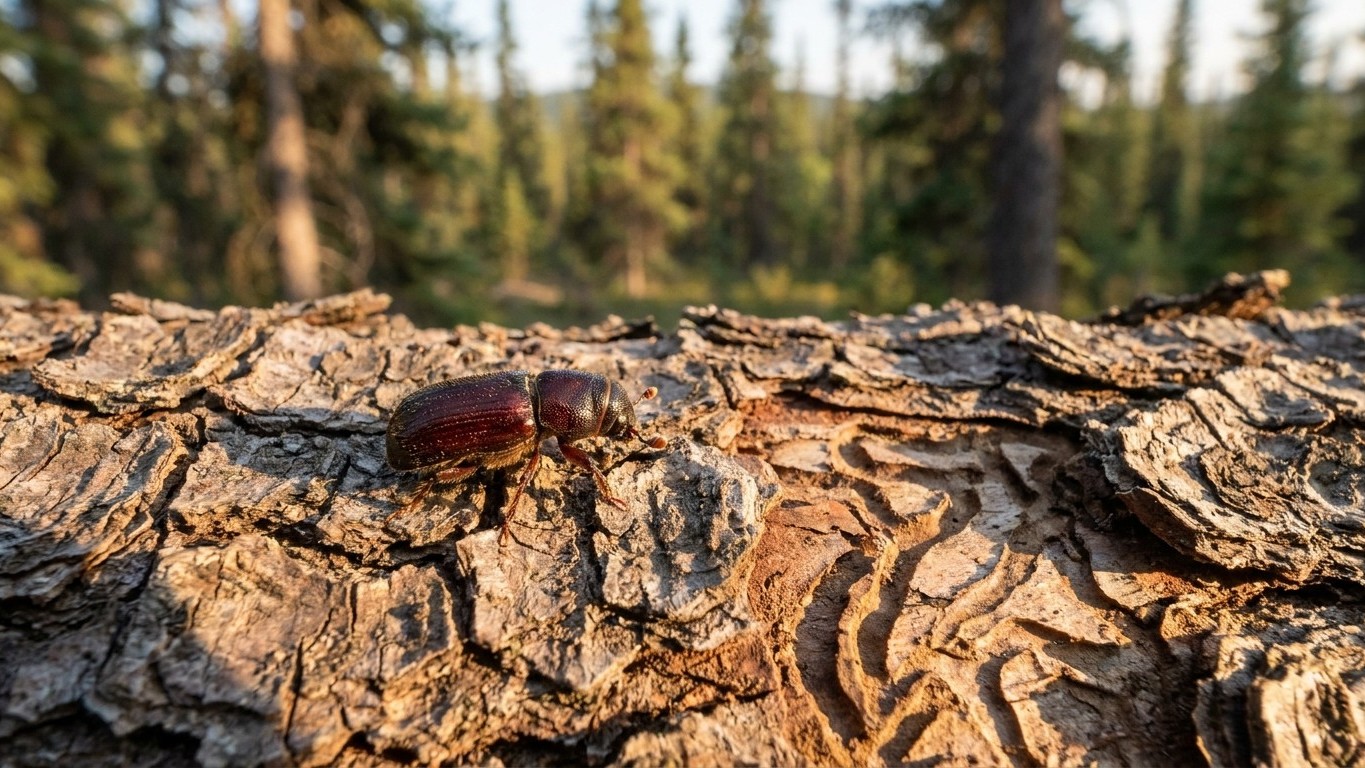

Spruce beetles show up in Yukon forests in late May through July, when adult beetles emerge from dead or dying spruce and fly to new hosts. The insect responsible, Dendroctonus rufipennis, has been active in the territory for decades, and one outbreak in the southwest Yukon became one of the largest bark beetle events recorded in North America. Stopping it comes down to three things: removing the fallen and weakened trees beetles need to breed, using pheromone products that repel or trap adults, and relying on the hard winter cold that Yukon still delivers most years.
When Spruce Beetles Actually Show Up

Adult spruce beetles are creatures of habit. They wait for warm, dry stretches in late spring and fly short distances, often just a few hundred yards, to find a new host tree. In Yukon, that flight window typically runs from late May into July, tracking closely with the first sustained stretch of daytime temperatures above 60°F. Once a female locates a suitable spruce, usually one already stressed by drought, root damage, or storm injury, she bores through the bark and starts an egg gallery running vertically along the trunk.
The historic life cycle for this beetle in northern climates takes two years: eggs hatch into larvae that feed under the bark through one winter, pupate the following summer, and emerge as adults the second spring. That two-year cycle used to keep populations in check because a cold enough winter could kill a large share of the overwintering larvae before they matured. Warmer winters and longer summers changed that math. Researchers with the Canadian Forest Service have documented spruce beetle populations in the Yukon and Alaska completing their life cycle in a single year when conditions allow, effectively doubling the reproductive rate compared to the historical pattern.
The Haines Junction Outbreak
The most cited spruce beetle event in Yukon history began in the early 1990s around Haines Junction and the Kluane region, southwest of Whitehorse. A run of warm summers, combined with drought-stressed white spruce stands and large volumes of windthrown timber left standing after storms, gave the beetle exactly the conditions it needed. By the early 2000s, the outbreak had spread across an estimated 300,000 hectares of forest, roughly the size of Prince Edward Island’s entire land area, killing mature white spruce across much of the Shakwak Trench. It stands as one of the reference cases forest entomologists point to when explaining how a single warm decade can reshape a boreal forest.
How to Spot an Infestation Before It Spreads
Spruce beetle damage is easy to miss the first year and impossible to miss the second. The clearest early sign is boring dust, a fine reddish-brown sawdust that collects in bark crevices or at the base of the trunk where beetles have tunneled in. Unlike mountain pine beetle, spruce beetle rarely produces prominent pitch tubes, so homeowners and landowners scanning for the resin blobs typical of pine beetle damage often overlook spruce beetle entirely.
Needle discoloration tells the real story, but it lags behind the actual attack by nearly a full year. A tree hit by beetles in one summer usually still looks green through that fall and winter, then fades to a yellowish-green the following spring, and finally turns a rust-red or brown by the second summer, by which point the beetles that killed it have already left to attack neighboring trees. That delay is the single biggest reason outbreaks catch landowners off guard, and it means:
- Green trees near dead ones may already be infested and simply haven’t shown color change yet
- Waiting for visible red crowns before acting means missing the window to stop the current generation from spreading
- Peeling bark on a suspect tree will reveal winding, mostly vertical egg galleries packed with fine white boring dust if beetles are present
Woodpecker activity is another practical clue. Woodpeckers strip bark off infested trees hunting for larvae underneath, leaving patches of exposed, lighter-colored wood on the trunk. In areas of the Yukon with active infestations, that flecked bark pattern on scattered trees is often the first thing landowners notice, well before any red foliage appears.
What Actually Stops Spruce Beetle Spread
Cold used to do most of the work. Sustained winter temperatures below minus 30°F for several days in a row historically killed a large share of overwintering larvae, which is part of why outbreaks in the Yukon interior stayed relatively contained for most of the 20th century. Milder winters over the past three decades have removed that natural check in many areas, shifting the burden onto active management.
Removing Blowdown and Weakened Timber
Windthrown and storm-damaged spruce are the beetle’s preferred nursery. A single fallen tree can produce thousands of new adult beetles within a year or two if left in place through a warm summer. Forest managers and private landowners in beetle-affected areas of Yukon are generally advised to buck up and either burn, chip, or debark blowdown within one winter of the damage occurring, before beetles have a chance to colonize it the following spring. Peeling the bark off cut logs also works, since it exposes the developing larvae to weather and predators.
Pheromone Tools: Repel and Trap
Spruce beetles communicate through aggregation pheromones that tell other beetles a tree is being colonized, and through anti-aggregation signals that tell late arrivals to move on because the tree is already full. Forest health programs exploit both signals. MCH, the anti-aggregation pheromone naturally produced by spruce beetles, can be applied to high-value trees to trick incoming beetles into believing the tree is already occupied, steering them toward less valuable stands instead. On the opposite end, aggregation pheromone lures placed in trap trees or funnel traps concentrate beetles in locations where they can be removed and destroyed before they reproduce, a technique used both for population monitoring and for reducing local beetle numbers ahead of a flight season.
Sanitation Harvesting
Where infestations are already established, selectively logging the most recently attacked trees, the ones still holding developing broods under the bark, removes the next generation before it can emerge and fly. Timing matters here more than volume. A sanitation harvest completed in late winter or early spring, before adult emergence, does far more to slow an outbreak than the same harvest done in August after the beetles have already dispersed.
What This Means for Yukon Property Owners
Anyone with mature white spruce on their property in areas like the Haines Junction corridor, the Alaska Highway forests, or the Kluane region should treat blowdown and storm-damaged trees as a priority cleanup task, not a chore that can wait until next season. A stack of storm-felled logs left in a backyard through a warm summer can turn a small woodlot problem into an infestation affecting an entire block of neighboring trees. Checking for boring dust and flecked bark each spring, particularly on trees near recent storm damage or drought-stressed stands, gives landowners a much earlier warning than waiting for needles to turn red.
The Yukon’s forest health monitoring efforts track outbreak trends across the territory and can advise on whether a given area is in an active flight period. For homeowners dealing with a handful of affected trees, removing and properly disposing of infested wood before the following spring’s flight window remains the single most reliable step available, cheaper and faster than most chemical or pheromone treatments and effective at the scale most residential properties actually need.